
Introduction
A nursery should feel calm, warm, and thoughtful from the moment you walk in. The right Wall Art Decor for Nursery spaces does more than fill blank walls. It sets the mood, supports the theme, improves the room’s balance, and helps the space feel finished instead of random. That matters because nursery pages across the web usually split into three separate lanes: shopping galleries, budget roundups, or styling inspiration boards. Very few pages combine design choice, placement, and safety into one practical guide.
This guide solves that gap. It shows you how to choose nursery wall art, how to place it safely, what styles work best in modern and classic nurseries, how to decorate on a budget, and how to make the room feel beautiful now while still working a few years later. That last part matters: the strongest nursery inspiration today leans toward adaptable rooms, soft colors, clean contrast, and decor that can grow with the child.
What is wall art decor for a nursery?
Wall art decor for a nursery includes any decorative item placed on the walls of a baby’s room. That can mean framed prints, canvas art, removable decals, wallpaper, murals, wall letters, gallery walls, woven pieces, and personal photos. Pottery Barn Kids, Houzz, and BHG all show that nursery wall design now goes beyond a single framed print and often includes wallpaper, decals, statement art, and layered wall features.
In a nursery, wall art serves three jobs at once. First, it makes the room feel complete. Second, it supports the room’s color palette and theme. Third, it can help define focal points around the crib, dresser, reading corner, or changing area. The best nursery wall decor ideas feel intentional, soft, and coordinated rather than crowded or overly busy.
Snippet-ready answer
Nursery wall art decor is the visual styling placed on baby room walls, including prints, decals, wallpaper, murals, and gallery walls. The best choices are calm, safe, and easy to grow with the child.
Why Nursery Wall Art Matters in 2026
Nursery design in 2026 is less about filling every wall and more about creating a room that feels soothing, functional, and easy to live with. Current inspiration leans toward soft palettes, clear contrast, mural accents, framed statement art, and decor that can transition from baby to toddler without a full redesign. IKEA emphasizes soft colors, clear contrasts, and functional, age-appropriate furniture, while Houzz highlights rooms designed to endure beyond the newborn stage.
That makes wall art one of the most flexible tools in the room. You can refresh a nursery with a single print, create a calmer mood with a wallpaper accent wall, or build a gentle story through a gallery wall. BHG also shows that modern nurseries often mix white walls, wallpaper accents, framed art, patterned rugs, and playful touches to strike a balance between stylish and child-friendly.
Another reason nursery wall art matters now is safety. Official guidance says to decorate the room, not the crib, and to keep wall decor away from the baby’s sleep space so nothing can fall into the crib or be pulled down later. That turns wall styling into a design decision with real safety impact, not just a visual one.
Mini summary: In 2026, nursery wall art is expected to be beautiful, practical, and safe. The most successful rooms look calm first, styled second.
Best Types of Wall Art for a Nursery
The best nursery wall art depends on your room size, theme, budget, and how long you want the decor to last. Here is a practical comparison.
| Wall Art Type | Best For | Main Benefit | Watch Out For |
| Framed nursery prints | Modern, classic, or gender-neutral nurseries | Easy to style and replace | Needs safe placement and proper hanging |
| Wall decals | Renters, temporary decor, playful themes | Affordable and flexible | Can look busy if overused |
| Nursery wallpaper | Accent walls and high-impact style | Strong visual identity | More commitment than decals |
| Mural art | Statement nurseries | Memorable, custom feel | Needs good planning and scale |
| Gallery wall | Larger blank walls | Personal and layered look | Requires spacing discipline |
| Canvas art | Soft, modern rooms | Lightweight and easy to coordinate | Still needs secure mounting |
| Woven or wooden wall decor | Boho, natural, or neutral nurseries | Adds texture and warmth | Can become cluttered if mixed with too many styles |
This mix of nursery wall decor ideas reflects what the current market shows: wallpaper, decals, framed art, and gallery arrangements are the most common directions across nursery inspiration pages and shop collections.
1. Framed Nursery Prints
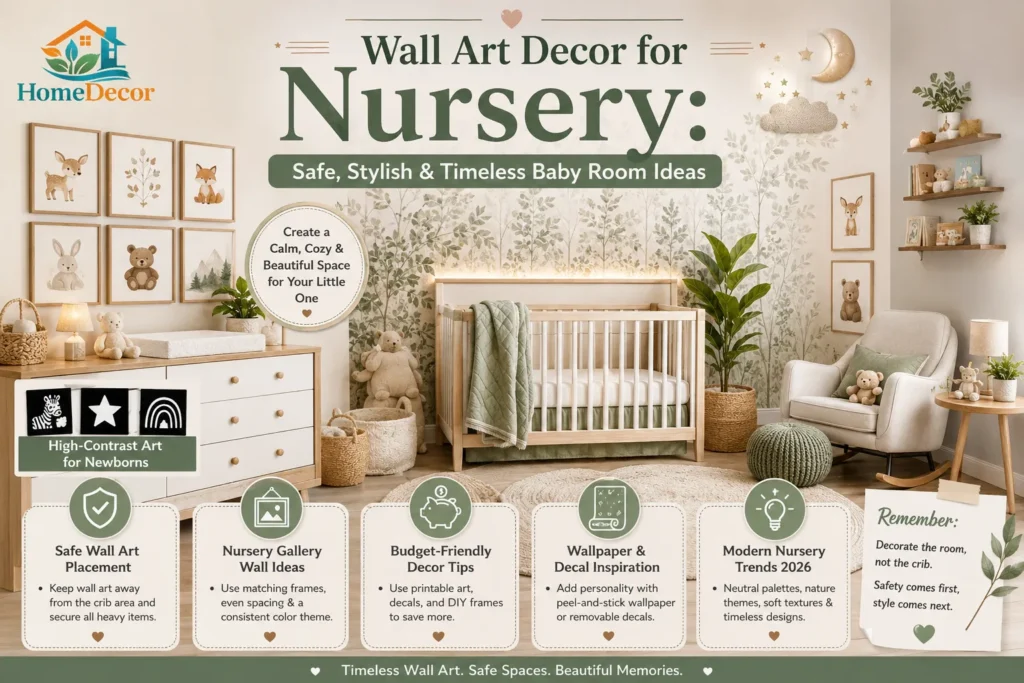
Framed nursery prints are one of the safest and easiest ways to style a nursery wall. They work well above a dresser, along a reading corner, or on a wall that does not sit directly over the crib. They also make it easy to change the room as your child grows.
2. Nursery Wall Decals
Nursery wall decals are ideal when you want visual interest without a permanent commitment. BHG notes that decals can be arranged above a crib, around a mirror, or as a border-like treatment, which makes them useful for creating playful composition without heavy construction.
3. Nursery Wallpaper
Nursery wallpaper works well when you want the wall itself to be part of the design. A wallpaper accent wall can make a nursery feel more polished and complete, especially in modern or luxury interiors. BHG and Houzz both show wallpaper as a strong nursery styling choice that adds depth and personality.
4. Gallery Walls
A gallery wall for nursery spaces can tell a story through shapes, animals, names, family photos, or calming illustrations. Pottery Barn Kids suggests treating a gallery as a visual unit and building it on one wall rather than scattering pieces randomly. That approach creates a cleaner, more intentional result.
5. High-Contrast Art for Newborns
For newborn spaces, simple high-contrast black-and-white art can be useful because infants respond more easily to strong contrast in early visual development. Michigan State University Extension notes that babies have an easier time focusing on high-contrast objects, such as black-and-white images with contrasting patterns.
Mini summary: For most nurseries, the best mix is one focal format plus one supporting format. For example: framed prints + decals, or wallpaper accent wall + one framed statement piece.
Best Nursery Wall Art Styles for Every Theme
Modern Nursery
Modern nursery wall decor usually uses a limited palette, clean lines, and one strong focal point. BHG shows examples built from white walls, wallpaper accents, framed art, and stylish furniture, which is a reliable formula for a modern look.
Neutral Nursery
Neutral nursery wall art works well when you want a calm room that does not feel overly themed. IKEA’s nursery approach highlights soft colors, clear contrasts, and large surfaces that help a room feel spacious and easy to live with. That is a strong fit for beige, ivory, taupe, sage, and soft gray palettes.
Woodland Nursery Wall Art
Woodland nursery wall art is a popular evergreen choice because it feels gentle, nature-based, and easy to coordinate with wood furniture, greenery, and earthy textiles. Houzz’s nursery inspiration repeatedly points toward nature-themed rooms that feel adaptable as the child grows.
Gender-Neutral Nursery Decor
Gender-neutral nursery decor works best when you combine soft color families with warm natural accents. Houzz notes that neutral nursery designs often use shades like blue, green, yellow, and orange, plus wood or metallic accents to tie the room together.
Boho Nursery
Boho nursery wall decor often includes woven textures, arch shapes, botanical prints, and earthy colors. It works best when the room feels relaxed and tactile rather than overdecorated.
Classic Nursery
Classic nursery wall art often includes storybook prints, soft animal illustrations, family name signs, and symmetrical layouts. It suits rooms that use traditional furniture and a timeless palette.
Luxury Nursery
Luxury nursery wall art tends to be larger in scale, cleaner in presentation, and more deliberate in its materials. Think framed art with quality mats, wallpaper with subtle texture, or a single mural used as a focal feature.
Mini summary: Style matters less than consistency. A nursery looks better when art, furniture, and textiles share the same mood and color logic.
How to Choose Wall Art for a Baby Room
Choosing nursery wall decor becomes much easier when you follow a simple system.
Start with the mood
Ask what the room should feel like. Calm, playful, airy, cozy, modern, or elegant. The strongest nursery inspiration today is built around comfort and longevity, not just cute details.
Choose one visual direction.
Pick one main direction:
- animals
- clouds and stars
- botanicals
- woodland scenes
- alphabet art
- abstract shapes
- neutral line art
- storybook-inspired art
This keeps the nursery from feeling visually confused.
Match the art to the furniture
A large wall above a dresser can support a bigger statement piece or a gallery wall. A small corner works better with one framed print or a pair of coordinated pieces. Pottery Barn Kids recommends starting in one corner of the room and building outward from there, which is a smart way to avoid overdesigning the space.
Think about how long the piece will last
Some nursery wall decor is easy to grow out of. Babyish quotes, extremely specific cartoon themes, and very bright novelty art may feel old quickly. More flexible choices include neutral prints, nature art, soft animals, and abstract shapes.
Use the room’s architecture
If the nursery has paneling, an accent wall, a nook, or built-in storage, let the architecture guide the art. BHG shows that paneling, accent walls, decals, and wallpaper can all work as part of the room’s structure, not just as decoration.
Nursery Wall Art Placement and Hanging Height
Placement is where many nursery rooms go wrong. Good art in the wrong place can feel disconnected, too high, too low, or unsafe.
Profile Products recommends a general eye-level hanging range of about 145 to 152 cm from the floor for the center of the artwork in most rooms, while also noting that art should sit lower above furniture so the composition feels linked. When using a gallery wall, the whole arrangement should be treated as one visual unit.
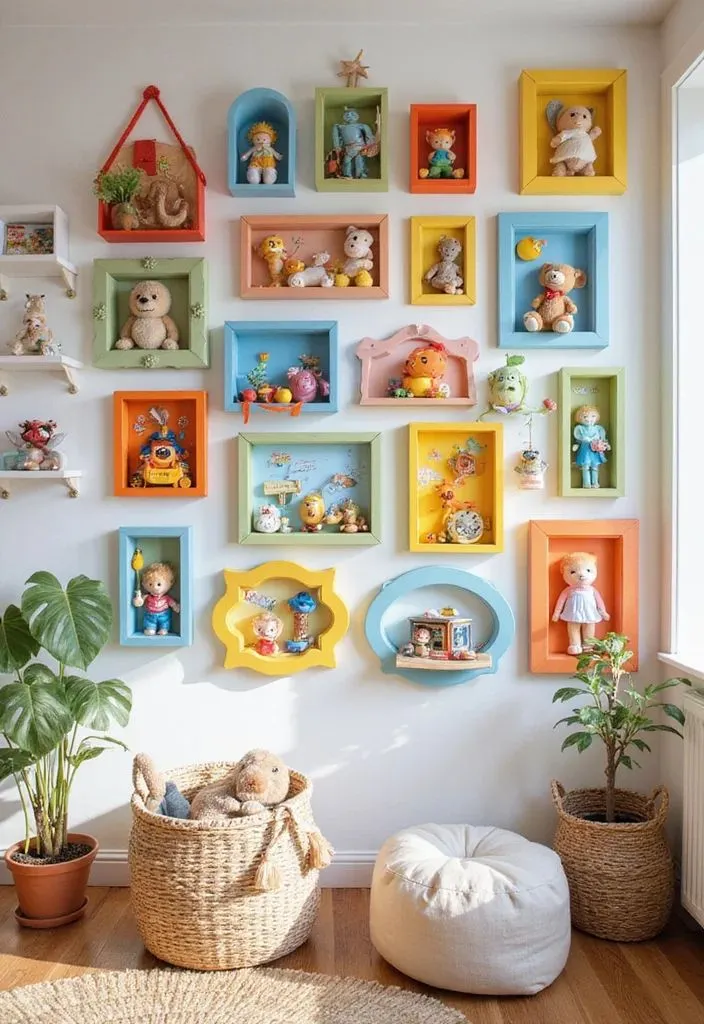
Pottery Barn Kids also supports the idea of creating a gallery wall on a single surface and choosing one corner to begin the design process. That is useful in nurseries because it prevents overcrowding and keeps the room visually calm.
Simple placement rules
- Center art over the dresser, not the entire wall, when the dresser is the main furniture anchor.
- Leave breathing room above furniture instead of pushing art too high.
- Use larger pieces on big walls and smaller pieces in tight spaces.
- Keep equal spacing if you build a gallery wall.
- Think in one visual block, not as separate frames scattered across a wall.
Placement by room zone
Above the dresser: Best place for framed prints, a gallery wall, or a statement canvas.
Reading corner: Great for a calming print or a pair of soft illustrations.
Changing area: Good for soothing art that does not visually overwhelm.
Feature wall: Best Place for Wallpaper, decals, or a large mural.
Mini summary: For nursery wall art, placement matters as much as style. A well-hung simple print often beats a beautiful piece placed awkwardly.
Is Nursery Wall Art Safe Above a Crib?
This is one of the most important questions in the whole topic.
Official safe-nursery guidance from the Government of Canada says to decorate the room, not the crib, cradle, or bassinet, and to hang artwork and other wall decor away from the crib because items can fall into the sleep space or be pulled down as the baby grows. The guidance also says to place the crib away from windows and keep cords out of reach.
That means the safest nursery wall decor is lightweight, secure, and not directly positioned where a child could reach it from the crib. Heavy glass frames, loosely mounted pieces, and unstable decor are not worth the risk.
Safer choices near sleep areas
- lightweight canvas art
- securely anchored framed prints
- decals instead of heavy objects
- wallpaper or mural treatments
- decor placed well away from the crib zone
Avoid being near the crib
- heavy frames
- loose hanging decor
- glass-fronted artwork
- anything that could be pulled down
Snippet-ready answer
It is safer to keep wall art away from the crib and avoid heavy or loose decor near the sleep space. Official nursery safety guidance says art can fall or be pulled down into the crib as babies begin standing and climbing.
Budget-Friendly Nursery Wall Decor Ideas
You do not need a full custom mural to create a beautiful nursery. In fact, some of the best-looking rooms use a few carefully chosen low-cost elements.
The Bump shows that affordable nursery decor often includes decals, animal prints, and small art pieces. That makes sense because wall styling can be effective even when the budget is small.
Best budget options
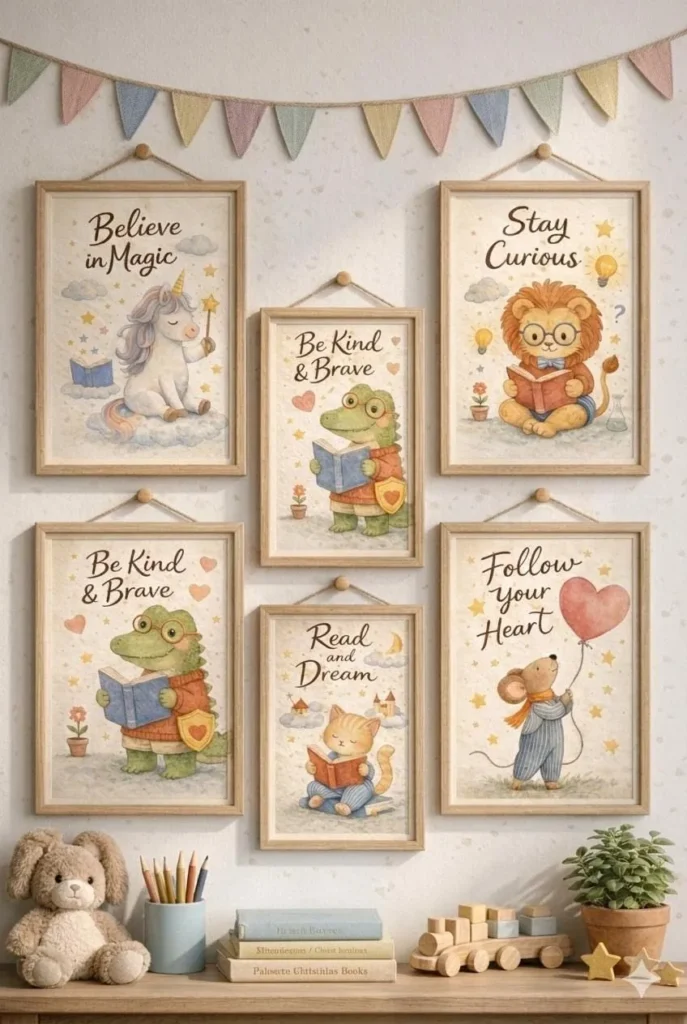
- printable nursery art in a simple frame
- peel-and-stick wall decals
- one statement print instead of several small pieces
- secondhand frames with new art inserts
- small gallery wall using coordinated prints
- removable wallpaper on one accent wall
Budget strategy that works
Spend more on the single element that gives the room its identity, then keep the rest simple. For example, one wallpaper accent wall can reduce the need for multiple decorative pieces. BHG shows that even one accent wall can carry a lot of the room’s visual interest.
Pros and cons of budget nursery wall decor
| Option | Pros | Cons |
| Printable art | Very affordable, easy to replace | Needs good framing to look polished |
| Decals | Flexible, renter-friendly | Can look generic if overused |
| One statement print | Simple and stylish | Needs the right size for the wall |
| Removable wallpaper | Strong design impact | More prep and planning are needed |
Mini summary: A nursery feels expensive when the composition is thoughtful, not when every item costs more.
Premium and Luxury Nursery Wall Decor Options
Luxury nursery wall art is usually about finish quality, scale, and restraint. A premium nursery often uses fewer pieces, but each one is more intentional.
Premium options
- custom mural
- large framed statement art
- quality matting and matching frames
- wallpaper with subtle texture
- layered wall treatments like paneling plus art
- bespoke name art or commissioned illustration
BHG’s nursery examples show that statement wallpaper, stylish furniture, and well-placed art can create a polished, design-forward room without needing visual clutter. Houzz also emphasizes adaptable nursery design with room to grow, which is a major luxury signal in modern interiors.
Why do luxury nursery artworks
- It creates a clear focal point.
- It makes the room feel designed, not assembled.
- It gives the space a more timeless, editorial look.
- It usually pairs well with neutral furniture and soft textiles.
Mini summary: Premium nursery wall decor does not mean more objects. It means better composition, better materials, and better restraint.
Smart and Modern Nursery Design Trends
The strongest current nursery trends are practical, soft, and easy to update. IKEA emphasizes furniture and design that can adapt as children grow, while Houzz focuses on nurseries that stay stylish beyond babyhood.
Trends to watch
- soft contrast instead of harsh color
- nature-inspired prints
- Wallpaper Accent Walls
- framed statement art
- simple gallery walls
- removable decals
- organic textures like wood and woven decor
- nursery layouts that transition into toddler years
BHG also shows that modern nurseries often use white walls, patterned accent walls, framed art, and playful touches to balance function and style.
Why these trends work
They are not tied too tightly to a single baby phase. They can transition into a toddler room, a shared room, or a more mature child’s room without requiring a complete redesign. IKEA’s children’s room guidance specifically highlights adaptable furniture and age-appropriate design for long-term use.
Common Nursery Wall Art Mistakes to Avoid
1. Overcrowding the wall
Too many prints can make the nursery feel restless instead of calm.
2. Hanging art too high
A piece can look disconnected if it floats too far above furniture. Profile Products notes that art should usually be visually linked to the furniture below it, not isolated.
3. Ignoring safety near the crib
Official nursery safety guidance says wall decor should be kept away from the crib sleep space.
4. Mixing too many styles
Animal prints, abstract art, boho textures, and bold color can work together, but only if one style is clearly dominant.
5. Choosing art that will age out too fast
Extremely themed decor can feel outdated before the nursery stage is over.
6. Using the wrong scale
Tiny art on a large wall looks unfinished. Oversized pieces in a small nursery can feel heavy.
Mini summary: The best nursery wall art mistakes are boring to avoid but powerful in result: keep it simple, sized well, and safely placed.
Expert Tips Most People Ignore
Treat the nursery like a whole composition
Do not choose wall art in isolation. Make it work with the crib, dresser, rug, curtains, and lighting.
Let one wall do the heavy lifting
A wallpaper accent wall or large statement print can reduce clutter elsewhere. BHG’s nursery examples repeatedly show how one strong wall choice can anchor the whole room.
Use contrast thoughtfully
IKEA emphasizes clear contrast and soft colors in children’s spaces, while infant-vision guidance shows that high-contrast visuals are easier for newborns to focus on. That makes black-and-white or strong shape-based art a smart early-month choice.
Build for the toddler years
Houzz and IKEA both support nurseries that can grow with the child. Choose art that still feels good when the crib becomes a bed and baby decor becomes a more mature child’s room.
Keep one area calm
If the wall above the crib is busy, keep the rest of the room quieter. If the wallpaper is bold, let the art stay simple.
Best Color Combinations for Nursery Wall Art
Color is one of the fastest ways to make nursery art feel right.
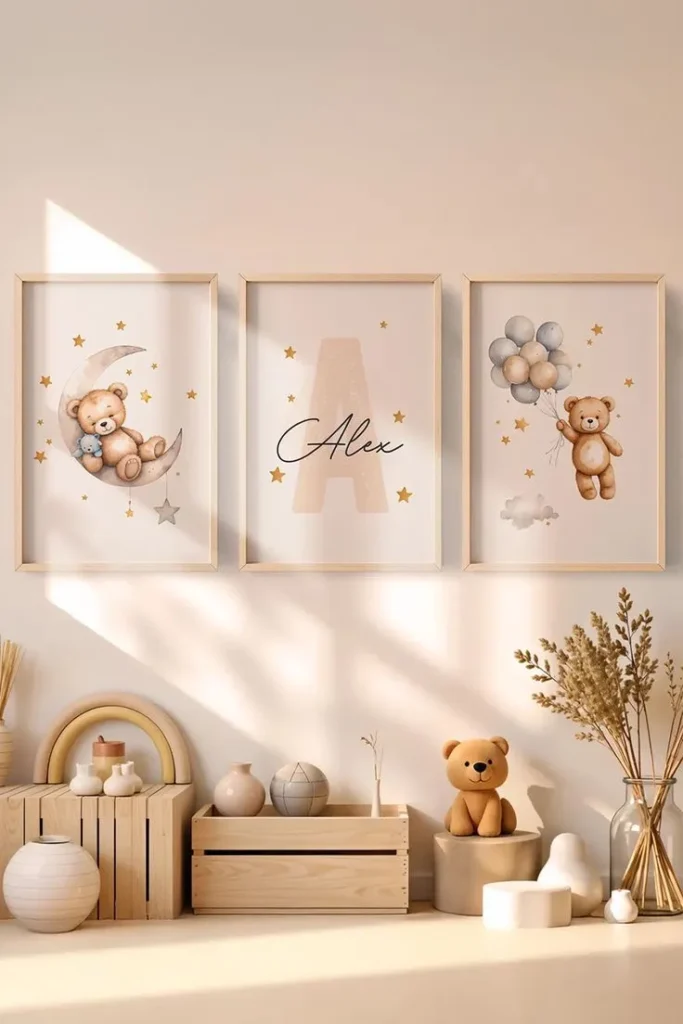
Best combinations
- white + sage + warm wood
- beige + soft blush + ivory
- gray + mustard + white
- navy + crisp white + natural oak
- olive + cream + tan
- black + white + light wood for newborn contrast
BHG and Houzz both show that nursery rooms often use soft, coordinated palettes with either a single accent color or a nature-inspired blend. IKEA similarly favors soft colors and clear contrast that make the room feel open and easy to maintain.
Color tip
Avoid making the art more colorful than the rest of the room unless you want the art to be the main star. In most nurseries, harmony beats intensity.
Best Materials and Decor Choices
The safest and most practical nursery wall decor materials are usually lightweight and easy to secure.
Recommended materials
- canvas
- lightweight framed prints
- peel-and-stick decals
- removable wallpaper
- wood signs that are firmly mounted
- soft textile wall hangings placed away from the crib
Materials to use carefully
- heavy glass frames
- awkwardly mounted decor
- loose hanging pieces near sleep areas
Official nursery safety guidance supports keeping wall decor away from the crib, and it also stresses secure nursery furniture and a safe sleep environment overall.
Space-Saving and Functional Tips
Nurseries often need to do more with less space.
IKEA’s children’s room guidance highlights large surfaces, clear contrast, and adaptable furniture that can evolve. That same principle works for wall art: use fewer pieces, make them more intentional, and let the wall help define the room.
Smart space-saving ideas
- Use one large print instead of many small ones
- Choose decals instead of bulky wall objects
- Use a picture ledge for flexible styling
- combine art with storage zones
- Keep the wall over the crib visually calm
- Use vertical space for a taller room feel
A well-planned nursery looks bigger because the wall decor supports the space instead of crowding it.
Styling Tips for Different Room Sizes
Small Nursery
Choose one statement piece or a small gallery wall with even spacing. Keep the palette light and use one accent wall only if the room can handle it visually.
Medium Nursery
You can combine a wallpaper feature wall with framed prints or a two-piece gallery arrangement.
Large Nursery
Large rooms can support a mural, a bigger gallery wall, or layered wall treatments such as paneling plus art. BHG’s modern nursery examples show how larger rooms can carry both pattern and framed decor without feeling crowded.
Rental Nursery
Use decals, framed prints, and removable wallpaper. These options give you a strong visual result without major commitment.
Luxury Nursery
Use oversized art, custom wallpaper, refined frames, and fewer but better-chosen pieces. Houzz and BHG both support this kind of room-forward approach.
Comparison Section: Which Nursery Wall Art Type Is Best?
| Goal | Best Choice | Why |
| Lowest budget | Printable art | Easy to make and replace |
| Rental-friendly | Decals | Removable and flexible |
| Biggest visual impact | Wallpaper or mural | Turns the wall into a design feature |
| Timeless look | Framed prints | Easy to update and style |
| Baby-to-toddler transition | Gallery wall with neutral art | Adapts well over time |
| Newborn visual interest | High-contrast art | Easier for babies to focus early on |
This comparison reflects the current market direction, where nursery pages tend to feature art, decals, wallpaper, and framed decor as the main styling tools.
Who Should Choose This Style?
Wall art decor for the nursery is a strong choice for:
- parents who want a calm, finished room
- renters who need removable options
- homeowners planning a longer-term room
- budget-conscious decorators who want impact without overspending
- design lovers who want a polished, curated nursery
- families who want a room that can grow with the child
Who Should Avoid This Style?
This style may not suit:
- people who want a completely bare, minimalist room
- parents who prefer all decor to be fully hidden
- anyone who wants highly temporary decor with no long-term plan
- rooms where safe hanging placement is not possible near the planned furniture layout
How to Build the Perfect Nursery Wall in 7 Steps
- Pick the room mood first.
- Choose one main style direction.
- Decide whether you want prints, decals, Wallpaper, or a gallery wall.
- Measure the wall and the furniture below it.
- Keep the crib area safe and uncluttered.
- Hang art so it feels connected to the furniture.
- Add only enough decor to support the room, not overwhelm it.
People Also Ask
The best nursery wall art is calming, safe, and sized correctly for the wall. Framed prints, decals, wallpaper accents, and soft gallery walls are the most versatile choices.
It is safer to keep wall decor away from the crib sleep space. Official nursery guidance warns that wall decor can fall or be pulled into the crib as the baby grows.
Soft neutrals, sage, warm white, blush, muted blue, and gentle contrast palettes work well. For newborns, high-contrast black-and-white art can also be helpful.
Yes, if it is balanced and not overcrowded. A gallery wall works best when treated as one visual unit with even spacing and a clear focal point.
Framed prints, decals, and removable wallpaper are the easiest to update as the child grows.
Conclusion
The best wall art decor for nursery strategy is simple: choose one clear style direction, keep the room calm, place decor safely, and use art that can grow with the child. The current search results mostly show shopping pages, inspiration boards, and partial advice, so a stronger pillar article wins by answering the full decision process in one place.
If you are decorating a nursery for the first time, start with safety and layout, then build the look around one or two strong wall elements. That approach works for small nurseries, modern nurseries, neutral nurseries, and luxury spaces alike. Official nursery guidance Supports Safe Placement, while current design sources favor rooms that are adaptable, soft, and practical.
Legal disclaimer: Prices, materials, trends, and product availability may change over time depending on region, suppliers, and brands. Always verify dimensions, materials, and compatibility before purchase or renovation.
