
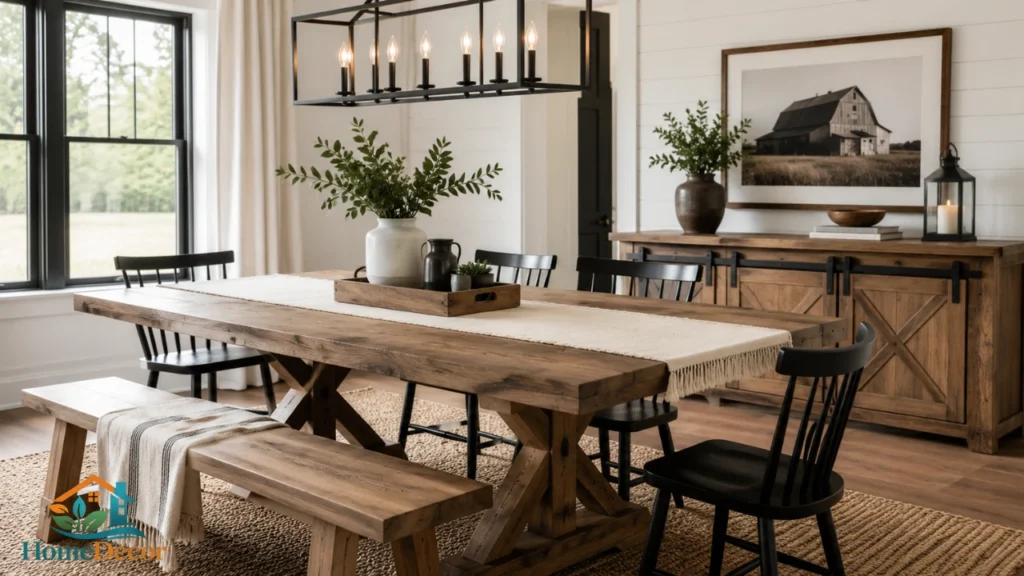
Modern Farmhouse Dining Room Table
A Modern Farmhouse Dining Room Table is more than a place to eat. It is the anchor of the room, the surface where family dinners happen, the spot where guests naturally gather, and often the one piece that defines the whole mood of the space. In 2026, the style still works because it balances comfort, craftsmanship, and simplicity instead of chasing a short-lived trend. Current design coverage keeps returning to rustic wood tables, shiplap, vintage-style lighting, earthy paint colors, mixed wood tones, and casually layered decor because those elements feel warm and timeless when they are used with restraint.
The challenge is that many people know what the style looks like, but not how to choose the right table for their room size, family size, or budget. That is where this guide helps. You will learn how to pick the best shape, size, base, material, and finish, then style the table so the whole dining room feels collected, practical, and expensive-looking without being stiff.
What Is a Modern Farmhouse Dining Room Table?
A modern farmhouse dining room table blends the warmth of traditional farmhouse furniture with cleaner lines and a lighter visual feel. The table still usually brings in wood grain, natural texture, and an inviting silhouette, but it avoids looking overly distressed or overly themed. The result is a table that feels familiar, comfortable, and easy to live with every day.
In practice, that usually means one or more of these features:
- a solid wood or wood-look top
- a painted or stained base
- a simpler profile than old-country farmhouse pieces
- a pedestal, trestle, turned-leg, or straight-leg base
- a finish that feels warm rather than heavily weathered
The most successful modern farmhouse tables do not try too hard. They look like they belong in a home where people actually eat, talk, and live. That lived-in quality is exactly what current editorial coverage keeps emphasizing.
Why It Matters in 2026
The style remains strong because it solves a real emotional need: people want dining rooms that feel cozy, grounded, and personal without looking dated. Current trend coverage points to rustic wood, mixed wood tones, vertical shiplap, vintage-style lighting, warm beige and earthy paint colors, mismatched seating, thrifted art, patterned textiles, and botanical details as the core ingredients of a lasting modern farmhouse room.
It also matters because dining rooms are working harder than before. In many homes, the dining table is used for meals, homework, laptop work, game nights, and holiday hosting. That means the best table is not just beautiful; it has to fit the room, the traffic flow, and the way the household really lives. Google’s guidance around helpful, reliable, people-first content strongly favors this kind of practical problem-solving.
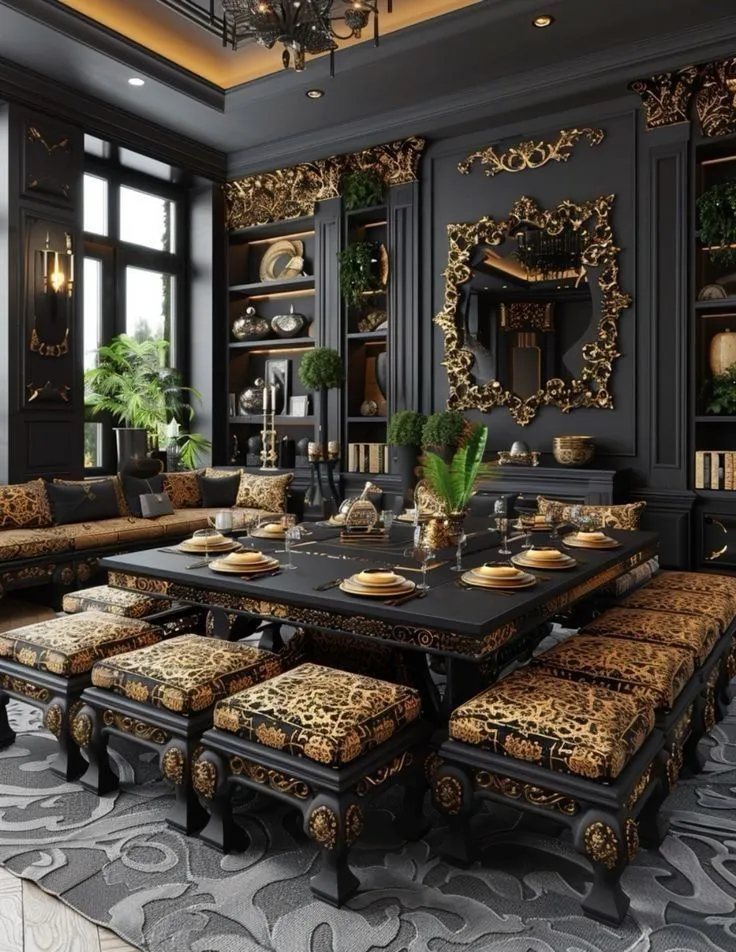
Best Table Shapes for a Modern Farmhouse Dining Room
1) Rectangle
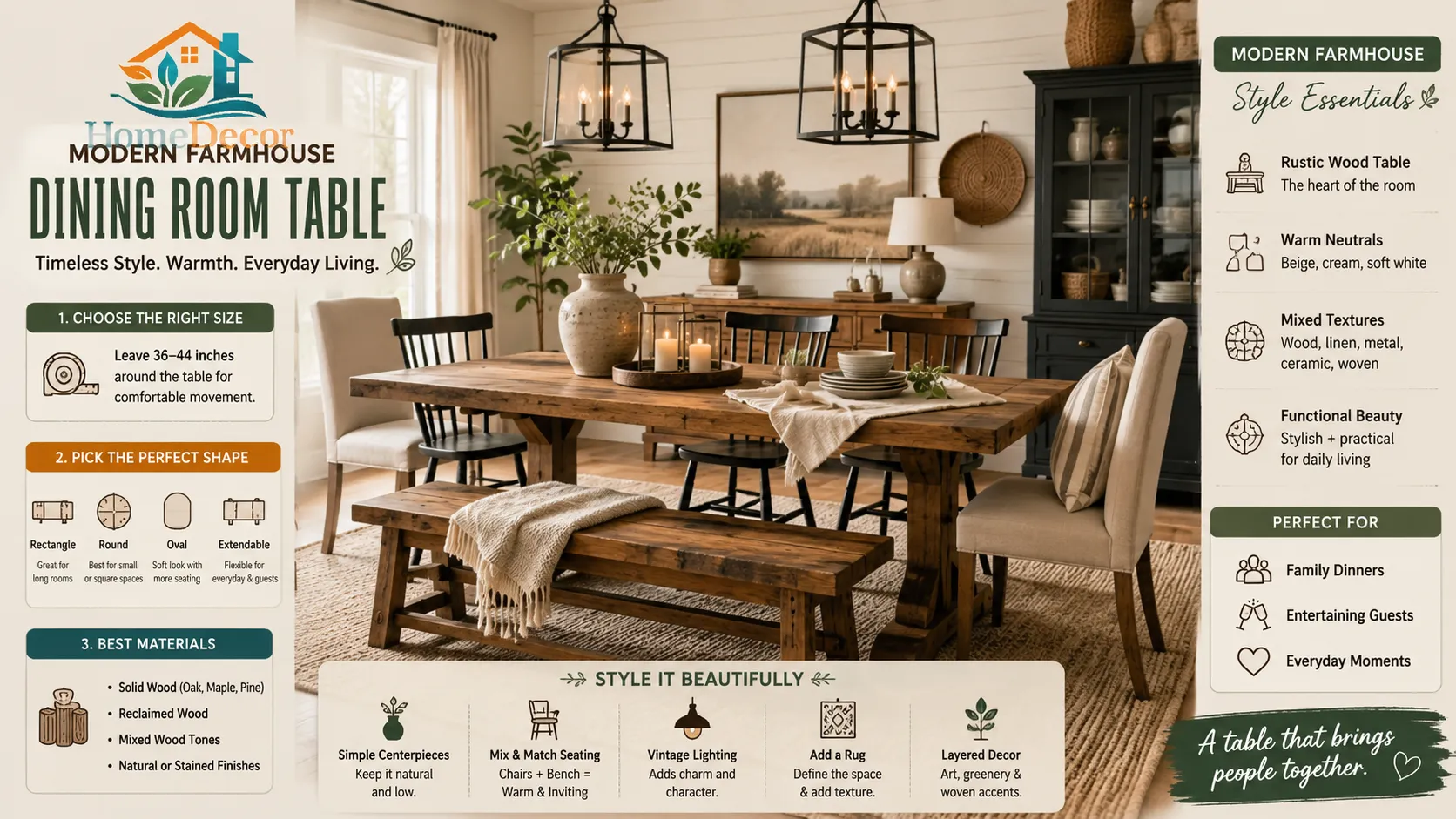
A rectangular table is still the most classic farmhouse choice. It works especially well in long rooms, open-plan layouts, and homes that need flexible seating for family dinners or guests. The shape feels familiar, grounded, and easy to style with a bench or a pair of end chairs.
2) Round
Round tables are especially good for square rooms and smaller spaces because they soften the room and make movement easier. West Elm notes that round tables are great for small spaces and conversation, while its sizing guidance shows how round tables scale for four, six, or more diners. Dutch Craft also highlights smaller round farmhouse tables for compact rooms.
3) Oval
Oval tables are a smart middle ground. They keep the softness of a round table but stretch the seating capacity more like a rectangle. That makes them useful in rooms that need visual flow without losing practicality. Their curved ends can also make a narrower room feel less boxy. This is a design inference based on how the shape distributes visual mass and traffic paths.
4) Extendable
Extendable tables are the most versatile option for households that entertain or grow in size over time. IKEA and Crate & Barrel both position extendable tables as flexible solutions for changing seating needs, and The Spruce’s 2026 roundup names an extendable farmhouse table as the best overall pick because it combines style and function.
Comparison Table: Which Table Shape Fits Best?
| Table Shape | Best For | Main Benefit | Watch Out For |
| Rectangle | Long rooms, family dining, hosting | Most seating flexibility | Can feel heavy in very small rooms |
| Round | Square rooms, small spaces | Easier flow, more conversation-friendly | Less efficient in narrow rooms |
| Oval | Medium rooms, softer look | Feels airy while still seating well | Harder to style with some benches |
| Extendable | Entertaining, changing household needs | Everyday compact size + guest flexibility | Often costs more and needs more planning |
West Elm’s room rules and IKEA’s seating guidance are useful here because they tie shape choice to actual movement and capacity, not just aesthetics.
How to Choose the Right Size for Your Dining Room
This is the step many buyers skip, and it is the step that causes most regret.
A beautiful table can still feel wrong if the room is too tight. West Elm recommends allowing 36–44 inches between the table and the wall for chair clearance and 54–62 inches if you want room for a buffet. IKEA similarly advises measuring seating width by person and choosing a table length that matches how many people you want to seat.
Simple size checklist
- Measure the room.
- Subtract the walkway space you need on each side.
- Decide how many people must sit there most days.
- Decide how many guests you need to seat on special occasions.
- Choose the smallest table that still feels generous.
A table that leaves breathing room almost always feels more luxurious than one that technically fits but crowds the chairs. This is especially true in open-plan homes, where the dining area has to coexist with a kitchen, living room, or patio path. That practical approach matches the sizing logic in West Elm’s and IKEA’s dining guides.
Quick Size Guide
| Household / Room Type | Good Starting Point | Why It Works |
| 2–4 people, small room | Round 36–48 inches or compact rectangle | Keeps the room open |
| 4–6 people, medium room | Rectangle or oval around 60–72 inches | Balances comfort and flow |
| 6–8 people, larger room | Extendable rectangle or large oval | Handles daily use and hosting |
| Frequent Hosting | Extendable or large rectangular table | Best flexibility for guests |
IKEA’s and West Elm’s guides support the idea that the right table is the one that fits both the room and the number of diners, not just the one that looks best in a catalog.
Best Materials and Finishes for a Timeless Look
Solid wood remains the most reliable choice for a modern farmhouse table because it brings warmth, texture, and durability. The Spruce’s 2026 farmhouse table guide highlights solid spruce in its best-overall pick, while Dutch Craft emphasizes solid wood farmhouse sets and expandable table options in maple, walnut, white oak, hickory, and other woods.
Best material directions
- Oak for a classic, balanced grain
- Walnut for a richer, more elevated look
- Maple for a lighter and cleaner feel
- Spruce for a farmhouse-friendly, approachable finish
- Reclaimed wood for character and history
- Painted base + stained top for contrast and freshness
Finish choices that work well
- natural wood
- lightly stained wood
- whitewashed or soft-painted base
- matte or low-sheen finish
- lightly patinated finish
The key is restraint. A modern farmhouse table should still show some grain and organic texture, but it should not look overly distressed unless the rest of the room is very calm and minimal. That balance is consistent with current editorial coverage that favors mixed wood tones and warmer, more layered interiors over hard, rustic styling.
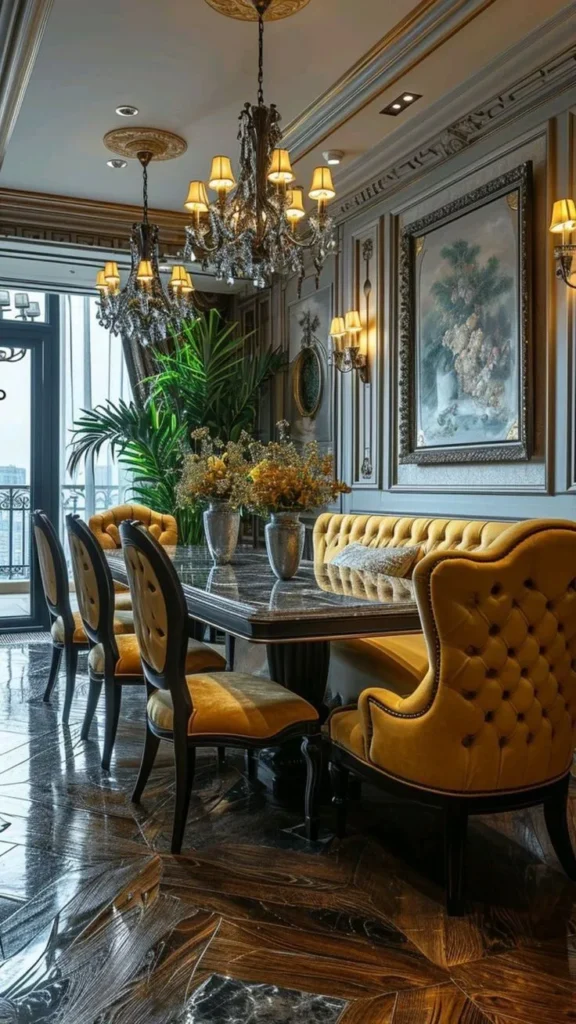
Best Bases: Pedestal, Trestle, Turned Legs, and Straight Legs
The base matters almost as much as the tabletop.
Pedestal base
A pedestal base works especially well with round and oval tables. It often makes seating easier because there are fewer corner obstructions, and it can help a room feel lighter visually. Pottery Barn’s and Apartment Therapy’s current round farmhouse examples show why pedestal-style forms remain popular.
Trestle base
A trestle base gives the table a classic farmhouse feel. It feels grounded, strong, and family-friendly. This is a good choice when you want a substantial table that still reads as design-forward rather than bulky. The Spruce’s product roundup and Dutch Craft’s collection both show how much the base style changes the overall mood.
Turned legs
Turned legs lean more traditionally. They work well if you want the table to feel farmhouse without looking too modern. They are also useful in spaces that mix old and new pieces. Dutch Craft specifically highlights turned-leg dining sets in its product collection.
Straight legs
Straight legs create a cleaner, more modern profile. They are the best choice if you want a farmhouse table that feels lighter and less ornate. This is the easiest way to keep the style current without losing warmth. That direction also lines up with The Spruce’s advice to pair streamlined furniture with soft neutrals and vintage-style lighting.
Seating Ideas: Chairs, Benches, and Mismatched Looks
Seating is one of the easiest ways to make a farmhouse table feel modern.
Apartment Therapy points out that a solid wood table can work well with a long bench, dining chairs, or a mix of both. West Elm also encourages mixing tables and chairs instead of relying on rigid matchy-matchy sets. The Spruce’s style guide shows that mismatched seating and mix-and-match chairs are now a core farmhouse styling move.
Best seating combinations
- Bench on one side, chairs on the other
- Two end chairs with side chairs
- Mixed wood or painted chairs
- Upholstered host chairs with simpler side chairs
- One statement chair style paired with neutral companions
The most expensive-looking rooms usually avoid a perfect showroom set. They feel collected over time, which is exactly the effect current modern farmhouse coverage celebrates.
How to Style the Table for Everyday Use
A modern farmhouse dining table should look styled, but not staged.
Use a centerpiece that is low enough for conversation and easy to move. Good everyday choices include a ceramic bowl, a wood tray, a candle group, a simple vase, or a seasonal branch arrangement. The Spruce’s dining-room coverage repeatedly shows that layered texture, thrifted art, botanical accents, and mix-and-match tableware make the room feel warm and lived-in.
Easy styling formula
- one organic centerpiece
- one texture-rich surface layer
- one soft accent color
- one seasonal change element
- One practical item you can remove quickly
The best styling is flexible. The table should still work for dinner, homework, and weekday life without requiring a full reset every time someone sits down. That practical mindset is what separates a real home from a photo set. Google’s people-first guidance supports content that solves the everyday use case clearly and honestly.
Lighting, Rugs, and Wall Decor That Finish the Look
Lighting can make or break the room. The Spruce recommends vintage-style lighting, black metal pendants, and rustic chandeliers as reliable farmhouse signals. A soft rug adds texture and helps the table feel grounded. Wall decor can then tie the whole room together with shiplap, framed art, woven pieces, or a china cabinet for storage and display.
What works best
- pendant or chandelier with some visual weight
- natural-fiber or low-pile rug
- warm neutral walls
- art that feels collected, not over-curated
- optional shiplap, wainscoting, or beadboard if the room suits it
A good rule is to keep one or two farmhouse signals strong, then let the rest of the room stay simpler. That prevents the space from feeling themed. This is also consistent with current design coverage that favors warmth, layering, and a more relaxed mix of old and new.
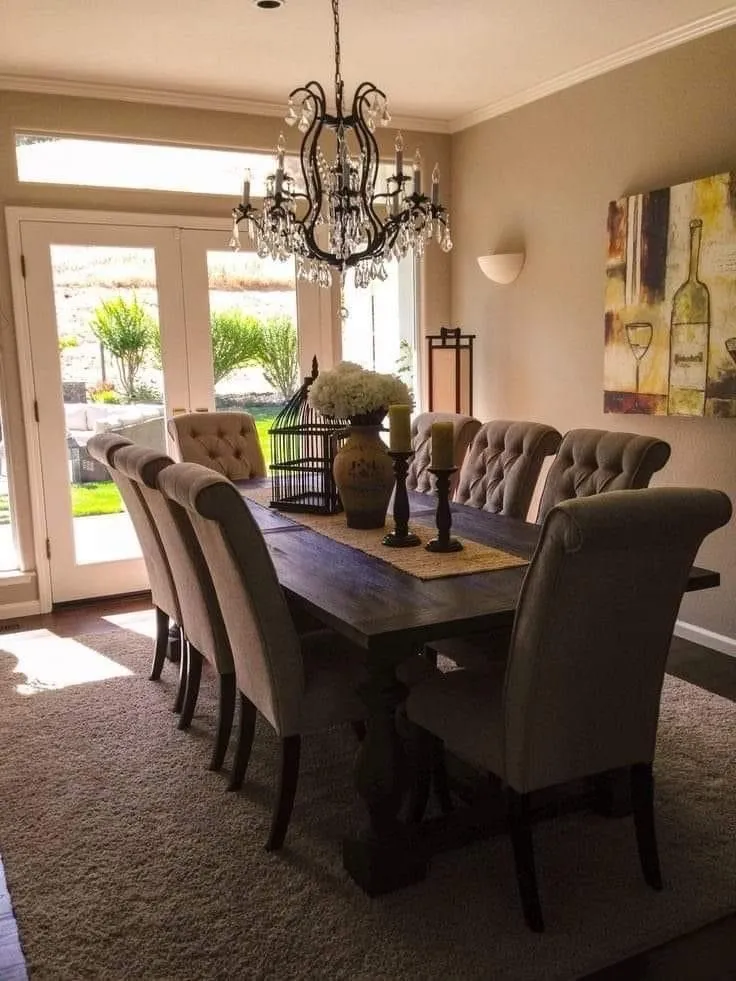
Budget-Friendly vs Premium vs DIY
Not every reader needs the same buying path.
The Spruce’s 2026 roundup shows farmhouse tables across budget tiers, including a budget pick, a modern pick, a small-space pick, and a large-table pick. Apartment Therapy also organizes farmhouse dining tables by budget, starting below $200. On the other end, Dutch Craft highlights custom sizing, premium solid woods, and expandable dining sets. Kreg offers a full DIY route for readers who want to build instead of buy.
Budget table
Best for renters, first homes, and quick room refreshes.
Mid-range table
Best for most families who want a better finish, more durability, and a design that feels upgraded.
Premium table
Best for long-term use, larger homes, and readers who want custom sizing or an heirloom feel.
DIY table
Best for builders who want a hands-on project and full control over stain, paint, and dimensions.
Comparison Table: Which Buying Path Fits You?
| Option | Best For | Strength | Limitation |
| Budget | Fast refresh, renters, first-time buyers | Accessible price | May sacrifice material quality |
| Mid-range | Most homes | Best balance of style and value | Less customization |
| Premium | Long-term investment | Better materials and finish | Higher cost |
| DIY | Makers and hobbyists | Full control over size and look | Time, tools, and skill needed |
That mix of paths is part of the article’s value: readers do not need to leave the page to understand which route matches their situation.
Step-by-Step: How to Choose the Right Modern Farmhouse Dining Room Table
- Measure the room first.
Leave room for chairs, walking paths, and any nearby furniture. West Elm’s 36–44 inch clearance rule is a strong practical baseline. - Choose the shape based on the room.
Rectangle for long rooms, round for square rooms, oval for softness, extendable for flexibility. - Decide how many people you seat most days.
IKEA notes that each seat needs about 2 feet of width, which makes capacity planning much easier. - Pick the base that supports the look.
Pedestal for openness, trestle for farmhouse character, straight legs for a cleaner modern feel. - Match the finish to the rest of the home.
Choose tones that work with flooring, cabinets, wall color, and lighting. - Finish the room around the table.
Add chairs, rug, lighting, and wall decor only after the table is chosen. That keeps the room cohesive instead of crowded.
Best Color Combinations for a Modern Farmhouse Dining Room
The current palette is warmer and softer than the old high-contrast farmhouse look. The Spruce highlights warm beige, earthy paint colors, sage, soft neutrals, and black accents. Those combinations keep the room grounded while still looking fresh.
Strong color pairings
- warm white + natural oak + black lighting
- beige + walnut + woven texture
- sage green + light wood + cream upholstery
- soft gray-beige + painted base + brass accents
- taupe + mixed wood tones + matte black details
The goal is not to make the room look rustic for its own sake. The goal is to create contrast that feels soft, livable, and modern.
Best Materials and Decor Choices
For the table itself, solid wood is still the safest long-term choice. For the surrounding decor, natural textures do the heavy lifting.
Good decor companions
- linen or cotton napkins
- woven placemats
- ceramic vases
- matte dishes
- vintage or vintage-style pendant lighting
- natural fiber rug
- framed landscapes or abstract art
- a china cabinet or buffet if storage is needed
The Spruce’s dining-room examples show that thrifted art, botanical wallpaper, patterned textiles, and mix-and-match tableware can make the room feel personal rather than formulaic.
Space-Saving and Functional Tips
Small dining rooms and eat-in kitchens can still look expensive if the table is chosen correctly. West Elm recommends round tables for small spaces, and IKEA and Dutch Craft both show how extendable or compact tables solve real-life constraints.
Space-saving ideas that work
- Use a round pedestal table in a square nook
- Choose an extendable table for flexibility
- Use benches that tuck under the table
- Keep lighting visually light
- Avoid oversized chairs in narrow rooms
- Pick a table base that leaves legroom open
This is where modern farmhouse design is at its best: warm, practical, and easy to use every day.
Styling Tips for Different Room Sizes
Small dining rooms
Choose round, oval, or compact extendable tables. Keep decor simple and airy. Light wood, soft beige, and whitewashed finishes usually help the room feel larger.
Medium dining rooms
A rectangular or oval table usually works best. Add a bench, a rug, and one strong lighting fixture to define the zone without crowding it.
Large dining rooms
Use a long rectangular or extendable table with a substantial base. Bring in a china cabinet, larger art, or layered seating so the room does not feel empty.
Common Mistakes to Avoid
- buying the table before measuring the room
- choosing a finish that fights the flooring
- making every piece equally rustic
- Using too many farmhouse signs at once
- overcrowding the room with oversized chairs
- Ignoring how the table will work in daily life
- choosing style over comfort
The strongest modern farmhouse rooms are edited, not overloaded. They use a few clear signals and leave space for the room to breathe. That approach is exactly what current editorial coverage keeps reinforcing.
Expert Tips Most People Ignore
1) The base can make the table look smaller or bigger
Open bases feel lighter. Heavy bases feel more grounded. That visual weight matters as much as the tabletop size. This is a design inference based on how negative space and leg visibility affect perceived bulk.
2) Matching chairs are not required
A little mismatch often makes the room feel more collected and less staged. The Spruce explicitly highlights mismatched seating as a modern farmhouse move.
3) Lighting is a style multiplier
A simple table can look high-end when the pendant or chandelier is right. The Spruce’s examples show vintage-style lighting as one of the most reliable farmhouse upgrades.
4) One great table beats three average farmhouse pieces
That is the Difference Between a room that feels designed and a room that feels decorated. This aligns with Google’s guidance to focus on unique, useful content instead of commodity clutter.
Maintenance, Care, and Long-Term Value
A dining table is an everyday object, so care matters.
Best care habits
- Use coasters and placemats
- wipe spills quickly
- rotate decor to avoid marks
- Use felt pads under chairs
- Avoid harsh cleaners on wood finishes
- Keep the room at a stable humidity if possible
Solid wood and quality finishes usually age better than trend-heavy alternatives, which is why they remain the most dependable choice for a long-term farmhouse dining room. The Spruce and Dutch Craft both emphasize durability, workmanship, and solid hardwood-style construction in their table coverage.
Who Should Choose a Modern Farmhouse Dining Room Table?
This style is a strong fit for:
- families who use the table every day
- homeowners who want warmth without clutter
- renters or buyers who want a timeless dining room
- people who like natural materials and relaxed styling
- hosts who need a room that works for guests
It is especially good for readers who want one room that can feel casual on weekdays and polished on weekends.
Who Should Avoid It?
This style may not be the best match for:
- people who want ultra-minimal or sleek contemporary interiors
- those who prefer glossy, high-shine finishes
- homes that need a very compact, hidden dining solution
- readers who do not want visible wood grain or texture
That does not mean the style cannot adapt. It just means the best version of modern farmhouse still depends on warmth, texture, and a slightly relaxed feel.
People Also Ask
A modern farmhouse dining table has the warmth of farmhouse style but cleaner lines, lighter finishes, and less distressing. It feels cozy without looking overly rustic.
Round tables are often best for small or square rooms because they improve flow and keep the space from feeling boxed in. West Elm specifically calls round tables a strong choice for small spaces.
A practical rule is 36–44 inches around the table for chair clearance, with more room needed if you want a buffet or sideboard nearby.
Yes. Benches are a simple way to make the room feel more casual, flexible, and family-friendly. Apartment Therapy notes that farmhouse tables work well with long benches or a mix of benches and chairs.
Natural wood, warm oak, walnut, whitewashed finishes, and painted bases with stained tops all work well. The safest palette is warm, natural, and softly layered.
Conclusion
The best modern farmhouse dining room table is not just the prettiest one. It is the one that fits the room, supports daily life, and gives the dining area a warm, Collected Look that still feels current. If the room is small, choose a round or compact extendable table. If the room needs softness, choose an oval or pedestal base.
For TheRoomsArt.com, this topic is ideal for readers who want practical home decor guidance, not just inspiration. It also connects naturally to other living-room, small-space, wall-art, and styling content, which makes it a strong pillar page for topical authority and internal linking. Google’s guidance consistently rewards this kind of helpful, expert-led, people-first content.
