
Introduction
Wall Pictures for Living Room spaces can do more than fill a blank wall. They can make a room feel finished, larger, warmer, more personal, and more expensive-looking without changing the furniture. The problem is that many people buy art based only on what looks pretty online, then realize it is too small, hung too high, or mismatched with the sofa and wall behind it. That is why the right wall picture is not just decoration. It is a design decision. Practical hanging guidance from Architectural Digest and product-led room styling advice from IKEA, Pottery Barn, and Better Homes & Gardens all point to the same truth: scale, placement, and style matter just as much as the artwork itself.
In this guide, you will learn how to choose the best wall pictures for your living room, how large they should be, where they should go, which styles work best in different rooms, and how to avoid the mistakes that make wall art feel awkward instead of elevated. You will also get a decision framework for canvas vs framed prints, single art vs gallery walls, and budget vs premium options, so the final choice feels simple instead of overwhelming.
What Are Wall Pictures for a Living Room?
Wall pictures for a living room are any framed prints, canvas art, photographic pieces, illustration sets, or mixed-media artworks used to decorate the walls of a living space. They can be one large statement piece, a pair of coordinated prints, a triptych, or a full gallery wall. In practical design terms, they help define the room’s mood, create a focal point, and balance the furniture layout. IKEA’s living-room wall décor guidance frames this as a way to make the room feel personal without needing a major renovation.
Quick summary
Wall pictures are not just about filling empty wall space. They should support the room’s scale, color palette, and furniture layout. The best ones look intentional from across the room and still feel good when you sit down and live in the space.
Why Wall Pictures Matter in 2026
In 2025 and into 2026, interior design is leaning away from cold, impersonal, all-gray rooms and moving toward warmer, more inviting spaces with texture, character, and personality. Better Homes & Gardens highlights this shift toward warm colors, patina-rich materials, and more expressive, tactile interiors. That means wall pictures are no longer just accessories; they are one of the easiest ways to add emotion and depth to a living room without a full remodel.
Designers are also using walls in more flexible ways. Gallery rails are making a comeback, offering a damage-free, change-friendly option for renters and style refreshers. At the same time, large artwork and carefully planned gallery walls remain strong solutions for focal walls, especially in living rooms with sofas, consoles, fireplaces, or long blank spans.
What Types of Wall Pictures Work Best in a Living Room?
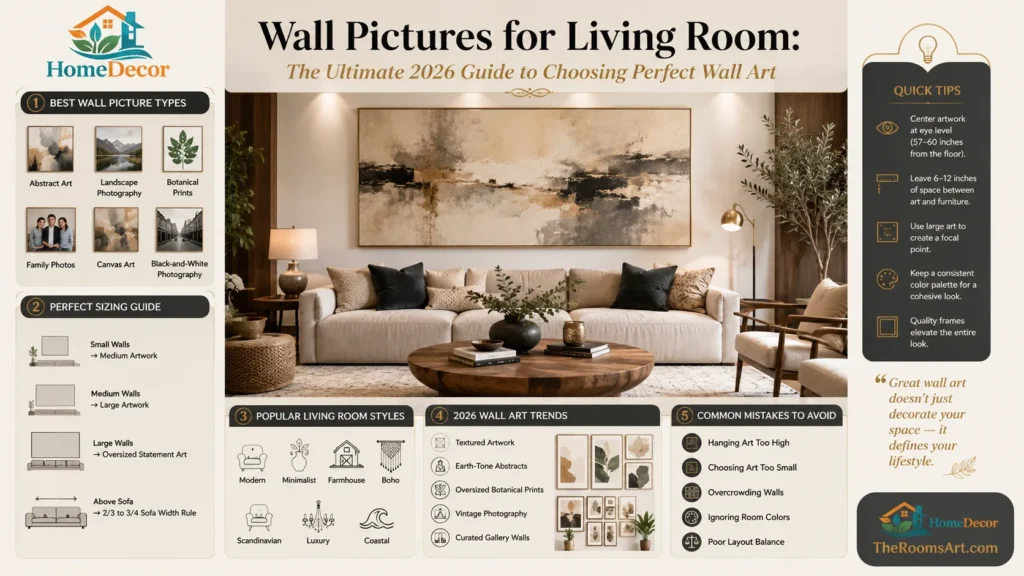
The best living room wall pictures are the ones that match the room’s purpose and your taste. You do not need to follow one formula. The most successful options usually fall into a few broad categories:
- Abstract art for a modern, flexible look
- Landscape photography for calm, expansive energy
- Botanical prints for softness and biophilic warmth
- Black-and-white photography for timeless contrast
- Family photos for a personal, lived-in feel
- Canvas art for a softer, gallery-like finish
- Framed prints for sharper definition and a more tailored look
- Vintage or travel-inspired art for character and storytelling
Best choice by room mood
| Room mood | Best picture type | Why it works |
| Calm and airy | Landscape or botanical art | Adds softness without visual noise |
| Modern and polished | Abstract or black-and-white prints | Clean, graphic, easy to style |
| Personal and warm | Family photo wall | Feels authentic and emotionally connected |
| Luxe and dramatic | Oversized framed art | Creates a strong focal point |
| Flexible and renter-friendly | Leaned art or gallery rails | Easy to rearrange and update |
Mini summary
The best style is the one that fits your furniture, wall size, and daily life. A living room should not look staged to death; it should look considered and comfortable.
How to Choose Wall Pictures for Your Living Room
Choosing art gets much easier when you follow a sequence instead of shopping randomly.
1. Start with the wall
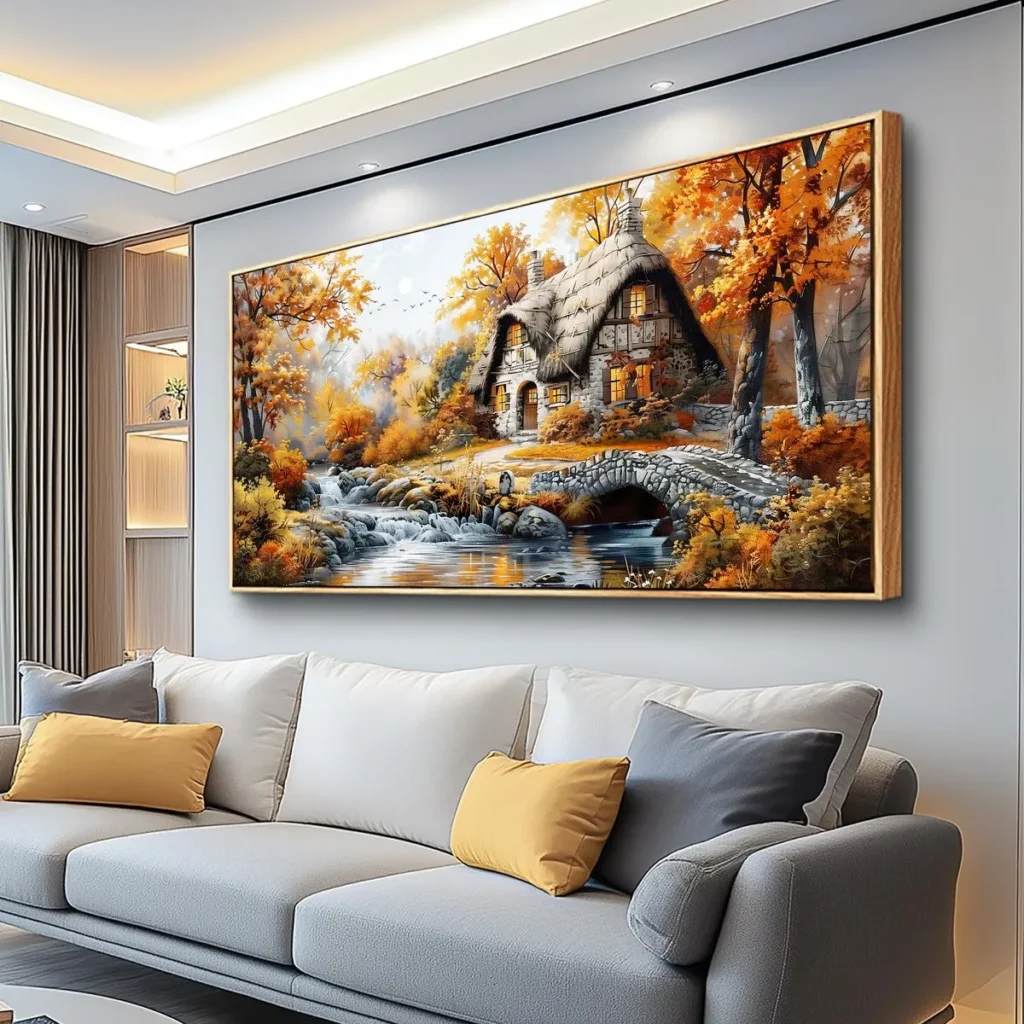
Measure the width and height of the wall area you want to fill. If the wall is large and uninterrupted, one tiny print will almost always feel undersized. BHG’s living-room wall decor examples show that larger walls often work better when split into zones or anchored with larger pieces.
2. Look at the furniture first
The sofa, console, or fireplace usually decides the scale of the artwork. Art placed over furniture should relate to the furniture, not float awkwardly in relation to the ceiling. That furniture-first approach is also how retailers like AllModern and Framebridge present gallery-wall planning.
3. Match the style of the room
A minimalist room usually wants clean lines and fewer frames. A farmhouse room often likes soft neutrals, natural textures, or vintage-inspired art. A luxury room can handle a bigger scale, richer contrast, and more dramatic framing. Scandinavian interiors often rely on light neutrals, wood, and contrast to keep the space feeling calm but not flat.
4. Choose a palette
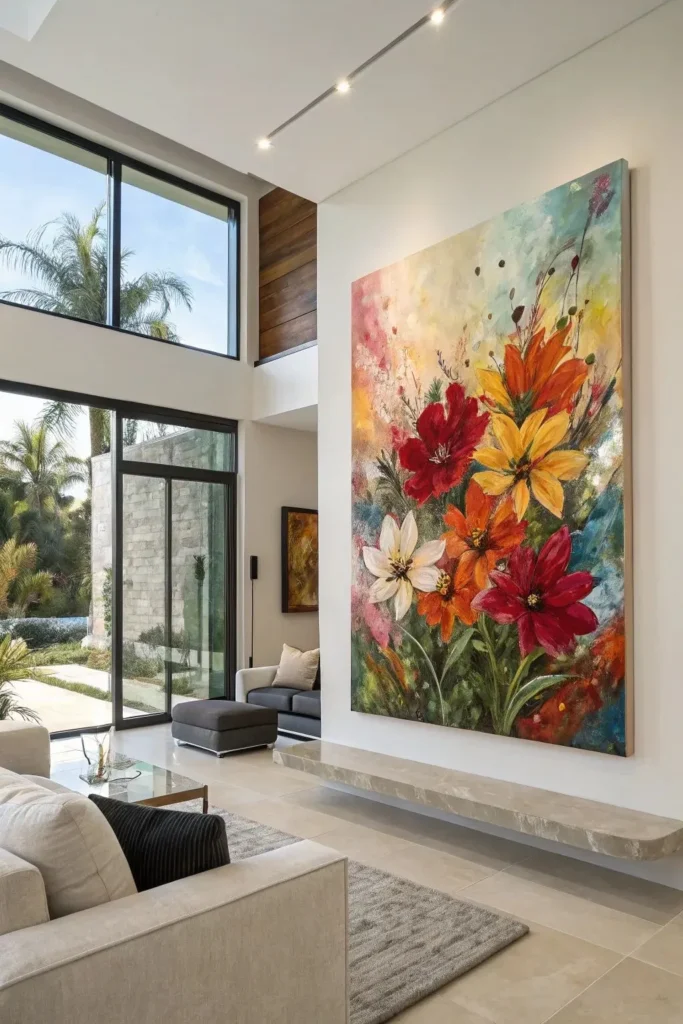
Wall pictures should either echo the room’s colors or intentionally contrast them. BHG’s wall decor coverage shows how art can be used to pull together existing colors, create contrast on darker walls, or make a focal point feel intentional.
5. Decide whether you need one focal point or many
One statement artwork creates calm and simplicity. A gallery wall creates personality and movement. Both can work beautifully, but they solve different design problems.
Mini summary
Measure the wall, check the sofa, match the room style, and then choose the artwork. Shopping in that order prevents the most Common Mistake: buying art that looks good alone but wrong in the room.
Wall Picture Sizes Explained
A huge reason living room art fails is simple: the size is wrong. Decorative sources and design retailers repeatedly recommend choosing wall art in proportion to the furniture below it. A common rule of thumb is that art above a sofa should be roughly two-thirds the width of the furniture beneath it, with hanging height adjusted so the art feels connected to the piece below, not the ceiling. Architectural Digest also notes a common hanging reference of about 57 inches to the center of the artwork in general, while allowing a few extra inches above furniture depending on the room.
Practical size guide
| Wall type | Recommended art approach | Why |
| Small wall | One medium piece or two small coordinated frames | Keeps the wall from looking cramped |
| Medium wall | One large print or a neat 2–3-piece arrangement | Adds balance without clutter |
| Large feature wall | Oversized art, a gallery wall, or layered compositions | Prevents the wall from feeling empty |
| Above sofa | Art about two-thirds of the sofa width | Keeps the relationship visually balanced |
A simple sizing rule
If your sofa is 84 inches wide, art or an art grouping around 55–60 inches wide is usually a strong starting point. If the room is compact, keep the composition tight but still substantial enough to matter.
Mini summary
Size is not a detail. It is the difference between “styled room” and “random picture on a wall.”
Pictures Above a Sofa: The Most Important Placement Rule
The area above the sofa is where many people make the biggest mistake. They hang art too high, make it too small, or center it on the wall instead of the seating. Designers and retailers consistently recommend treating the sofa as the anchor. AD says a few inches above furniture is usually enough, and Pottery Barn advises hanging art roughly at eye level, around 60 inches to the center of the frame. Other design guidance points to keeping artwork close enough to the sofa to feel connected, not detached.
Best above-sofa formulas
- One large picture: easiest and cleanest
- Two matching pictures: ideal for symmetry
- Triptych canvas: great for long sofas
- Gallery wall: best for personality and variety
Above-sofa placement tips
- Keep the artwork visually tied to the sofa.
- Leave a sensible gap between the top of the sofa and the bottom of the art.
- Avoid hanging art so high that it looks like ceiling decor.
- Use the sofa width, not the wall width, as the sizing anchor.
Mini summary
Above-sofa art should feel like part of the seating area. If it looks like it belongs to the ceiling, it is too high. If it looks swallowed by the sofa, it is too small.
Large Wall Pictures for Living Room Spaces
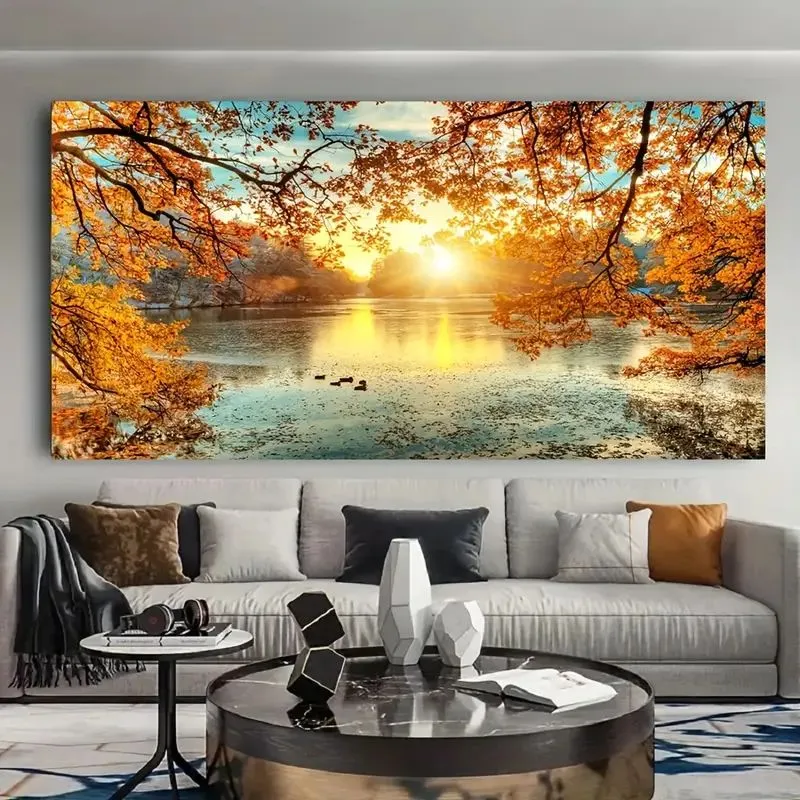
Large wall pictures are one of the strongest solutions for a living room because they instantly create a focal point. BHG notes that large-scale artwork can anchor a reading corner or large wall and bring color and personality into a room. In a spacious living room, one oversized piece often feels more elegant than too many small ones.
Best large picture formats
- Oversized abstract art
- Panoramic landscapes
- Large canvas prints
- Statement photography
- Single framed artwork with generous matting
When large artworks are best
Large art is especially effective when:
- The wall is broad and empty
- The sofa is long
- The room has high ceilings
- The living room needs a strong focal point
- You want a cleaner look than a gallery wall
Why it feels premium
Big art creates visual confidence. It says the room was intentionally designed rather than assembled piece by piece. That is one reason large artwork is so popular in modern and luxury interiors.
Modern Wall Pictures for Living Room
Modern living rooms usually work best with simplicity, contrast, and clean shapes. AllModern’s gallery-wall styling advice leans toward abstract prints, varied sizes, and careful layering, while Scandinavian styling guidance favors light neutrals, natural materials, and contrast between black and pale wood or white.
Modern wall picture ideas
- Minimalist line art
- Geometric prints
- Neutral abstract paintings
- Black-and-white photography
- Soft tonal landscapes
- Mixed-size modern gallery walls
Best colors for modern rooms
Think black, white, ivory, beige, stone, taupe, sand, charcoal, muted olive, and soft clay. These shades fit the broader move toward warm, inviting interiors and away from sterile, high-contrast minimalism.
Mini summary
Modern does not have to mean cold. In 2026, modern wall art is cleaner, warmer, and more textural than the ultra-minimal look of the past decade.
Living Room Gallery Wall Ideas
Gallery walls remain popular because they solve two problems at once: they fill a wall, and they tell a story. BHG recommends matching-frame grid layouts for a cleaner gallery look, while other design sources suggest centering the arrangement on the furniture rather than the wall. Framebridge also emphasizes the 2/3 rule when sizing a gallery wall over a sofa or bed.
Gallery wall styles that work
- Symmetrical grid gallery wall for a formal or modern look
- Eclectic gallery wall for a collected, personal feel
- Family photo gallery for warmth and memory
- Mixed art collection for a curated, designer look
- Split-zone gallery wall for wide walls or walls with architectural breaks
Smart gallery wall tips
- Keep frame finishes consistent if you want calm and order.
- Mix frame sizes when you want energy and creativity.
- Use a paper template or floor layout before hanging.
- Keep spacing tight enough to read as one composition.
Mini summary
A gallery wall works best when it feels like one story, not twenty separate decisions.
Best Wall Pictures by Interior Design Style
Modern
Choose abstract art, monochrome photography, geometric shapes, and large-scale minimal compositions.
Minimalist
Use fewer pieces, More Space, and simple framing. One large print often works better than many small ones.
Farmhouse
Use vintage-inspired prints, botanicals, soft landscapes, muted florals, and weathered frames. These pair well with wood, linen, and cozy textures.
Boho
Choose layered art, earthy color palettes, textured pieces, relaxed gallery walls, and natural motifs. Baskets and other dimensional pieces also work well in boho-inspired living rooms.
Scandinavian
Focus on pale neutrals, black accents, light wood, and simple art with breathing room. Contrast should feel crisp, not harsh.
Traditional
Use framed landscapes, portraits, botanical studies, classic photography, and symmetrical arrangements. Traditional rooms usually benefit from balance and structure.
Luxury
Choose large-format art, rich textures, custom framing, restrained but dramatic palettes, and high-quality finishes. Luxury rooms usually feel best when the art is larger and more deliberate.
Coastal
Go for ocean photography, sand-and-sea palettes, soft blue-greens, airy abstracts, and calm horizons.
Canvas vs Framed Pictures: Which Is Better?
| Feature | Canvas | Framed print |
| Look | Softer, more painterly | Sharper, more structured |
| Style fit | Modern, casual, coastal, transitional | Classic, traditional, polished, gallery-like |
| Visual weight | Often lighter visually | Can feel more defined and formal |
| Best for | Large abstract art, statement pieces | Photography, illustrations, curated collections |
| Room effect | Relaxed and contemporary | Tailored and refined |
Canvas is often a strong choice when you want a simple statement with less visual fuss. Framed prints work better when you want contrast, formality, or a more finished editorial look. Product guides from IKEA and Pottery Barn also show how frames, mats, and hanging systems contribute to the overall finish, not just the image itself.
Mini summary
Canvas usually feels softer. Frames usually feel more polished. Neither is “better” in general; the right choice depends on the room.
Single Large Picture vs Gallery Wall vs Multi-Piece Art
| Option | Best for | Pros | Cons |
| Single large picture | Clean, calm, luxury, modern rooms | Easy to style, strong focal point | Less personal variety |
| Two-piece set | Sofas, long walls, symmetrical rooms | Balanced and elegant | Needs careful spacing |
| Triptych | Large sofas and feature walls | Feels designed and cohesive | Can be harder to source |
| Gallery wall | Family photos, eclectic style, storytelling | Personal and flexible | Can look busy if poorly planned |
BHG’s layout examples, Framebridge’s 2/3 guidance, and AllModern’s gallery-wall advice all point to the same principle: the room should dictate the format. Furniture, wall width, and desired mood are more important than trend chasing.
Best Wall Pictures for Different Room Sizes
Small living rooms
Use fewer, larger pieces. Small rooms can look cluttered when overloaded with tiny frames. A single medium-to-large print or a lean art setup can make the room feel taller and less busy.
Medium living rooms
This is the most flexible zone. Two-piece sets, a moderate gallery wall, or one statement print all work well. Try to keep the art connected to the sofa or console rather than the full wall.
Large living rooms
Go bold. Large walls often need oversized art, a multi-zone gallery wall, or layered wall decor so the space does not feel empty. BHG shows large walls being divided into zones and balanced with shelving, books, art, or structural elements.
Mini summary
Small rooms need discipline. Large rooms need Confidence. The wrong scale is usually the real problem, not the wrong style.
Trending Living Room Wall Picture Ideas for 2026
Design trend coverage for 2025 points toward more texture, personality, warmth, and architectural interest. That carries directly into wall art. The strongest living-room wall picture trends for 2026 are likely to stay close to those themes.
Top trend directions
- Textured art
- Warm neutral abstracts
- Oversized botanical prints
- Earth-tone compositions
- Vintage-inspired photography
- Mixed-media wall art
- Gallery rails and flexible display systems
Why these trends work
They feel personal, less disposable, and more layered than generic mass-market wall art. They also fit the broader shift toward homes that feel lived in rather than staged.
Common Mistakes to Avoid
1. Hanging art too high
This is the most common mistake. It makes the wall art feel disconnected from the furniture. AD and Pottery Barn both support a more eye-level, furniture-related placement strategy.
2. Choosing art that is too small
Tiny art on a big wall looks accidental. Large walls usually need larger pieces or coordinated groupings to feel balanced.
3. Using too many unrelated frames
When everything is different, nothing feels intentional. A gallery wall needs a unifying idea, even if it is eclectic.
4. Ignoring the sofa width
The art should relate to the sofa or furniture below it, not just the empty wall.
5. Overcrowding the wall
More art is not always better. Sometimes one large piece gives the room more breathing room than ten small ones.
Expert Tips Most People Ignore
- Use art to correct a room problem.
If a room feels too low, tall vertical art can help. If it feels too wide and empty, horizontal pieces can balance it. - Let the furniture lead.
Sofa width, console width, and wall breaks are more important than “perfect wall center.” - Think in layers.
A picture, a mirror, a shelf, and a lamp can work together more effectively than art alone. IKEA and BHG both show how layered wall décor improves function and personality. - Consider rental-friendly systems.
Gallery rails, leaned art, and damage-free hanging solutions are especially useful for renters and people who change decor often. - Use texture as a design tool.
In a room with smooth fabrics and plain walls, textured art can add depth without clutter. That fits the current move toward more tactile interiors.
Maintenance, Care, and Long-Term Value
Quality wall pictures can last for years if you choose well and care for them properly. Framed prints protect paper artwork better than exposed prints. Canvas can feel beautiful and modern, but it still benefits from placement away from direct sunlight and moisture. If you use family photos, make sure the image quality is high enough for the size you want. Framebridge notes that print quality matters and that modern phone photos can often be enlarged significantly when the source file is strong.
Simple care tips
- Dust frames regularly.
- Avoid direct sunlight where possible.
- Keep hanging hardware secure.
- Store extra prints flat.
- Re-evaluate the scale if the room changes.
Best Color Combinations for Living Room Wall Pictures
The easiest winning palettes for 2026 are the ones that feel warm, grounded, and flexible.
Reliable combinations
- Cream + taupe + soft black
- Beige + clay + ivory
- Charcoal + white + oak
- Sage + sand + warm gray
- Navy + cream + brass
- Terracotta + off-white + walnut
How to choose
If your living room already has strong furniture colors, choose art that repeats one or two of those shades. If the room feels flat, pick wall pictures with contrast, texture, or a richer accent color to wake the room up.
Best Materials and Decor Choices
Canvas
Best for modern, casual, and large-format art.
Framed paper prints
Best for a polished, tailored, gallery-like feel.
Photographic prints
Best for travel, family, city, and black-and-white themes.
Mixed media
Best for adding texture and making a room feel unique.
Gallery rails
Best for renters, vintage lovers, and people who change art often.
Space-Saving and Functional Tips
Wall pictures can do more than decorate. They can also help a living room feel organized.
- Use ledges to change art often without drilling more holes.
- Place art above consoles to create a clear focal area.
- Combine art with shelves for books and decor.
- Use one large piece instead of several small frames in tight rooms.
- Lean art on mantels or sideboards for a relaxed look.
Who Should Choose Wall Pictures for the Living Room?
Wall pictures are ideal for:
- homeowners who want a quick room refresh
- renters who need non-permanent styling
- apartment dwellers with blank walls
- families wanting personal decor
- design lovers who want an easy focal point
- budget-conscious decorators who want maximum visual impact
Who Should Avoid a Heavy Wall-Art Look?
A very dense gallery wall may not suit:
- extremely minimal interiors
- very small walls with limited space
- rooms that already have many visual focal points
- people who prefer one calm, simple statement rather than layered decor
In those cases, a single large picture or a pair of framed prints is usually the safer choice.
People Also Ask
The best pictures are the ones that match the room’s scale and mood. Abstract art, landscapes, family photos, and framed prints all work well when sized correctly and placed at the right height.
A strong rule is to aim for art that is about two-thirds the width of the sofa. That keeps the composition balanced and prevents the piece from looking too small.
It should coordinate with furniture, not copy it exactly. Repeating a color, texture, or mood is usually enough to create harmony.
Yes. Canvas remains a strong choice because it works especially well for large statement art, modern rooms, and softer, less formal interiors.
The strongest direction is warm, textured, personal, and flexible: oversized abstracts, botanicals, vintage-inspired pieces, gallery rails, and curated gallery walls.
Conclusion
Wall pictures for living room spaces work best when they solve a design problem, not just fill space. The right piece can make a small room feel more intentional, a large room feel more grounded, and an ordinary wall feel like the centerpiece of the home. In 2026, the strongest choices are still the simplest ones: the right size, the right placement, and a style that feels personal and timeless. That is where real visual impact comes from.
For homeowners, renters, apartment dwellers, and anyone refreshing a tired living room, the safest winning formula is clear: measure first, choose the mood second, and hang with the furniture as your guide. If you build more articles around this topic cluster on TheRoomsArt.com, you can extend authority into gallery walls, above-sofa art, modern living room decor, and family photos Wall Ideas.
Legal disclaimer: Prices, materials, trends, and product availability may change over time depending on region, suppliers, and brands. Always verify dimensions, materials, and compatibility before purchase or renovation.
