
Introduction
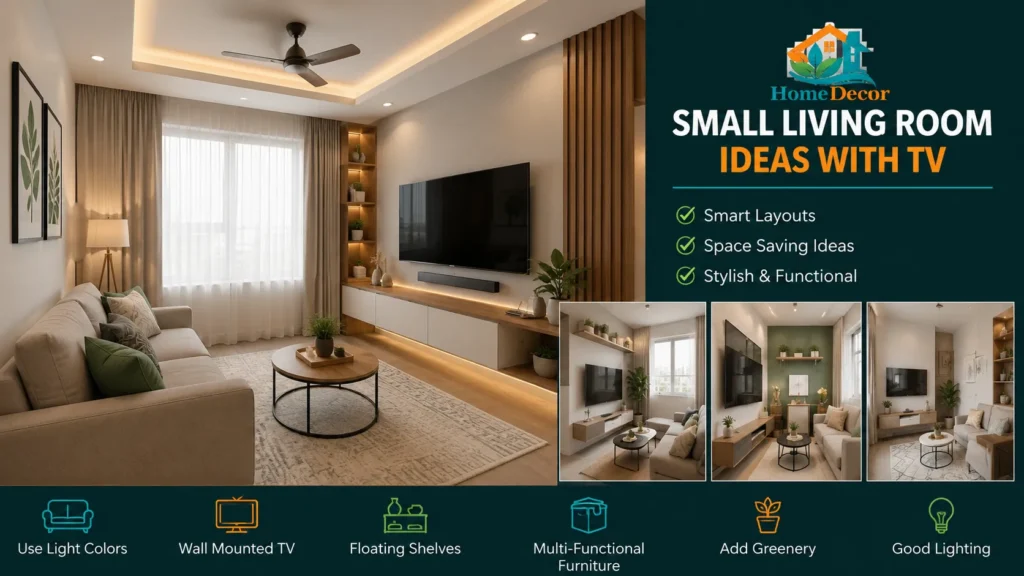
A Small Living Room with a TV can feel tricky because the screen wants attention, but the room still needs breathing space. The good news is that compact rooms often look better when every piece has a clear job. Current design guidance keeps repeating the same essentials for a reason: mount the TV smartly, protect walking paths, use light-visual-weight furniture, add layered lighting, and keep storage controlled. Sony recommends eye-level alignment for wall-mounted TVs and suggests choosing a comfortable viewing distance based on screen size, while BHG and IKEA stress circulation, scale, mirrors, multifunctional furniture, and layered lighting for small rooms.
This guide goes beyond surface-level ideas. You will get real layout logic, style options, budget-friendly moves, premium upgrades, and room-by-room advice so the TV feels intentional instead of dominating the room. If your goal is a small living room that looks calm, modern, and usable every day, the next sections will give you a clear plan.
What Are Small Living Room Ideas with TV?
Small living room ideas with TV are layout and styling strategies that help you fit a television into a compact living room without making the room feel crowded. The goal is not just to place a TV somewhere. The goal is to build a room that still feels open, comfortable, and balanced. That usually means using wall mounting, slim consoles, compact seating, open shelving, or corner setups that protect space and sightlines.
In practice, this style is about solving three problems at once: where the TV should go, where the sofa should go, and how the room can still move easily. That is why the best examples from current design sources focus on visual balance, functional storage, and lighter furniture rather than simply adding more decor.
Why This Topic Matters in 2026
Small-space living continues to matter because many homes and apartments now need one room to do several jobs at once. A living room may also be a media room, reading zone, work corner, or guest space. That makes smart TV placement and furniture planning more important than ever. Current design guides reflect this by repeatedly recommending multifunctional furniture, hidden storage, flexible seating, and clear traffic paths.
Design trends also lean toward cleaner walls, calmer visuals, and smarter storage. IKEA highlights mirrors and layered lighting to make a room feel brighter and more dynamic, while The Spruce and Havenly show how designers increasingly integrate TVs into shelving, art walls, or concealed storage rather than letting them dominate the room.
Best Types of Small Living Rooms with TV Layouts
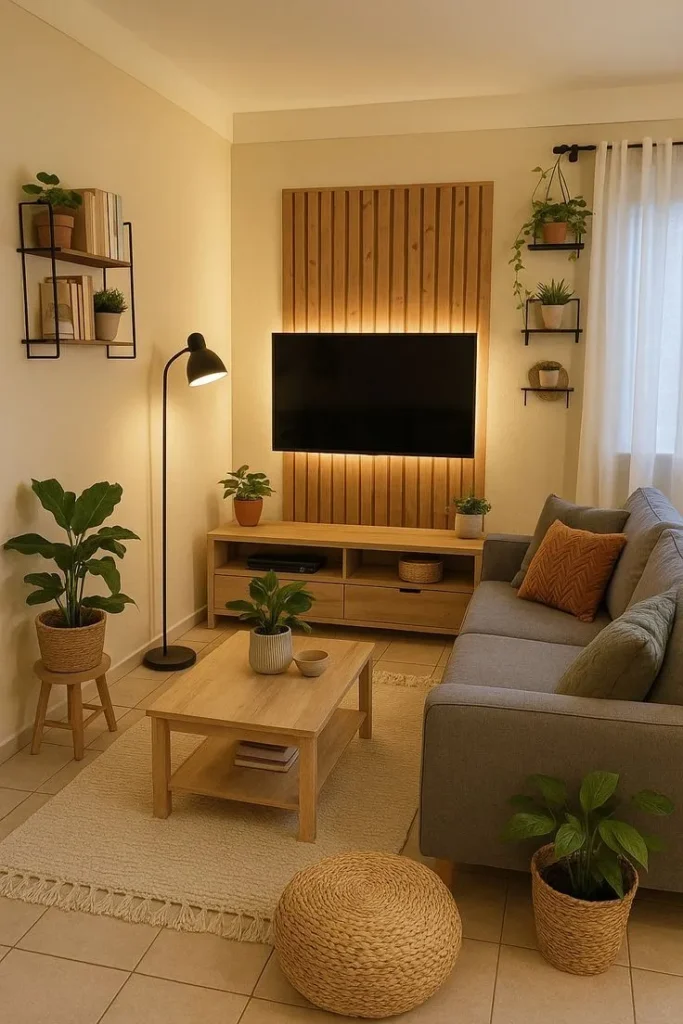
| Layout Type | Best For | Main Benefit | Main Trade-Off |
| Wall-mounted TV + slim console | Most small rooms | Frees floor space and looks clean | Less hidden storage |
| Corner TV + angled sofa | Narrow or awkward rooms | Uses dead corners well | Sightlines can be less perfect |
| Built-in media wall | People who need storage | Strong focal point and organization | Higher cost and planning |
| Floating shelves + TV | Minimalist rooms | Open, airy look | Needs careful styling |
| Concealed TV panels | Multi-use rooms | Cleanest visual result | More expensive and deeper wall depth |
| Rolling TV stand | Flexible rooms | Easy to rearrange | Less polished look |
This table is a practical way to match layout to room shape. The strongest current examples use exactly these kinds of solutions, especially wall-mounting, slim consoles, shelving, and hidden storage.
Top Small Living Room Ideas with TV
1. Wall-Mount the TV First
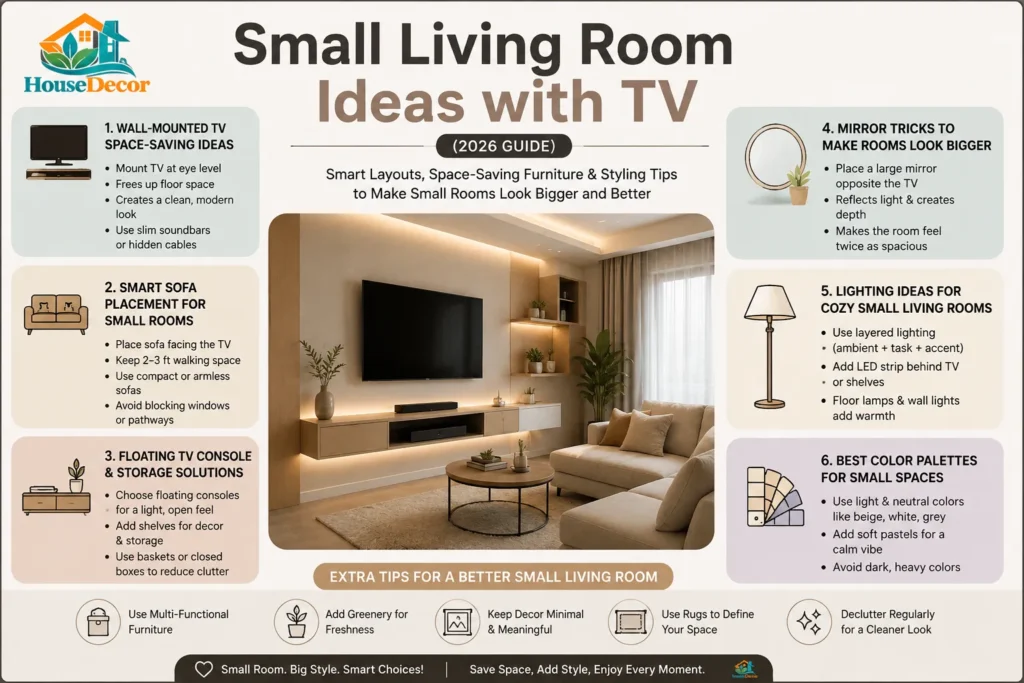
Wall-mounting is still the strongest space-saving move because it removes the need for a bulky stand and opens up the floor visually. Sony also says the TV should generally be mounted with the screen center near eye level for the viewers seated in the room. That makes the setup both prettier and more comfortable.
2. Use a Slim Floating Console
A narrow floating console gives you a place for remotes, streaming boxes, or a small decorative tray without taking up floor volume. Coohom specifically highlights this as a way to create clean sightlines and the illusion of more floor space in tiny apartments.
3. Build Around a Clear Focal Point
BHG recommends designing the room around one strong focal point, such as a TV, fireplace, or window. In a small living room, it keeps the eye from bouncing around and makes the room feel more intentional.
4. Choose Open Shelving Instead of Heavy Cabinets
Open shelving keeps the wall from feeling closed in. Havenly and IKEA both show that shelves can blend the TV into the room while still giving you room for books, baskets, and a few decorative pieces. The important part is restraint: do not overfill the shelves.
5. Bring in a Corner TV Setup When the Main Wall Is Busy
If your main wall has windows, doors, or radiators, a corner setup may work better. Coohom’s corner TV and diagonal sofa idea is a good example for irregular rooms because it keeps the room usable while creating a comfortable sightline.
6. Use a Compact Sofa or Loveseat
BHG notes that scale matters and oversized furniture can overwhelm a small room. Smaller seating, visible legs, and lighter silhouettes help the room feel open.
7. Let Furniture “Float” a Little
Pushing everything against the walls can make a room feel disconnected. BHG recommends pulling furniture inward to create a more social and comfortable conversation zone. That advice matters even more when a TV is part of the room, because the layout needs to feel intentional, not shoved into a corner.
8. Add a Mirror to Expand the Room
IKEA says mirrors reflect light into the room and trick the eye into reading the room as bigger and brighter. A mirror placed opposite or near the TV wall can visually widen the space.
9. Layer the Lighting
One overhead light is rarely enough in a small living room. IKEA recommends mixing task, general, mood, and cabinet lighting to support different activities and improve atmosphere. BHG also notes that layered lighting keeps a room from feeling flat.
10. Keep the Palette Light and Calm
Neutral and light colors remain one of the most effective ways to make a small room feel open. BHG recommends neutral palettes, light visual weight, and repeating light tones; Southern Living also notes that light colors help small rooms feel larger.
Mini summary:
The best small living room TV setups are usually simple: wall-mount the screen, keep furniture compact, preserve walkways, and use shelving or storage that does not visually block the room. That is the core formula current design sources keep reinforcing.
Step-by-Step Guide to Designing a Small Living Room with TV
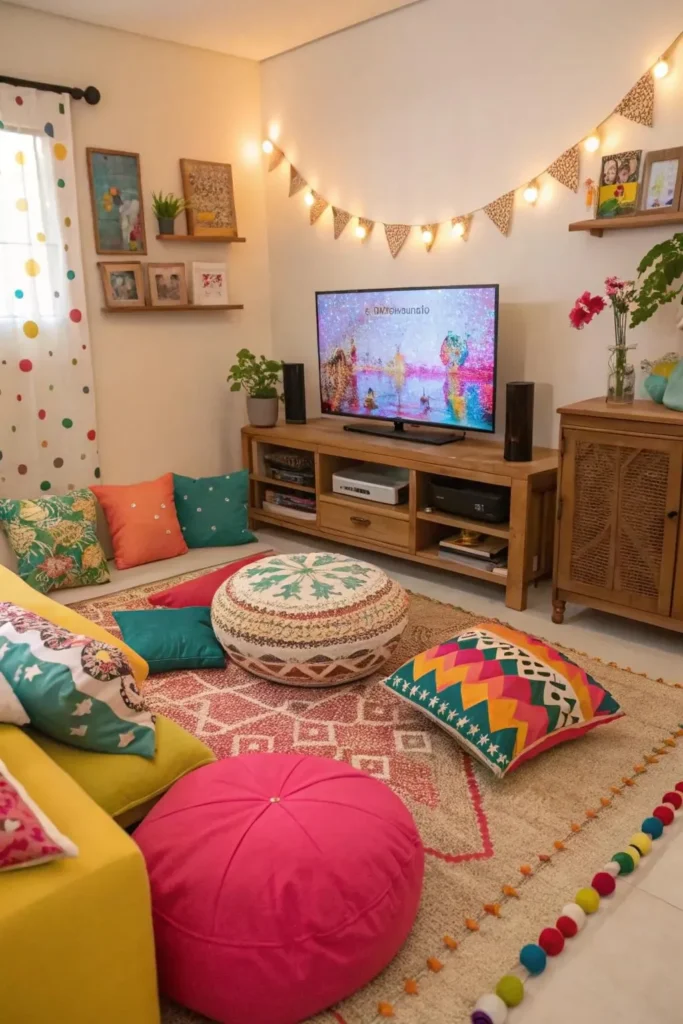
- Measure the room first.
Note wall lengths, doorway swing, window positions, and how much walking space you need. - Choose the best focal wall.
Pick the wall with the least obstruction and the cleanest sightline. - Check TV height and viewing distance.
Sony recommends eye-level mounting for wall TVs, and viewing distance should match screen size and resolution so the picture stays comfortable. Samsung also provides viewing-distance guidance by screen size. - Place the sofa to protect circulation.
Keep walkways open and avoid blocking main paths. BHG suggests leaving roughly 2.5 to 3 feet for circulation around key furniture and walkways. - Decide whether you need storage or openness more.
If storage is critical, use a media wall or closed cabinet. If openness matters more, use a floating console or open shelves. - Add one strong visual anchor.
That could be a rug, an art piece, or a mirror. This helps the TV feel like part of the room instead of a random black rectangle. - Finish with layered lighting and one or two soft textures.
A floor lamp, wall light, curtain, and rug can make the room feel complete without clutter.
TV Placement Comparison: Which Option Works Best?
| TV Placement Option | Best Room Shape | Pros | Cons |
| Center of the main wall | Standard small living room | Balanced and easy to style | Needs the cleanest wall |
| Corner placement | Narrow or awkward layouts | Saves wall space | Can be harder to align |
| Above slim console | Most common compact layout | Practical and tidy | Must manage cables well |
| Hidden behind panels | Guest room/studio use | Cleanest visual result | Higher cost |
| On a movable stand | Flexible multi-use room | Easy to reconfigure | Less polished look |
Current design examples repeatedly return to these five placement types because they solve the same core issue in different room shapes.
Budget-Friendly Small Living Room with TV Ideas
- Use a basic wall mount instead of a full media wall.
- Pick a slim, secondhand console or accent chest.
- Add one mirror and one lamp rather than many decor objects.
- Use baskets for hidden storage.
- Keep curtains simple and light.
IKEA and BHG both support this kind of low-clutter, low-cost approach because it improves the room visually without requiring a full renovation.
Budget Pros
- lower upfront cost
- easy to update later
- flexible for renters
Budget Cons
- less built-in storage
- fewer custom options
- Cable Management may be harder
Premium / Luxury Small Living Room with TV Ideas
Luxury in a small room is less about size and more about finish quality and restraint. A premium version of this look might use:
- a custom built-in media wall
- hidden cable management
- textured wall panels
- concealed storage
- a better-quality sofa with slim arms
- a large-format mirror or statement art
Coohom’s built-in wall unit and hidden-panel approach, along with The Spruce’s note that designers often hide or integrate TVs more artfully, are both strong premium-direction cues.
Luxury Pros
- polished, custom look
- strong visual calm
- excellent storage integration
Luxury Cons
- higher cost
- less flexibility
- May need professional installation
Smart and Modern Design Trends for 2026
- More concealed technology: TVs hidden behind panels or integrated into wall systems.
- Open shelving with restraint: less clutter, more curation.
- Multifunctional furniture: storage ottomans, sleeper sofas, movable side tables.
- Layered lighting: ambient, task, and mood lighting.
- Light-visual-weight pieces: slim legs, narrow consoles, airy silhouettes.
Common Mistakes to Avoid
- Using furniture that is too large
Oversized sofas and heavy cabinets make a small room feel tighter. - Blocking walkways
A room should be easy to move through. BHG recommends protecting circulation paths. - Mounting the TV too high
Sony says the TV should generally be mounted with the center at eye level for seated viewers. - Ignoring viewing distance
Screen size and resolution matter for comfort. Sony and Samsung both give viewing-distance guidance. - Overfilling shelves
Havenly warns that too much shelf styling around a TV can feel crowded. - Using only one light source
A single overhead light can flatten the room. Layer lighting instead.
Expert Tips Most People Ignore
- Measure the room before buying furniture, not after.
- Use lighter furniture finishes where possible.
- Keep one wall visually quieter than the others.
- Choose a rug that defines the seating zone.
- Add hidden storage for remotes, chargers, and game accessories.
- Make sure the TV does not compete with too many visual focal points.
These tips are simple, but they make a room feel calmer and more expensive without adding clutter. That is exactly the direction current design authorities recommend for small rooms.
Best Color Combinations for a Small Living Room with TV
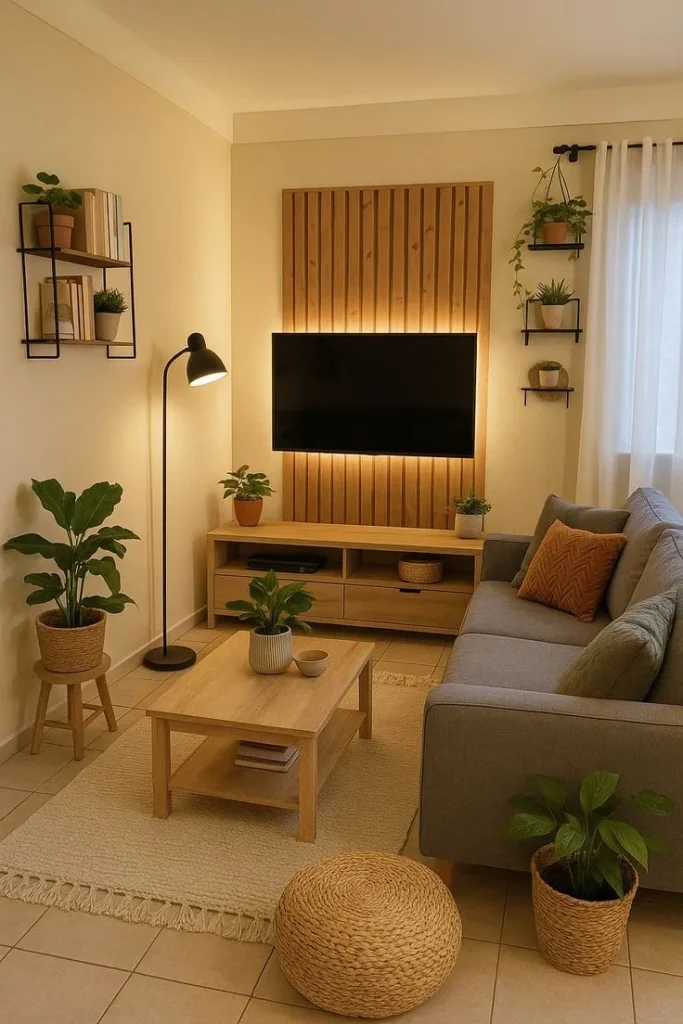
| Color Combo | Mood | Why It Works |
| White + beige + wood | Calm and airy | Reflects light and softens the TV wall |
| Warm gray + oak + black accents | Modern and balanced | Gives structure without feeling heavy |
| Cream + sage + brass | Soft and refined | Adds personality while staying light |
| Greige + walnut + linen | Cozy and grounded | Works well with compact furniture |
| Pale blue + white + light wood | Fresh and bright | Helps a small room feel open |
Light and neutral palettes are consistently recommended for smaller rooms because they visually expand the space and create a calmer backdrop for the TV wall.
Best Materials and Decor Choices
- Furniture: slim wood, matte finishes, visible legs
- Textiles: linen, cotton, boucle, light wool
- Decor: one mirror, one plant, a few books, a framed print
- Storage: closed bins, woven baskets, low-profile cabinets
- TV wall accents: open shelves, paneling, or a narrow ledge
IKEA and BHG both support furniture and decor that lighten the visual load of the room instead of making it feel packed.
Styling Tips for Different Room Sizes
For very small living rooms
Use a wall-mounted TV, one loveseat, one side table, and as little loose furniture as possible.
For narrow living rooms
Try a corner TV or wall-mounted screen with a slim console to protect the walkway.
For open-plan spaces
Use the sofa, rug, or a low console to define the living zone without blocking light.
For studio apartments
A concealed or wall-mounted TV often works best because it keeps the room flexible.
Coohom’s layouts and BHG’s circulation advice are especially useful here because they show how to fit the TV without sacrificing movement.
Maintenance, Care, and Long-Term Value
A good small living room TV setup should stay easy to live with. That means:
- dusting shelves and screens regularly
- hiding cables neatly
- Choosing Wipeable Finishes
- avoiding fragile decor clutter
- Keeping storage simple so the room stays tidy
The long-term value of this style is strong because it is flexible. You can swap the decor, change the art, or upgrade the TV later without rebuilding the room. That makes it a smart option for renters, first homes, and small apartments.
Who Should Choose This Style
This style is ideal for:
- apartment renters
- homeowners with compact living rooms
- studio apartment residents
- people who want a clean, modern look
- families who need both seating and entertainment in one room
It works best when you need the room to feel open but still usable every day.
Who Should Avoid This Style
This style may not suit you if:
- You want a very formal sitting room with no media focus
- You prefer very maximalist, heavily layered decor
- Your room cannot comfortably handle a TV at all
- You need a very large sectional and lots of extra seating
That is not a design failure. It simply means your room may need a different focal point or a different furniture scale.
People Also Ask
The best size depends on your room and viewing distance. Sony recommends choosing a viewing distance based on the TV’s size and resolution, and Samsung also provides screen-size distance guidance. In a small room, it is usually better to match the TV to the seating distance instead of buying the biggest screen available.
Yes, wall-mounting is often the best move because it frees floor space and makes the room feel cleaner. Sony also recommends mounting the TV with the center near eye level for seated viewers.
Use a light color palette, compact furniture, a mirror, layered lighting, and a slim console or open shelves. IKEA and BHG both point to these choices as reliable small-room strategies.
Yes, especially if the main wall is blocked by windows or doors. Coohom shows that a corner TV with a diagonal sofa can open up awkward rooms and improve the layout.
Avoid oversized furniture, blocking pathways, overdecorating shelves, and mounting the TV too high. These are the most common mistakes that make compact rooms feel cramped.
Conclusion
Designing a small living room with a TV is really about balance, not compromise. When the layout is planned with intention, even the tiniest space can feel open, Comfortable, and visually calm. The key principles stay consistent: keep the TV placement smart and eye-level, choose compact and lightweight furniture, protect walking space, and rely on simple storage that doesn’t overwhelm the room.
Instead of treating the TV as the main problem, it works better to treat it as part of a complete system—sofa, lighting, wall setup, and circulation all working together. When these elements are aligned, the room naturally feels larger and more functional without needing expensive renovations.
In the end, a well-designed small living room is not about how much you fit in—it’s about how clearly everything is placed and how easy the space feels to live in every day.
Legal disclaimer: Prices, materials, trends, and product availability may change over time depending on region, suppliers, and brands. Always verify dimensions, materials, and compatibility before purchase or renovation.
