

Introduction of Living Room Wallpaper Decor
Once pushed aside, Living Room Wallpaper Decor now shapes spaces with depth and mood. Not merely seen, it’s felt through rough weaves, soft fibers, or slick vinyls. High-res scenes stretch across walls like frozen moments from distant places. Materials grow from recycled pulp, some peeling off cleanly when desire shifts. Seasons change, moods turn, and designs follow without damage left behind. Planning begins long before paste meets paper. Matching Patterns demands patience; wrong lighting warps tones by noon. Mistakes show fast if corners curl too soon. Professionals move quickly with brushes and trimming blades. Others take time, learning how seams hide in shadow. Each choice tells what matters most: boldness, calm, memory, or quiet craft. Trends lean into nature’s textures, digital illusions, and hand-drawn quirks. Longevity ties to prep work, surface readiness, and clean tools. Confidence grows step by step, roll after roll.
Why choose wallpaper for your living room?
Wallpaper changes the rules of decorating. Where paint provides color and finish, wallpaper introduces pattern, scale, texture, and narrative instantly. Use it to:
- Create an immediate focal point (mural behind a sofa).
- Add tactile depth (grasscloth, embossed papers).
- Layer color and pattern without costly carpentry.
- Make a rental feel custom (peel-and-stick options).
- Introduce durable, washable surfaces in a high-traffic room (vinyl and washable papers).
When to pick wallpaper over paint: choose wallpaper if you want pattern, dimensional texture, or a high-impact single wall. Paint wins when you need the simplest, most economical full-room refresh.
How to choose the right living room wallpaper
Choosing wallpaper is about scale, light, and furniture harmony. Here’s a practical approach.
Room size & lighting rules of thumb
- Small room + low light → pale colors, subtle patterns, vertical lines to lift.
- Medium room → mid-scale patterns; anchor with neutral furniture.
- Large room + lots of light → large motifs, murals, or bold repeats.
Pattern scale decision table
| Room size | Best pattern scale | Why |
| Small | Small, low-contrast repeats | Avoid overpowering scale |
| Medium | Mid-scale motifs | Adds interest without dominating |
| Large | Oversized motifs/murals | Carries a room scale & becomes a statement |
Color & mood
- Neutrals = calm, timeless.
- Blues/greens = restful, biophilic.
- Warm terracotta/rust = cozy, social.
- Deep navy/charcoal = moody, luxe.
Pattern vs furniture
Start with a bold print on the walls when sofas and chairs are kept in a calm color. When floor coverings shout with design, let the wall covering whisper. Choose quiet patterns there instead. Pick out two or three shades from the wallpaper – use them again in throw pillows and framed pieces nearby. That way, everything feels tied together without trying too hard. A room like that just makes sense.
Materials & finishes: choose the right finish
A fresh look starts underfoot, where material shapes both vibe and upkeep. Each type brings its own rhythm – knowing when to pick which one makes all the difference.
Peel-and-Stick (self-adhesive)
- Folks who rent often like it because setup takes just minutes. When winter comes knocking, swapping things out feels almost effortless.
- How long it lasts changes a lot. Usually between two and ten years. Quality plays a big role here. Some wear out fast. Others keep going much longer. It really depends on what you get.
- Wherever change feels too heavy, try this instead.
Vinyl
- Fabric stands up to daily mess, handles spills without fading. Perfect where kids play, or animals roam. Cleans easily when life gets messy. Built to last through constant use.Stays Fresh after repeated washing.
- Bright? Go for sheen – but steer clear of that flimsy plastic look. Finish matters more than you’d think. Gloss levels shift the whole feel, yet flat tones keep it grounded. Skip Anything Shiny and thin. Real texture stands out.
- Built tough where people gather most. Stands up to spills without fuss. Handles daily messes like they’re nothing.
Grasscloth and Natural Fibers
- Softness meets a surface you can feel, where slight unevenness adds character. A richness in touch appears through quiet variation. Gentle layers rise under fingertips, each shift noticeable yet calm.
- Some need careful handling. Water might damage them.
- Fine for fancy lounges, or accent walls – spots where hands won’t touch much. Touch happens less there, so it suits quiet spaces better.
Fabric And Textile Wallpapers
Fabric that gives just right under your fingers – deep, quiet luxury lives here. A touch slow to respond, yet worth the wait.
Installation usually requires an expert, making it expensive. Cleaning also tends to need specialists.
Fine details show best this way.
Metallic & Reflective Finishes
- Modern Geometrics crisp repeats, architectural lines that pair well with minimalist and mid-century furniture.
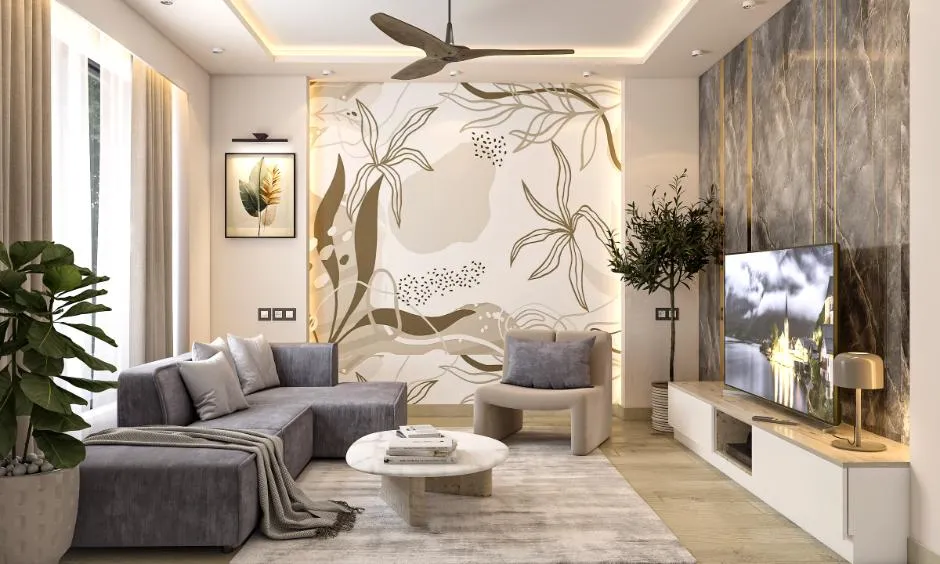
- Botanical Murals & Biophilic Prints: oversized foliage and mural scenes that bring nature inside.
- Tactile Papers embossing, suede-like finishes, and layered textures for touchable luxury.
- Dopamine Decor playful, saturated patterns used selectively (small walls, nooks).
- Refined Neo-Deco jewel tones, glossy accents, and stylized symmetry for upscale rooms.
Pro tip: pick one bold element (mural, textured wall), then anchor with neutral large pieces and complementary accents.
Living room wallpaper ideas by style (copyable examples)
Minimalist / Scandinavian
- Paper: pale neutrals, soft linear patterns, or linen textures.
- Furniture: pale wood, streamlined silhouettes.
- Result: airy, calm, collected.
Boho / Eclectic
- Paper: warm botanicals, block prints, layered textures.
- Furniture: rattan, mixed vintage, layered rugs.
- Result: curated, relaxed, layered.
Luxury / Sophisticated
- Paper: deep grasscloth, velvet-like finishes, metallic highlights.
- Furniture: velvet sofas, brass hardware, marble accents.
- Result: elegant, dramatic, tactile.
Modern Eclectic (Maximalist)
- Paper: large florals, bright murals, chintz revivals.
- Furniture: mixed eras, saturated fabrics.
- Result: joyful, personal, show-stopping.
Each of these looks can be achieved by selecting a dominant wallpaper and coordinating 2–3 accent textiles that repeat key colors from the paper.
Feature walls & styling tips
Creating a feature wall is the least risky, highest-impact approach.
Which wall to choose
- The wall behind the main sofa (classic).
- The wall you face when entering the room.
- Behind the fireplace or built-ins.
- A recessed alcove or built-in shelving back.
How to style it like a pro
- Choose a paper with contrast to the surrounding walls.
- Pull two to three colors into cushions, artwork, or a rug.
- Add directional lighting (wallwashers or picture lights) to emphasize texture.
- Keep adjacent walls neutral to let the feature wall breathe.
Mix paint and wallpaper: paint three walls and wallpaper the fourth to balance cost and impact.
Step-by-step installation & pro vs DIY
Prep & tools
Tools: plumb line, Spirit Level, utility knife, seam roller, smoothing brush, adhesive/paste (if needed), measuring tape, ladder, sponge, bucket.
Prep: remove outlet covers, patch holes, sand, clean, and ensure dry walls. Prime porous or stained walls.
Peel-and-Stick installation (DIY friendly)
- Measure and cut strips with 5–10 cm extra for trimming.
- Use a plumb line for the first Strip Alignment is everything.
- Peel a small top section of the backing, align, and smooth down while removing the backing.
- Smooth with a tool to remove bubbles; trim excess.
- Match pattern panel to panel; butt edges (don’t overlap unless instructions say so).
Traditional paste method
- Cut panels with pattern repeat allowance.
- Apply paste per manufacturer (to paper or wall).
- “Book” the paper, allow rest time, then hang from the top while matching patterns.
- Use a seam roller and clean excess paste immediately.
Grasscloth and some textiles: strongly recommended to hire a professional; seams and shading are tricky.
When to hire a pro
- Complex murals and pattern matching across widths.
- Grasscloth/fabric walls.
- Irregular or damaged walls requiring leveling.
Maintenance & cleaning (keep it simple)
- Dust textured surfaces monthly with a soft brush or vacuum attachment.
- For washable vinyl: mild dish soap + warm water on a soft sponge; always test in an inconspicuous spot.
- Grasscloth & textiles: avoid water; vacuum or dust only. For stains, contact the supplier or a restoration pro.
- Address lifting edges early (adhesive failure); small open seams can be glued with a thin adhesive and pressed.
Budget vs luxury: where to save and where to splurge
Save here
- Wallpaper a single feature wall instead of the full room.
- Use high-quality peel-and-stick for looks at lower cost.
- Buy samples or off-cuts for small panels or Framed Wallpaper Art.
Splurge here
- Custom murals and hand-printed artisan papers.
- Grasscloth or Fabric Wallpapers for a genuine tactile finish.
- Professional hanging for complicated seams and large pattern repeats.
Common mistakes & how to avoid them
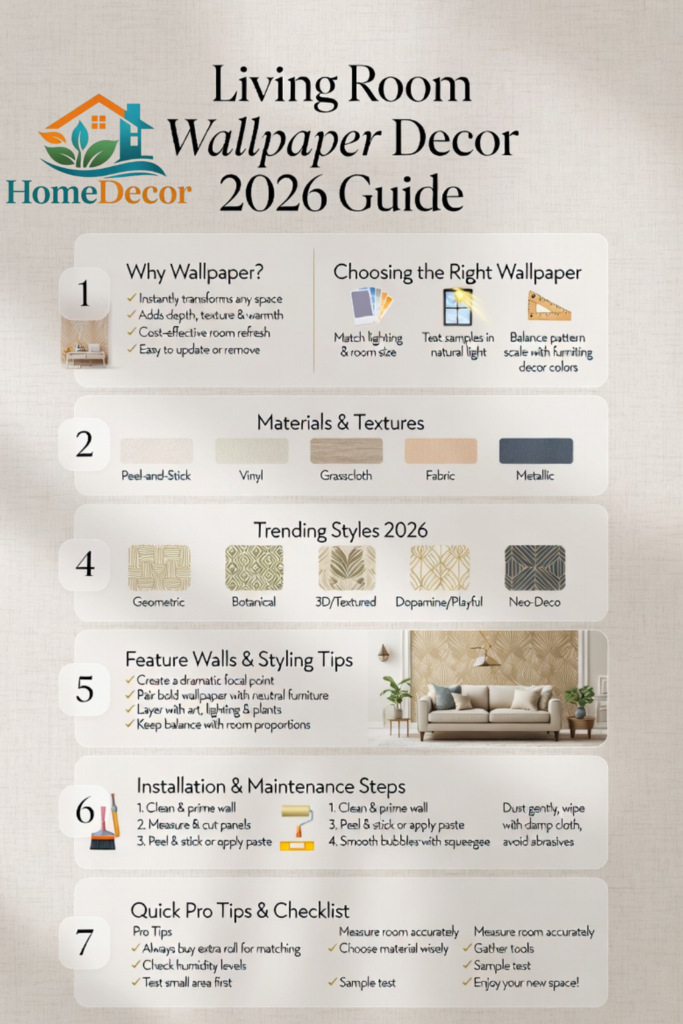
- Skipping surface preparation the single biggest cause of install failure.
- Picking a pattern too large for the room scale.
- Clashing multiple strong patterns in the same sightline.
- Not ordering extra for pattern repeat and repairs always adds 10–15%.
- Using delicate natural fiber wallpapers in high-humidity areas.
Smart & future-ready wallpaper ideas
- AR Previews: Many brands offer phone apps to visualize wallpaper on your wall before you buy use them to check scale and color in real light.
- Modular Digital Panels: Emerging systems let you change panels or swap digital artwork.
- Eco materials: Low-VOC inks, recycled fibers, and sustainably sourced natural papers are more common check certifications and manufacturer care notes.
Quick printable checklist & pro tips
Before buying:
- Measure twice (height × width) and account for windows/doors.
- Order samples and test in the room light for 48 hours.
- Buy +10–15% extra for pattern repeat and future repairs.
Before install:
- Patch, sand, and prime walls.
- Use a Plumb Line for the first panel.
- Number rolls in order and match patterns before cutting.
After install:
- Trim cleanly and install moulding where needed.
- Add lighting to show texture.
- Keep a Small Sample and leftover roll stored for repairs.
FAQs
A fresh look begins with thinking about how long it lasts, plus whether spills matter. Light rooms let bold textures shine, while small spaces often feel better with soft patterns. Grasscloth brings depth but needs care, unlike sturdy vinyl that shrugs off messes. Peel-and-stick works when walls can’t be altered, yet still demands attention. Furniture tones guide which surface fits best, even more than color alone.
One isn’t clearly superior. When it comes to feel under the hand or bold designs, paper takes the lead. Cost matters, though. So does how fast a room can be finished. Paint steps ahead there.
True enough, peel-and-stick wallpaper? Most folks handle it on their own without trouble. Sure, traditional paste versions might work at home – if you’ve got time to spare – though fabrics like grasscloth or detailed wall scenes tend to go smoother when experts step in.
Built to endure, top-grade wallpaper holds up a decade or more when looked after well. How long peel-and-stick lasts depends on what it’s made of, along with where it’s used.
Wipe things down every now and then. When it comes to vinyl, you can clean try gentle soap and a sponge that won’t scratch – check how it reacts before going further. With grasscloth or paper covered in fabric, keep liquids away.
Conclusion
Start with how you feel when walking into the room. A single roll might do what paint never could – shape memory through texture and hue. Instead of blending in, some walls pull focus like quiet Moments In Music. Texture breathes differently under morning light, while bold prints anchor scattered thoughts. Even neutral tones carry weight when placed where eyes rest longest.
Key Takeaways
A small room might feel tighter with bold patterns – light colors open things up instead. Sunlit spaces handle deeper tones well, while dim corners brighten under soft prints. Furniture sets the mood: vintage pieces lean into florals, modern frames prefer clean lines. Pull shades from your sofa or rug to tie it together quietly. Big walls need rhythm, so scale up prints without overwhelming the floor space. Choose what fits how you live – peel-and-stick if you like change, vinyl when long-term matters, grasscloth or fabric for a soft richness. A single accent wall can transform a room dramatically while staying balanced. Sometimes, less effort brings more visual punch than filling every surface. One colorful or textured side draws attention naturally instead of competing everywhere.
Start by checking a few pieces first. Get every measurement right before moving forward. Think through each step of putting things together so nothing goes wrong.
Start smart by mixing lower-cost picks with a few splurges – balance keeps things fresh but fair on your wallet. Style shows up when choices talk to each other, not scream.
A fresh look begins with a single choice – try samples first. Confidence grows when ideas meet real textures on your wall. Picture the space transformed, step by step. Small tests lead to bold changes. Your room reflects more than design – it shows what feels right. Colors settle differently in morning light. Let that sink in before deciding. Each decision shapes the mood. Live with a sample overnight. See how it shifts through hours. Trust what stands out quietly. A lived-in feel matters most. Wallpaper becomes part of daily moments. Choose one that fits how you move through the day.
