
Introduction
An Accent Wall Living Room design remains one of the most efficient ways to transform a space without renovating the entire room. One well-composed wall can introduce color, texture, depth, and character in a way that feels dramatic yet manageable. In 2026, the accent wall is still relevant, but the approach has matured. Designers are leaning away from harsh, isolated statement walls and moving toward warmer, more integrated surfaces that feel intentional, layered, and cohesive with the rest of the room. Better Homes & Gardens notes that accent walls are still popular, but the modern version is more subtle, more material-driven, and more connected to the overall interior story.
The biggest shift is this: the goal is no longer to create a wall that simply “stands out.” The goal is to create a wall that strengthens the room. That means the right finish, the right tone, the right scale, and the right relationship to furniture and lighting. A modern accent wall should feel like it belongs there from the beginning, not like it was added at the end. That is what makes it look polished, expensive, and current.
This guide rewrites the classic accent wall idea for 2026. It covers how to choose the best wall, which materials work best, what colors are leading the year, how to style a small living room, and how to avoid the mistakes that make accent walls feel disjointed. It also includes SEO-friendly ideas, design language, and practical layout guidance so the article works as both a reader resource and a pillar page.
What Is an Accent Wall in a Living Room?
An accent wall is one wall that looks intentionally different from the others because of color, texture, pattern, material, or architectural detail. In a living room, it typically acts as the visual anchor. The idea may have started with a single painted wall, but today it includes wood slats, limewash, plaster, wallpaper, molding, paneling, stone, built-ins, and even ceiling extensions that continue the design upward. Better Homes & Gardens has long framed accent walls as a flexible way to add personality, depth, and focal-point energy without redesigning every surface in the room.
Think of the accent wall as the room’s “main character.” It should not overpower the whole space, but it should guide the eye and clarify the layout. When done well, it makes the furniture feel more grounded, the room feel more finished, and the décor feel more deliberate. When done poorly, it can feel random, busy, or disconnected. That difference matters more than ever in 2026, because current design preferences reward cohesion and restraint as much as visual impact.
2026 Accent Wall Trends You Need to Know
The dominant design direction for 2026 is a move toward warmth, texture, and personality. Instead of cold minimalism, interiors are embracing layered neutrals, tactile finishes, rich earth tones, and statement surfaces that still feel composed. Better Homes & Gardens describes the 2026 living room style as more layered, more textural, and less dependent on loud standalone features. House Beautiful also points to ceilings as a growing statement surface, which suggests that feature walls are becoming more immersive and architectural rather than simply decorative.
The color direction for 2026 reinforces the same message. Sherwin-Williams selected Universal Khaki SW 6150 as its 2026 Color of the Year, describing it as a timeless neutral rooted in livability and longevity. Benjamin Moore chose Silhouette AF-655, a rich espresso-brown tone with charcoal notes. Behr named Hidden Gem N430-6A, a smoky jade blending blue and green for grounded depth and quiet sophistication. Together, those choices point to a palette that is earthy, refined, and comfortably expressive.
In practical terms, 2026 accent walls are trending toward:
Warm neutrals instead of icy whites
Earthy browns instead of flat grays
Smoky greens and blue-greens instead of harsh saturated tones
Natural texture instead of smooth emptiness
Integrated statement surfaces instead of isolated “one-wall” drama
That combination makes the room feel current without feeling trendy in a disposable way. The best 2026 accent walls look warm, layered, and architectural.
How to Choose the Right Accent Wall
1) Start with the true focal point
The strongest accent wall is usually the wall the eye already notices first: behind the sofa, behind the TV, or around the fireplace. Designers increasingly recommend choosing a wall that already has visual Importance rather than forcing attention onto a random side wall. The result should feel natural, not staged.
2) Respect the room shape and scale
A small living room needs a lighter, cleaner treatment. A medium room can handle more contrast. A large room can support richer color or deeper texture. Scale matters because a design that looks elegant in a spacious room can feel heavy in a compact one. Better Homes & Gardens and The Spruce-style guidance consistently emphasizes that light, scale, and proportion should shape the wall choice, not just personal preference.
3) Match the wall to the room’s style
A modern room may work best with fluted panels, matte paint, or geometric forms. A rustic or organic room may suit wood, limewash, or stone. A more luxurious room may benefit from paneling, marble-look surfaces, or a deep brown tone. The wall should extend the interior language already present in the room, not compete with it.
4) Test the lighting before you commit
Natural and artificial light can alter color dramatically. A sample that feels rich in the store may look muddy at home, and a subtle finish can become flat under weak lighting. Testing paint or wallpaper on the actual wall in morning, afternoon, and evening light is one of the simplest ways to avoid disappointment.
5) Decide what the wall should accomplish
Every accent wall should have a job. It may need to make the room feel taller, wider, calmer, warmer, or more expensive. Vertical lines can elongate the room. Horizontal emphasis can broaden it. Soft, earthy tones can make it feel restful. Texture can make it feel more sophisticated. Once the goal is clear, the design choices become much easier.
25+ Best Accent Wall Living Room Ideas by Style
1. Painted accent wall
A painted accent wall is still the simplest and most adaptable option. It is affordable, fast, and easy to refresh later. Deep green, navy, charcoal, warm khaki, and brown-based neutrals all suit the 2026 color direction.
2. Warm neutral accent wall
For timeless appeal, choose beige, khaki, mushroom, taupe, or soft clay. These shades feel calm, polished, and approachable.
3. Dark brown accent wall
Deep brown is back in a refined way. Benjamin Moore’s Silhouette AF-655 proves that brown can feel elegant, tailored, and modern rather than dated.
4. Sage green accent wall
Sage is a dependable color for a peaceful living room. It works well with wood, cream, black accents, and soft textiles.
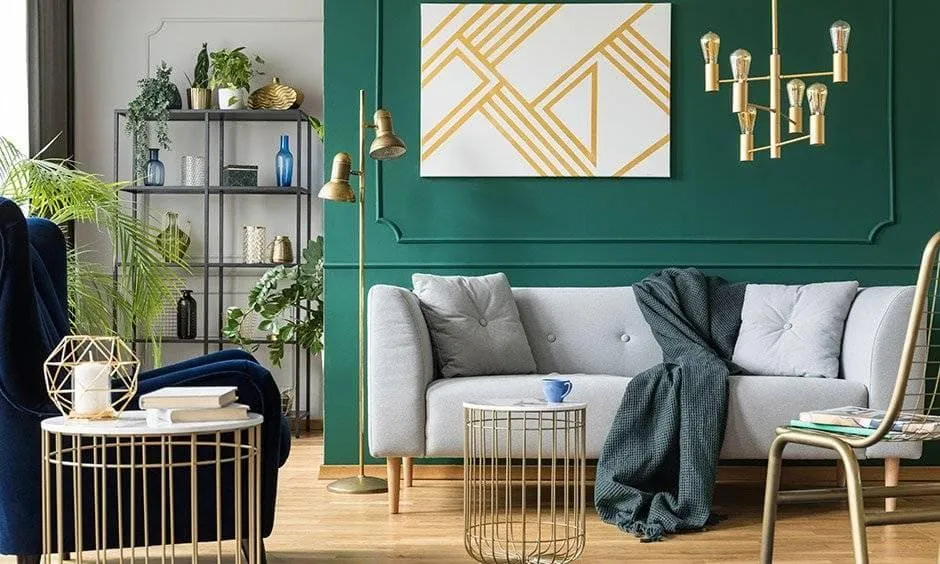
5. Deep teal accent wall
Deep teal adds richness and visual energy without losing sophistication. It performs especially well behind a sofa or fireplace.
6. Terracotta accent wall
Terracotta brings warmth, groundedness, and a relaxed, organic feel. It is ideal for homes leaning into natural materials and softer styling.
7. Limewash accent wall
Limewash creates movement, softness, and subtle variation. It suits a room that wants depth without shouting for attention. Better Homes & Gardens’ texture-forward design coverage aligns strongly with this kind of finish.
8. Plaster finish accent wall
Plaster gives the room a handcrafted, tactile, slightly artisanal feel. It is a strong option when you want refinement without a bold palette.
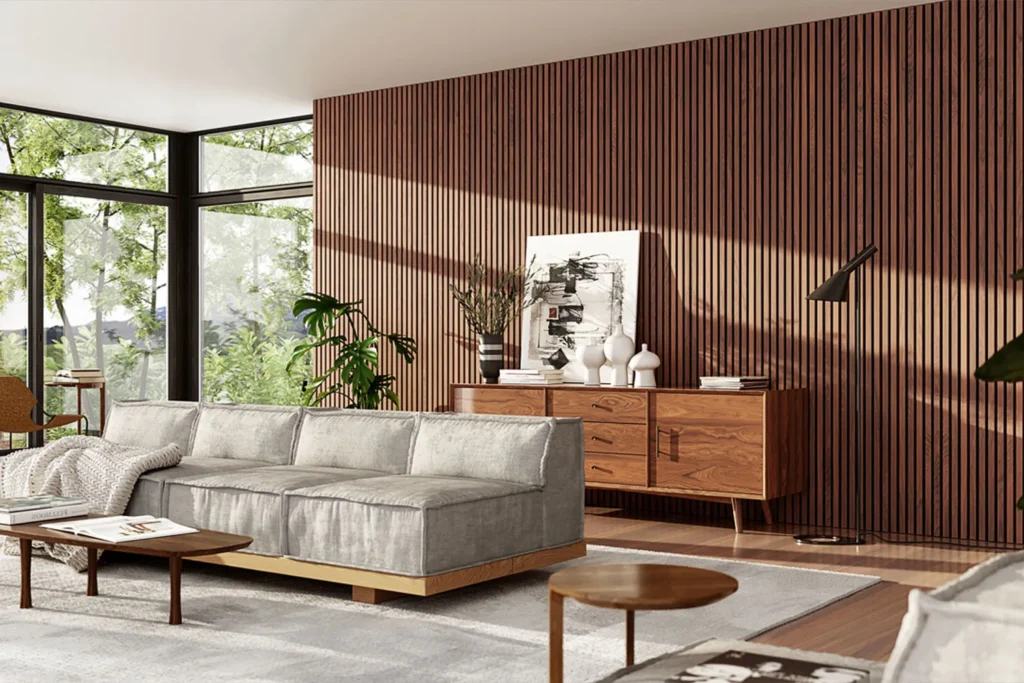
9. Wood slat accent wall
Vertical wood slats visually lift the room and add warmth at the same time. They are one of the clearest expressions of the 2026 move toward natural texture and architectural detail.
10. Fluted panel wall
Fluted panels create a soft three-dimensional rhythm. They feel custom, elegant, and especially suitable for modern luxury interiors.
11. Marble-look accent wall
Marble gives instant polish and a high-end mood. It works best when the rest of the room stays visually quiet, so the wall remains the centerpiece.
12. Brick accent wall
Brick adds character, warmth, and a slightly lived-in look. It suits industrial, rustic, loft-style, and eclectic homes.
13. Stone accent wall
Stone brings gravitas and permanence. It works beautifully near a fireplace or media zone when the goal is dramatic structure.
14. Wallpaper mural wall
A mural turns the wall into a large-scale artwork. It is ideal for expressive homeowners and rooms that can support a bold visual narrative.
15. Patterned wallpaper wall
Patterned wallpaper is one of the fastest ways to create personality. Keep the scale in sync with the room size: larger patterns feel more intimate, while smaller patterns can feel lighter.
16. Geometric accent wall
Geometric forms add energy, modernity, and a custom-designed feel. They work especially well in contemporary living rooms.
17. Color-block accent wall
Color blocking creates definition without covering the whole wall. It is useful in smaller spaces where a fully dark wall might feel too dense.
18. Gallery wall accent wall
A curated gallery wall can function as the accent itself. The key is consistent spacing, a considered palette, and a strong sense of composition so it feels collected rather than cluttered.
19. Picture molding the wall
Picture molding adds elegance and structure. It gives a room a classic architectural layer and works especially well with soft paint or wallpaper panels.
20. Wainscoting wall
Wainscoting creates a finished, grounded feeling. It suits traditional, transitional, and refined casual interiors.
21. Beadboard accent wall
Beadboard brings charm and comfort. It is a friendly choice for homes that want character without strong drama.
22. Shiplap accent wall
Shiplap still has a place when used carefully. It feels best in coastal, farmhouse, and relaxed casual rooms.
23. Built-in shelving wall
A full wall of built-ins can serve as the accent itself. Paint the shelf backs in a deeper hue or finish them with wallpaper to make the wall feel more dimensional. Modern design coverage increasingly treats built-ins as part of the feature-wall family.
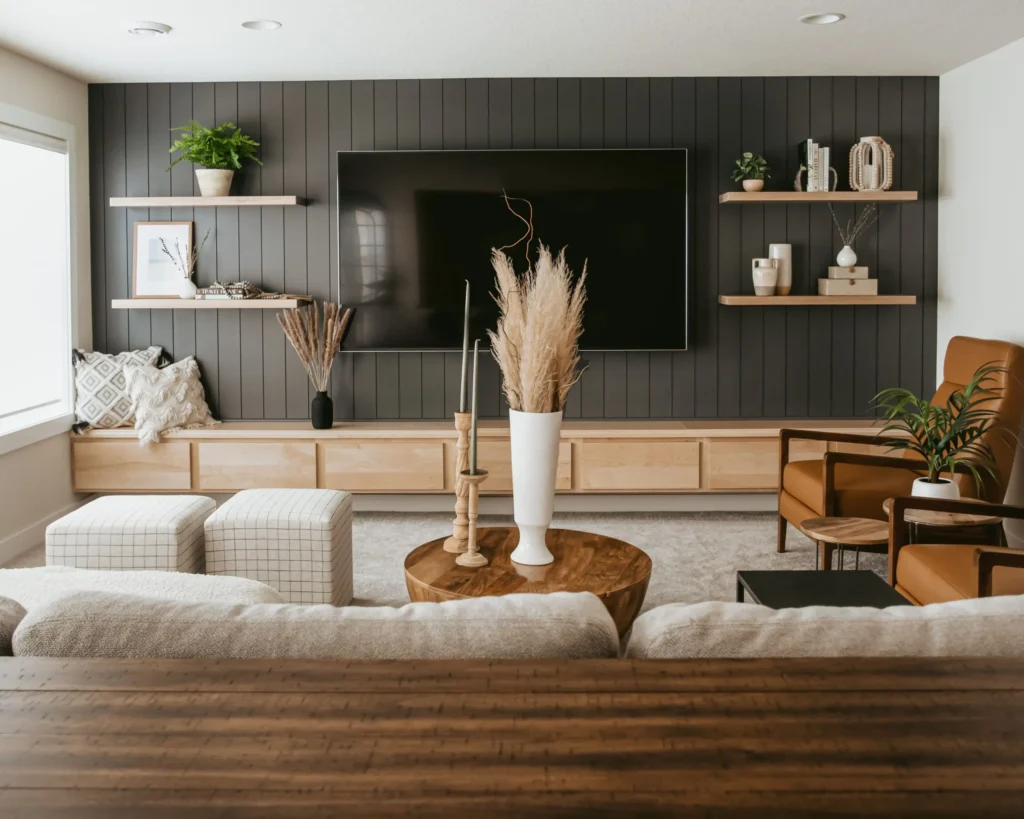
24. TV feature wall
The accent wall with TV is one of the most functional versions of the idea. Hidden wires, centered placement, and a strong backdrop help the TV feel integrated rather than added as an afterthought.
25. Fireplace accent wall
A fireplace is already a natural focal point, so it is one of the easiest places to anchor an accent wall. Stone, paneling, tile, or a deep paint tone can all reinforce the feature.
26. Ceiling-connected accent wall
In 2026, the wall may continue upward into the ceiling for a more immersive effect. House Beautiful’s 2026 coverage of the “fifth wall” supports this move toward wraparound, architectural statements.
Accent Wall Ideas for Small Living Rooms
A small living room accent wall should expand the room visually, not compress it. That usually means lighter colors, slimmer patterns, and more vertical movement. Light tones can make a room feel airier, while vertical lines help the eye perceive more height. Better Homes & Gardens and other design guidance repeatedly point to lightness, balance, and restraint as the safest approach for compact rooms.
For smaller living rooms, the best choices often include:
Soft beige
Warm white
Pale sage
Light taupe
Thin vertical wood slats
A small-scale wallpaper pattern
One large artwork instead of many tiny pieces
What to avoid? Heavy dark stone, oversized prints, too many colors, and layers of décor that compete with each other. In a compact room, the accent wall should create structure, not visual noise. Texture is usually better than chaos.
Best Accent Wall with TV Layouts
The accent wall with TV has to do two jobs at once: frame the screen and keep the room looking polished. A successful TV wall blends function and style.
| Layout | Best For | Why It Works |
| Dark painted wall behind the TV | Modern interiors | Helps the screen recede and look cleaner |
| Wood panel TV wall | Warm contemporary rooms | Softens the TV’s hard lines |
| Fluted panel TV wall | Luxury rooms | Feels bespoke and high-end |
| Built-in shelf TV wall | Family rooms | Adds storage and gives the TV a frame |
| Stone TV wall | Large rooms | Creates a dramatic focal point |
The best TV walls keep the screen centered, hide cables, and give the wall enough visual texture to feel finished. If the television is the main feature, the backdrop should support it rather than fight it.
2026 Color Guide for Accent Wall Living Room Designs
The strongest 2026 accent wall colors are grounded, richer, and more livable than loud novelty shades. The major paint brands are signaling a clear move toward comfort, warmth, and sophistication. Sherwin-Williams’ Universal Khaki is positioned as a practical, essential neutral. Benjamin Moore’s Silhouette offers deep espresso and charcoal richness. Behr’s Hidden Gem brings smoky jade depth and serenity.
| Color / Shade | Mood | Best Use |
| Universal Khaki | Calm, warm, timeless | Large walls, neutral rooms, soft modern homes |
| Silhouette AF-655 | Rich, elegant, dramatic | Luxury rooms, panel walls, moody focal points |
| Hidden Gem | Fresh, deep, stylish | Bold accent wall with modern furniture |
| Sage green | Natural, restful | Small and medium rooms |
| Terracotta | Cozy, earthy | Boho, organic, relaxed rooms |
| Deep teal | Sophisticated, bold | TV wall, fireplace wall, art wall |
| Warm beige | Easy and flexible | Nearly any living room |
| Charcoal gray | Strong, modern | High-contrast feature wall |
The best color is the one that supports the emotional goal of the room. For a quiet space, use warm neutrals. For a richer room, use darker earth tones.
Paint vs Wallpaper vs Wood Panels
This is one of the biggest decision points in the project. Each option gives a different aesthetic, budget requirement, and level of effort.
| Feature | Paint | Wallpaper | Wood Panels |
| Cost | Low | Medium | Higher |
| Installation | Easy | Moderate | More complex |
| Texture | Low | Medium | High |
| Style impact | Simple | Patterned | Premium |
| Durability | Medium | Medium | High |
| Best for | Quick refresh | Pattern lovers | Custom-looking walls |
Paint is ideal when you want flexibility and speed. Wallpaper is ideal when you want print, pattern, or visual rhythm. Wood panels are ideal when you want a more architectural, elevated result. In 2026, many designers are leaning toward texture-rich finishes because they feel more complete than a plain color block. That preference is visible in broader trend coverage that emphasizes patina, layered surfaces, and quieter luxury.
Budget Guide for Accent Wall Living Room Projects
A beautiful accent wall does not need a large budget. The smartest projects spend on the finish that will have the biggest visual payoff.
| Budget Level | Estimated Cost | Best Options |
| Low budget | $50–$200 | Paint, peel-and-stick wallpaper, tape designs, and simple molding |
| Medium budget | $200–$800 | Wood slats, textured paint, wallpaper, beadboard |
| Luxury budget | $800+ | Marble, custom panels, stone, built-ins, backlit details |
If your budget is limited, do not imitate a luxury wall with poor-quality materials. Choose one clear idea and execute it cleanly. A simple painted wall with excellent lighting and balanced styling often looks more impressive than a complicated wall that feels unfinished.
Designer Styling Rules That Make the Wall Look Expensive
1) Use the 60-30-10 rule
The 60-30-10 rule keeps the room balanced. One color dominates, one supports, and one accents. It is a simple way to create visual harmony without overcomplicating the palette.
2) Use the rule of three
Odd-number groupings often feel more natural to the eye. Group candles, frames, pillows, or decorative objects in threes when possible. The result usually feels more curated and less rigid.
3) Keep the palette tight
A successful accent wall should not fight with too many competing colors. Limiting the room to a small, controlled palette keeps the design clear and elegant.
4) Let furniture support the wall
A dramatic wall needs calm furniture. A lighter wall can support bolder furnishings. The relationship should be balanced, not competitive.
5) Use texture to carry the design
Sometimes the strongest wall is not the loudest one. It is the most tactile one. Limewash, plaster, paneling, wood, and wallpaper with subtle movement can create a richer room than a flat, bright color ever could. That matches the 2026 design direction toward texture and layered depth.
Room Layout & Space Planning Tips
A good accent wall works with the furniture plan, not against it. The sofa should usually face the accent wall or at least relate to it visually. If the wall is behind the TV, the seating should create a clear viewing zone. If the wall is behind the sofa, the rest of the room still needs visual balance through art, lighting, or rugs.
Leave breathing room around the feature wall. Do not crowd it with tiny objects, too many frames, or small décor pieces that dilute the effect. One oversized artwork, one mirror, a structured shelving unit, or a limited set of accessories usually works better than a dozen mismatched items. The stronger the wall treatment, the simpler the styling should be.
Lighting & Furniture Pairing Tips
Lighting is not optional; it is part of the design system. Wall sconces, downlights, LED strips, table lamps, and floor lamps can all change how the wall reads. Texture becomes visible when light touches it correctly, and a beautiful wall can look flat if the room is underlit. This is why sample testing in different lights remains essential.
Furniture should reinforce the mood of the wall. A neutral sofa can calm a dark accent wall. A glass or acrylic coffee table can lighten a heavy backdrop. A textured chair can echo a textured surface. The goal is not to make every piece match. The goal is to make every piece cooperate.
Budget-Friendly DIY Accent Wall Ideas
These are easy, practical, high-impact DIY directions:
Painter’s tape geometric design
Peel-and-stick wallpaper
DIY wood slats
Simple molding grid
Painted arch behind the sofa
Two-tone wall with a clean split line
Mini gallery wall with one strong theme
These ideas work because they deliver architectural presence without demanding a full remodel. Better Homes & Gardens has repeatedly shown that paint, wallpaper, molding, paneling, and built-in treatments can all produce strong accent-wall results when the composition is deliberate.
Premium & Luxury Accent Wall Ideas
For a more elevated living room, these options stand out:
Marble slab wall
Backlit onyx look
Velvet upholstered panel wall
Walnut wood wall
Custom fluted panels
Stone fireplace wall
Full-wall built-ins with integrated lighting
Luxury walls feel expensive when the materials look real, the edges are crisp, and the lighting is carefully handled. The 2026 paint direction from Sherwin-Williams, Benjamin Moore, and Behr suggests that these richer finishes pair especially well with warm neutrals, wood grain, and smoky statement colors.
Common Mistakes to Avoid
1) Choosing a random wall
A random wall usually looks random. Choose a wall with natural importance.
2) Using too many colors
Too many shades make the room feel scattered. Keep the palette controlled.
3) Ignoring lighting
A wall can look amazing in a sample and disappointing at home if the lighting is wrong.
4) Over-decorating
If the wall finish is already strong, the décor should be restrained.
5) Using the wrong scale
Large patterns in small rooms can overwhelm. Tiny patterns in large rooms can disappear.
6) Making the wall feel incomplete
An accent wall should look deliberate from edge to edge. Anything that feels half-finished weakens the result. Current design writing emphasizes that accent walls now work best when they feel intentional, elevated, and harmonized with the rest of the room.
Maintenance, Care & Durability Tips
Painted accent walls are the easiest to maintain. Wallpaper needs more care around moisture and lifted edges. Wood surfaces should be dusted and inspected for wear. Stone and panel walls need occasional cleaning to preserve their finish. LED details should be checked regularly so the design continues to read as intended.
Durability matters because the best accent wall is not only beautiful on installation day. It should still feel strong after the room has been lived in. That is why livable neutrals and long-lasting materials are so central to the 2026 palette direction. Sherwin-Williams explicitly frames Universal Khaki around longevity and practicality, which is a useful mindset for wall design, too.
Smart & Future-Ready Accent Wall Ideas
The future of accent walls is functional as well as visual. The wall can now carry hidden storage, acoustics, smart lighting, and built-in zoning in open-plan spaces. House Beautiful’s coverage of the ceiling as a statement feature also suggests that future wall treatment may expand upward and become more immersive.
Future-ready ideas include:
LED-integrated wall panels
Acoustic panels for sound control
Hidden storage walls
Wallpapered built-ins
Ceiling continuation for a more unified room
Color-drenched corners for smaller zones
These solutions are especially useful in open layouts because they define space without adding new partitions. That makes them practical, modern, and visually smart.
Quick Pro Tips
Test paint samples on the actual wall before choosing the final color.
Check the wall in morning, afternoon, and evening light.
Use one strong feature instead of multiple competing ideas.
Keep small rooms lighter, cleaner, and more breathable.
Match décor to the wall’s mood instead of forcing contrast everywhere.
FAQs
The best wall is the natural focal point—usually behind the sofa, the TV, or the fireplace. A strong accent wall should feel planned, not random.
Trending colors include sage green, terracotta, deep teal, warm beige, Universal Khaki, Silhouette AF-655, and Hidden Gem. These shades reflect the 2026 move toward warmth, depth, and natural-looking interiors.
Yes, but they are evolving. Designers are moving away from the old one-bold-wall approach and leaning into more textured, intentional, and immersive statement features such as wood, limewash, wallpaper, built-ins, and ceiling continuation.
Use light colors, vertical lines, smaller patterns, mirrors, and simple furniture. Avoid heavy, dark textures and oversized prints.
Wallpaper adds more pattern and texture, while paint is cheaper and easier to change. The better choice depends on budget, room size, and the mood you want.
Conclusion
A strong accent wall living room design is not about adding more for the sake of it. It is about making one thoughtful choice that improves the whole room. In 2026, the most successful accent walls feel warmer, more textural, and more connected to the space around them than the older “Single Bold Wall” formula. They look modern because they are layered. They feel stylish because they are balanced. And they feel expensive because they use color, light, and material with intention. The best result is not a wall that simply stands out. It is a wall that helps the entire room look better.
