
Introduction
Lounge Room Wall Lights can transform an ordinary room into a space that feels warm, composed, and beautifully finished. A well-chosen wall light doesn’t just brighten a spot. Through subtle glow, it shapes mood, carves out areas, eases dark corners, lifts ease of being, and settles the eye across the room. With today’s shared spaces pulling double duty, illumination along the walls offers smart shifts in function – no sledgehammer needed.
Lights on the walls of your living space do more than just glow. Picking the right ones means understanding their role first, then seeing how they fit with the room’s look and dimensions. Instead of guessing, think about height, shade direction, warmth of light, plus whether brightness suits daily use. Position matters too – too high or too low changes everything. Soft white often feels better, but cooler tones might help if tasks are performed there. Brightness levels depend on lumens, while control comes from properly fitted dimmer switches. Tiny rooms need scaled-down styles; large areas allow bolder choices without crowding sightlines. Fancy materials elevate design in luxury zones. Even with tighter budgets, simpler builds still deliver function and form when selected wisely. A side-by-side review helps sort options fast. Mistakes like ignoring switch placement or selecting incorrect bulb hues can ruin even well-meaning setups. Questions pop up – these get answered straight. Wrap it all together using a structure built for clarity, one that holds steady from start to finish.
What Are Lounge Room Wall Lights?
Wall lights in living rooms are mounted directly to vertical surfaces rather than hung from above or placed on furniture. These fixtures often provide a soft glow, focused brightness, or highlight specific areas. By actually shaping how light fills the space, they reduce dependence on a single main ceiling lamp. This setup makes sense, as people do different things here from morning through evening. The variety of uses means one type of illumination rarely fits all moments.
A space meant for sitting often does much more than that. By day, it might hold a person lost in pages, then shift to screen time once darkness falls. When visitors show up, conversation fills the corners. Later on, silence returns, offering calm. Mounted lights on walls adapt quietly to each change. They avoid crowding floors with tall stands or bright ceiling floods. Subtlety arrives through their glow. Order forms without effort. Comfort stays present, steady.
Wall lights bring more than just function to a lounge space. Sometimes quiet, sometimes bold, they shape how the walls feel and look. Minimal designs sit close to the surface, while ornate ones catch the eye like art. Whether slim strips or detailed fixtures, options span many styles. This mix helps them fit smoothly into nearly any current living area setup.
.
Why Lounge Room Wall Lights Matter
Wall lights matter because they support layered lighting, which makes a lounge feel balanced. A room lit only from the ceiling often feels flat and overly bright. A room lit only by lamps can feel patchy. A thoughtful combination of ceiling fixtures, wall lights, and smaller accent sources creates depth, comfort, and flexibility.
Lounge room wall lights are especially valuable because they:
- Save space on floors and side tables
- help create a calmer evening mood
- reduce dark corners and empty-wall gloom
- Add architectural rhythm to the room
- support reading and relaxed tasks
- highlight art, shelving, mirrors, or a fireplace
- make the room feel more polished and intentional
They also improve how a room feels psychologically. Light from different heights makes a room appear more inviting and human. It introduces visual layering, which helps the eye move through the space naturally. That is why wall lights are so often recommended in modern interior design: they not only brighten a lounge, but also shape it.
Types of Lounge Room Wall Lights
Choosing the right type of wall light starts with understanding what each style does best. The goal is not only to find a beautiful fit, but also to match the fit to the job you need it to do.
LED Wall Lights
On walls where light needs to feel just right, LED fixtures appear quietly yet clearly. Efficiency meets long life without trying too hard. Their look fits today’s rooms – thin shapes, straight edges, surfaces that don’t shout. Where design leans forward, these lights keep pace with quiet confidence. Dimming ability appears often, adding calm when brightness should fade. Lounge spaces benefit simply by having options that adapt.
LED lighting makes sense when lasting quality matters. Because they use less power, bills stay down over time. For homeowners, these lights mean fewer replacements and a tidy appearance with minimal effort. A warm glow fits cozy corners just as sharp lines shape modern spaces; how they look changes only by how they are built.
Adjustable Arm Wall Lights
A single swing of the lamp arm changes everything. Where it points decides how the room feels. Think beside your favorite seat, near a couch edge, or tucked into an unused nook. Light bends across pages or surfaces without requiring additional stands. Moving parts mean control shifts with what you’re doing. Fixed fixtures remain stationary, while these reach out differently each time.
Perfect if you read often or need light that keeps up with shifting routines. Not quite a desk lamp, yet it throws light just where needed – fixed to the wall, out of the way.
Decorative Wall Sconces
Lights on walls bring style just as much as brightness. Though turned off, they still shape how a space feels in living areas. Some look old-fashioned, others feel fresh, detailed, bold, or quiet. Their presence matters beyond giving light. Design choices reflect personality, whether they are glowing or not.
Wall lights like these stand out intentionally, meant to catch the eye rather than fade into the background. Where a room leans toward polished or refined, such fixtures add presence without trying too hard. Think grander seating areas or interiors where walls play a role in the overall look – they thrive there.
Picture Lights and Accent Lights
Lighting in the above pictures often highlights what matters most. A shelf gains presence when lit from above, not from the side. Mirrors reflect light differently when the light comes in at an angle. Framed art wakes up under focused beams. Walls change mood based on the brightness around them. Specific spots get importance through careful placement of light sources. Rooms start feeling intentional once key objects stand out clearly.
Lounges with standout art pieces often benefit most from focused light placement. Where broad illumination can obscure details, targeted beams draw focus naturally. A single fixture can shape how a space feels – drawing sight where it matters. Instead of washing everything in glow, selective brightness gives depth without effort.
Wall Washers and Uplighters
Light glides along walls when using wall washers or uplighters, providing a gentle glow rather than sharp spots. For lounges where mood matters more than function, this approach stands strong. Spaces begin to breathe, appearing wider, quieter, with structure that draws the eye.
Bright light bouncing off surfaces softens sharp shadows, making spaces feel more balanced. A smooth, even glow across bare plaster transforms emptiness into something quietly striking. Shadows fade gently instead of cutting hard lines. Subtle illumination draws attention without shouting. Blankness becomes depth when lit just right. Harsh spots disappear under even washes of brightness. Attention shifts slowly rather than snapping suddenly. Gentle radiance keeps eyes moving softly.
Shade Wall Lights
Light that slips through a Fabric Cover Tends to settle gently across a room. Because it spreads slowly, the edges blur instead of cutting sharply into corners. Warmth builds not by brightness but by how softly shadows form. Rooms meant for sitting, lingering, or gathering often benefit from this kind of hush. Traditional spaces find balance here – where texture speaks louder than glare.
A calm room usually benefits from simpler lighting choices. When comfort matters more than impressing guests, soft glow fixtures make sense. Homey spaces tend to shine with subtle touches – like a fabric-shaded wall lamp adding warmth without drawing attention.
How to Choose the Best Lounge Room Wall Lights
The best way to choose lounge room wall lights is to think in this order: purpose first, style second, technical details last. When you start with the room’s function, the rest becomes much easier.
Start With the Purpose
Ask yourself what the wall light is supposed to do.
- Do you need mood lighting?
- Do you need a reading light?
- Do you want to highlight artwork?
- Do you want to soften a dark wall?
- Do you want a decorative feature?
- Do you need a light for the TV area?
The answer may be more than one of these. If so, a dimmable fixture or a layered lighting setup is usually the smartest solution. A lounge should be adaptable. It should not remain stuck at a single brightness level or mood.
Match the Light to the Room Size
Scale matters. A tiny wall sconce can disappear in a large lounge, while a large decorative fitting can overwhelm a small room. In compact spaces, choose cleaner and slimmer forms that do not dominate the wall. In larger lounges, you can use larger fixtures, paired sconces, or stronger design statements.
The best results usually occur when the fixture is proportionate to the surrounding furniture and architecture. A wall light should look as if it belongs there, not as if it were added as an afterthought.
Choose the Right Colour Temperature
For most lounge room wall lights, warm white is the best choice. It creates a more relaxed, inviting feeling than cool white. A warmer tone is especially important in rooms where people unwind, watch TV, or socialise in the evening.
Warm lighting supports a cosy mood and makes finishes such as wood, brass, fabric, and textured paint look richer. Cool white can be useful in some settings, but in a lounge, it often feels too clinical or too bright.
Think Carefully About Dimmers
Dimmers are one of the most useful upgrades for lounge lighting. They allow the room to shift from bright and practical to low and relaxed with a single adjustment. That flexibility makes a huge difference in a room that serves multiple functions.
Dimmers also help you avoid overlighting the room. Many living spaces look better slightly softened than fully exposed. A dimmer lets the room breathe.
Consider Finish and Material
The finish of the wall light matters almost as much as the light itself. Brass and gold tones add warmth and elegance. Black adds contrast and a modern character. Glass adds lightness and visual clarity. Fabric shades create softness. Wood, rattan, and other natural materials create a more relaxed, organic mood.
A good finish should support the rest of the room rather than compete with it. If your lounge already has a strong style direction, the wall light should reinforce that direction.
Best Placement and Height Tips for Lounge Wall Lights
Placement is one of the most important factors in wall lighting. A beautiful fixture can still look wrong if it is installed too high, too low, too close to another feature, or in a position that causes glare. Good placement makes the difference between average lighting and elegant lighting.
A Simple Height Guideline
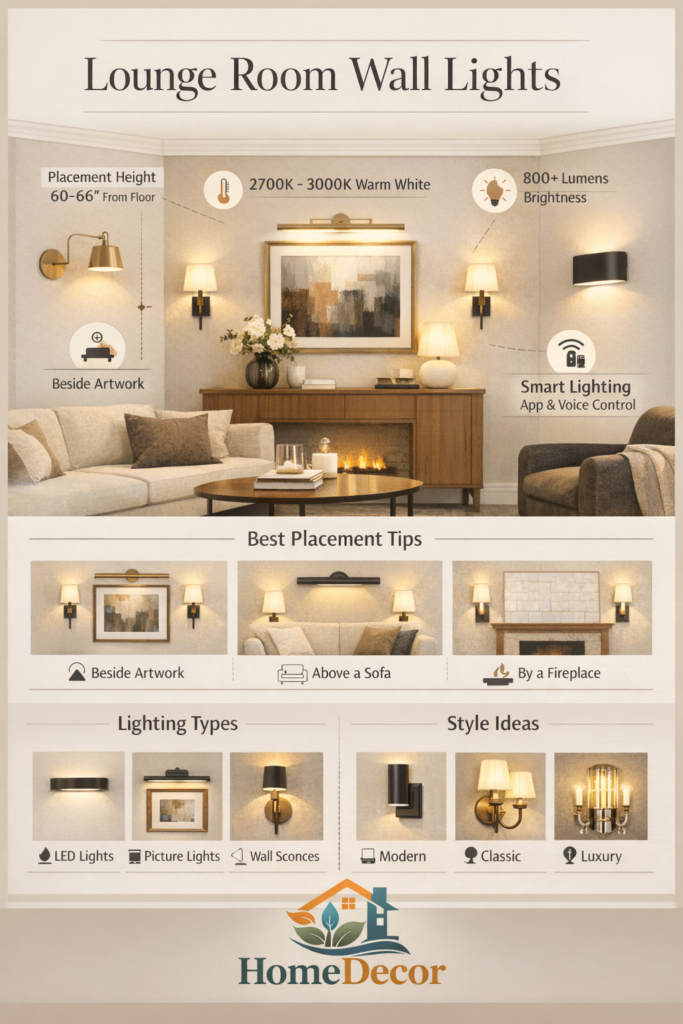
A common starting point for lounge wall lights is at eye level, typically 60 to 66 inches above the floor for general sconces. This range is not a strict rule, because ceiling height, furniture placement, and the purpose of the light all matter. Still, it is a reliable starting point for many spaces.
The aim is to keep the fixture connected visually to the room’s human scale. It should feel integrated with the seating area rather than floating awkwardly too high above it.
For Reading Areas
If the wall light is meant for reading, it often needs to be positioned lower and more precisely. The beam should fall naturally onto the book or magazine without shining directly into the eyes. Adjustable arm lights and directional sconces are especially useful here.
Reading lights should work with the person seated beneath them, not against them. That means considering chair height, sofa depth, and the placement of the head and shoulders relative to the fixture.
For Decorative Pairs
Symmetry works beautifully in many lounge settings. Two matching wall lights can frame a fireplace, mirror, feature wall, piece of artwork, or shelving arrangement. This creates visual balance and a finished, intentional look.
Paired lighting is especially strong in classic or formal lounges. It creates structure and order, which makes the room feel carefully designed.
For Asymmetrical or Relaxed Layouts
Not every lounge needs perfect symmetry. Modern or creative interiors often look better with a slightly more relaxed composition. In those rooms, a single wall light or an intentionally offset pair may feel more natural.
The key is always intention. Even asymmetry should feel deliberate. If it looks random, it usually feels wrong.
Avoid Glare
One of the biggest mistakes in wall-light placement is allowing exposed bulbs or direct beams to hit the eye line. A fixture can be stylish and still uncomfortable if the light is too direct. Shade wall lights, uplighters, and properly angled sconces help mitigate this problem.
Lounge Room Wall Lights by Interior Style
The best wall light is not always the most expensive or the brightest. It is the one that matches the room’s visual language. Style compatibility matters because wall lights are part of the room’s overall composition.
Modern Lounge Wall Lights
Modern lounges often suit slim LED wall lights, linear forms, matte black finishes, and simple geometry. These fixtures feel clean and controlled. They work well in rooms with minimal clutter and restrained decoration.
A modern wall light should support the architecture rather than distract from it. Simplicity often works best here.
Classic and Traditional Lounge Wall Lights
Traditional lounges often suit shaded sconces, brass finishes, curved arms, and more decorative forms. These styles pair well with moulding, fireplaces, built-in cabinetry, and classic furniture.
The softness of a traditional wall light adds warmth and familiarity. It can make a formal room feel more welcoming without losing elegance.
Luxury Lounge Wall Lights
Luxury lighting is about material quality, proportion, and quiet confidence. High-end wall lights often use brass, bronze, stone, glass, or carefully crafted mixed materials. Sculptural forms are also common in premium interiors.
In luxury spaces, the wall light should feel like part of the room’s architecture. It should appear intentional, balanced, and calm. The better the fixture feels integrated into the room, the more premium the result usually appears.
Small Lounge Wall Lights
In smaller lounges, compact wall lights are often the smartest choice because they save space and reduce visual clutter. They keep the room open and airy while adding softness and depth.
A small lounge benefits from fittings that are modest in scale but strong in function. The goal is to add atmosphere without overcrowding the wall.
Budget Lounge Wall Lights
Budget-friendly wall lights can still look great if they are well chosen. A simple LED sconce, a plug-in option where appropriate, or a clean black, white, or brass finish can work beautifully when positioned properly.
The most important factor is not the cost of the fixture alone. The question is whether the fixture meets the room’s lighting needs in a visually pleasing way. Good placement can elevate even a modest light.
Lighting Ideas for Different Lounge Uses
A lounge typically includes several smaller zones, each requiring a different lighting strategy. That is why wall lights are so useful: they can support different functions within the same room.
For Reading Corners
Use adjustable-arm wall lights or directional sconces beside a chair, at the end of a sofa, or on a window seat. These give focused light without occupying floor space. They are ideal for anyone who reads regularly.
A reading light should feel local and practical. It should light the page, not the whole room.
For TV Areas
The best TV lighting is usually soft and balanced. Strong direct light can compete with the screen and make the room feel tiring. Warm wall lights with dimming controls are often the best fit because they provide an ambient atmosphere without visual strain.
The goal in a TV area is to reduce contrast and maintain comfort. The room should feel calm enough for relaxation.
For Feature Walls
Feature walls benefit from accent lighting, picture lights, or carefully placed sconces. These help draw the eye to the wall’s texture, artwork, shelving, or architectural details.
This approach works especially well when you want one part of the room to feel special. A well-lit focal point can define the entire lounge.
For Open-Plan Living Areas
Open-plan spaces need a coordinated lighting strategy. Wall lights should complement ceiling lights, floor lamps, and table lamps rather than replace them entirely. Each layer defines a distinct zone.
In open-plan rooms, wall lights can help separate lounging, dining, and circulation areas. That makes the whole space feel more organised and easier to use.
Comparison Table: Which Lounge Wall Light Should You Buy?
| Buyer Need | Best Choice | Why It Works | Watch Out For |
| Want low running costs | LED wall light | Efficient, modern, and long-lasting | Avoid harsh, cool white |
| Need a reading light | Adjustable arm sconce | Directs light exactly where needed | Poor placement can cause glare |
| Want décor impact | Decorative wall sconce | Adds style even when switched off | Can overwhelm a small wall |
| Want to show art | Picture light | Highlights a focal point neatly | Needs careful alignment |
| Want a cosy mood | Shade wall light | Softens brightness and glare | May not be enough on its own |
| Want a modern finish | Minimal linear light | Clean and contemporary | Can feel cold if too bright |
This comparison makes one thing clear: the best wall light is the one that meets the room’s actual needs. A good fixture solves a problem. A great fixture solves the problem and enhances the room’s style.
Budget-Friendly Lounge Room Wall Lighting Ideas
Good lounge lighting does not need to be expensive. In many cases, the biggest improvement comes from better planning, better placement, and better control rather than a more costly fitting.
Smart Budget Moves
Use one well-chosen pair of wall lights instead of many scattered fittings.
Choose LED bulbs to reduce long-term energy use.
Use dimmable fittings where possible.
Stick with timeless finishes such as black, brass, white, or glass.
Combine wall lights with one floor lamp or table lamp for balance.
A modestly priced fixture can still look refined if it is the right shape, the right scale, and installed in the right position.
The Biggest Budget Mistake
The biggest mistake is buying a cheap wall light that looks attractive online but performs badly in the room. A poorly directed beam, a harsh colour tone, or a bad scale can ruin the effect. It is often better to choose a simpler, well-functioning fixture than a stylish one that causes discomfort.
Good lighting is not only about the product. It is also about the experience it creates in the room.
Premium and Luxury Lounge Wall Lighting Ideas
Luxury lounge lighting is not just about price. It is about proportion, finish, softness, and control. A premium wall light feels calm, refined, and well integrated into the interior.
What Makes a Wall Light Feel Premium?
- high-quality materials
- strong design proportion
- soft diffusion rather than harsh light
- precise installation
- compatibility with dimmers or smart controls
- a finish that suits the room’s palette
Luxury design often relies on subtlety. A wall light should not scream for attention. It should contribute to the atmosphere with confidence and restraint.
Luxury Design Tip
In a premium lounge, the wall light should feel as though it belongs to the room from the start. It often works best when used to frame a focal point, such as a fireplace, mirror, artwork, shelving, or a textured wall. That gives the lighting purpose and elegance.
Common Mistakes to Avoid
Even a beautiful wall light can fail if the basics are wrong. These are the most common mistakes homeowners make.
Choosing the Wrong Height
If a wall light is too high, it can feel disconnected from the seating area. If it is too low, it may produce glare or seem awkward. Starting around eye level is often the safest move for general use.
Using the Wrong Colour Temperature
Cool white light can make a lounge feel sterile or overly sharp. In a Living Room, warm white is usually more comfortable and more flattering.
Ignoring Dimmers
A lounge should not have only one brightness setting. Dimmers give you control over mood, comfort, and function. They are one of the easiest ways to improve a room’s lighting quality.
Overcrowding the Wall
Too many fixtures can make the wall feel busy and overdesigned. In most lounges, a few carefully placed lights are far better than a wall full of random fittings.
Forgetting Electrical Safety
Any hardwired installation should be handled carefully and, when necessary, by a qualified electrician. Safe installation matters just as much as good design.
Maintenance, Care & Durability Tips
A good wall light should look attractive for years, not just months. Fortunately, maintenance is usually straightforward.
Simple Care Routine
- Dust the fixture regularly
- wipe glass, painted, or metal surfaces with a soft cloth
- Check bulb compatibility if changing lamps
- Replace flickering bulbs promptly
- Keep decorative parts securely tightened
Durability Tip
LED-based wall lights are usually the most practical long-term option because they last much longer than older bulb types and reduce the need for frequent replacement. That makes them especially useful in busy households.
Smart, Modern & Future-Ready Lounge Wall Light Ideas
Smart lighting is now a common feature in many homes, and lounge room wall lights are a natural fit. A lounge’s function changes throughout the day, so its lighting should change accordingly.
Best Smart Features for Lounge Wall Lights
- app control
- voice control
- dim-to-warm settings
- tunable white settings
- preset scenes
- scheduling and timers
- memory functions for different moods
Smart lighting lets you switch between task and relaxation modes without changing the fixture. That flexibility is one of the main reasons it has become so popular in living rooms.
Future-Ready Tip
If you are renovating or rewiring, choose fittings and controls that give you room to upgrade later. That way, your lighting scheme stays useful as your needs change.
Quick Tips for Better Lounge Wall Lighting
Use warm white light for a softer, more comfortable lounge feel.
Use dimmers whenever you can.
Keep the wall light height near eye level or slightly above.
Match the fixture to the room style, not only to the wall colour.
Use wall lights to solve lighting problems, not just to decorate.
Balance them with floor lamps, ceiling lights, or table lamps.
A lounge looks best when lighting feels layered, thoughtful, and easy to live with.
FAQs About Lounge Room Wall Lights
Warm white LED wall lights, shaded sconces, and dimmable fixtures are usually the best choice for a cosy lounge. They create softer light and make people feel more relaxed than harsh white light.
A common starting point is around 60 to 66 inches from the floor for general wall sconces. The exact height depends on the room, the purpose of the light, and where people are seated.
Yes. LED wall lights are energy-efficient, durable, and well-suited to modern lounge designs. They are a practical choice for homeowners who want strong performance with lower maintenance.
For most lounges, 2700K to 3000K is optimal, as it creates a warm, welcoming feel. This range supports a comfortable living room atmosphere without looking harsh.
Yes, in most cases. Dimmable wall lights are more flexible for reading, relaxing, watching TV, and entertaining. They also help the room adapt to different times of day.
Conclusion
The best lounge room wall lights do three things at once: they improve the room’s appearance, make the space more comfortable, and support how the room is actually used. When you focus on purpose, placement, colour temperature, and dimming control, you achieve far better results than choosing a fixture based on looks alone.
For a polished, RoomsArt-style lounge, the most effective formula is simple: layer the light, keep the proportions balanced, and Choose Wall Fixtures that feel natural in the room. Whether you prefer LED wall lights, decorative wall sconces, picture lights, or shade wall lights, the right choice will make your lounge feel warmer, more composed, and more complete.
