

Living Room with Light
A Living Room With Light should do more than brighten a space. It should shape the mood, make the room feel lived in design guidance because it adds depth, improves usability, and helps a room shift easily from daytime living to evening relaxation.
If your living room feels flat, too dark, too harsh, or simply unfinished, lighting is usually the fastest fix. The right setup can make a small room feel calmer, a large room feel more intentional, and a plain room feel designed. This guide gives you the full system: what living room lighting means, why it matters in 2026, which fixtures to use, how to place them, how to choose the right light color, what mistakes to avoid, and how to create a look that feels modern without becoming cold or over-styled. Technical basics like lumens, CRI, and Kelvin matter too, because they help you buy smarter and avoid lighting that looks good online but fails in real rooms.
What Is a Living Room with Light?
A living room with light is a living space designed with intentional illumination, not just one central bulb. It uses multiple sources of light at different heights so the room feels comfortable, useful, and visually balanced. In practice, that means combining ceiling lighting, floor lamps, table lamps, wall lights, and accent lighting in a way that supports both function and atmosphere. The goal is not brightness alone. The goal is control: control of mood, shadow, focus, and style.
In simple terms
If one light does everything, the room usually feels flat.
If several lights work together, the room feels layered, warm, and designed.
Why Lighting Matters So Much in 2026
Living room lighting in 2026 is about flexibility. People want a room that works for reading, watching TV, hosting guests, working from home, and relaxing at night. That is why current design articles keep returning to layered lighting, sculptural fixtures, smart controls, and dimmable setups. The trend is also moving away from harsh overhead light and toward softer, more atmospheric combinations. Current 2026 coverage highlights statement chandeliers, cozy layered light, and visually interesting fixtures as major directions.
Lighting matters for three reasons:
- It changes the mood. Warm, diffused light feels calming.
- It changes the room’s shape. Light can make walls feel farther away, and corners feel less empty.
- It changes how the room functions. Reading, entertaining, and movie nights all need different light levels.
The 3 Layers of Living Room Lighting
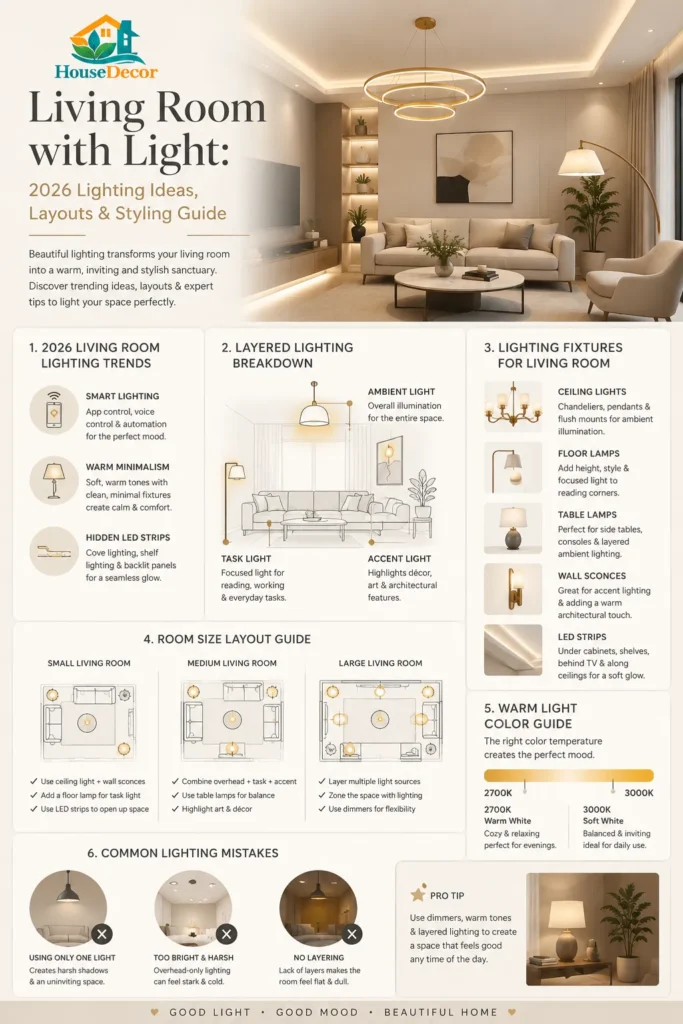
Current lighting guidance consistently supports a layered system: ambient, task, and accent lighting. This is the clearest and most useful structure for both readers and search engines because it mirrors how real rooms are used.
| Lighting Layer | What It Does | Best Fixtures | Best Use Case |
| Ambient lighting | Gives the room overall brightness | Ceiling light, flush mount, pendant, recessed lighting | General daily use |
| Task lighting | Supports reading, work, and hobbies | Floor lamp, table lamp, adjustable sconce | Focused activity |
| Accent lighting | Highlights art, shelves, textures, or architecture | Picture lights, LED strips, wall sconces | Style and depth |
Ambient lighting
Ambient lighting is the base layer. It prevents the room from feeling dark or patchy. But it should not do all the work alone. A single ceiling fixture is one of the most common mistakes in living room design. It often leaves corners shadowy and makes the room feel flat.
Task lighting
Task lighting is the light you use when you need focus. In living rooms, that usually means reading, crafting, or working on a laptop. Adjustable floor lamps and table lamps are ideal because they can be moved, angled, and dimmed.
Accent lighting
Accent lighting adds personality. It draws attention to artwork, shelves, textures, mirrors, and architectural details. This is where a room begins to feel curated instead of just illuminated.
Best Lighting Ideas for a Modern Living Room in 2026
The most effective 2026 living room lighting ideas are warm, flexible, and visually interesting. They do not rely on one dramatic fixture alone. Instead, they mix design and utility. Current trend coverage points toward sculptural pendants, layered ambient-task-accent systems, metallic finishes, hidden LED details, and smart dimming.
1. Warm minimal lighting
Soft white or warm white lighting creates a calm, lived-in mood. This works especially well in neutral interiors, modern apartments, and cozy family rooms.
2. Hidden LED strip lighting
LED strips beneath shelves, behind media walls, or inside ceiling coves create a floating effect. They are subtle, modern, and excellent for adding atmosphere without visual clutter.
3. Sculptural lamps
A lamp can act like decor when the shape is strong enough. Curved, architectural, or textural lamps help the room feel designed, not just lit.
4. Japandi-inspired lighting
Japandi style stays popular because it favors simplicity, natural materials, and warm restraint. A clean pendant, paper shade, light wood, and soft illumination can make a room feel calm rather than busy.
5. Smart lighting
Smart bulbs and smart systems let you adjust brightness and mood throughout the day. This is especially useful if one room has to handle TV time, reading, guests, and relaxation. IKEA’s current smart-lighting guidance emphasizes controlling brightness, preset moods, and color temperature from an app or smart controls.
How to Light a Living Room Properly
The best way to light a living room is to start with the room’s functions first and the fixtures second. That means thinking about where people sit, where you read, where you walk, and what you want to highlight. The core sequence is simple.
Identify the room’s main use
Ask what the room does most often:
- watching TV,
- hosting guests,
- reading,
- family time,
- or a mix of all four.
Choose your base light
Pick one reliable ambient source. This may be a flush mount, semi-flush ceiling light, or pendant, depending on ceiling height.
Add one task light per activity zone
A reading chair needs a floor lamp.
A sofa corner may need a table lamp.
A console or shelf may need a small accent source.
Add depth with accent light
Use LED strips, sconces, or picture lights to guide the eye and create visual hierarchy.
Put everything on dimmers if possible
Dimmers are one of the easiest upgrades because they make the room far more flexible without changing the decor. Smart and dimmable lighting is highlighted repeatedly in current guidance for this reason.
Living Room Lighting Comparison Table
| Option | Best For | Pros | Cons |
| Ceiling light only | Very small budgets | Simple, affordable | Flat, harsh, often unbalanced |
| Ceiling + floor lamp | Small to medium rooms | Better depth, easy setup | Still limited control |
| Ceiling + floor + table lamps | Most living rooms | Comfortable and layered | Needs planning |
| Full-layered system | Design-focused homes | Best atmosphere and function | Costs more and takes time |
A layered system is the strongest option for most homes because it gives you brightness when needed and softness when you want comfort. That is why current design guidance keeps returning to multiple light sources at different heights.
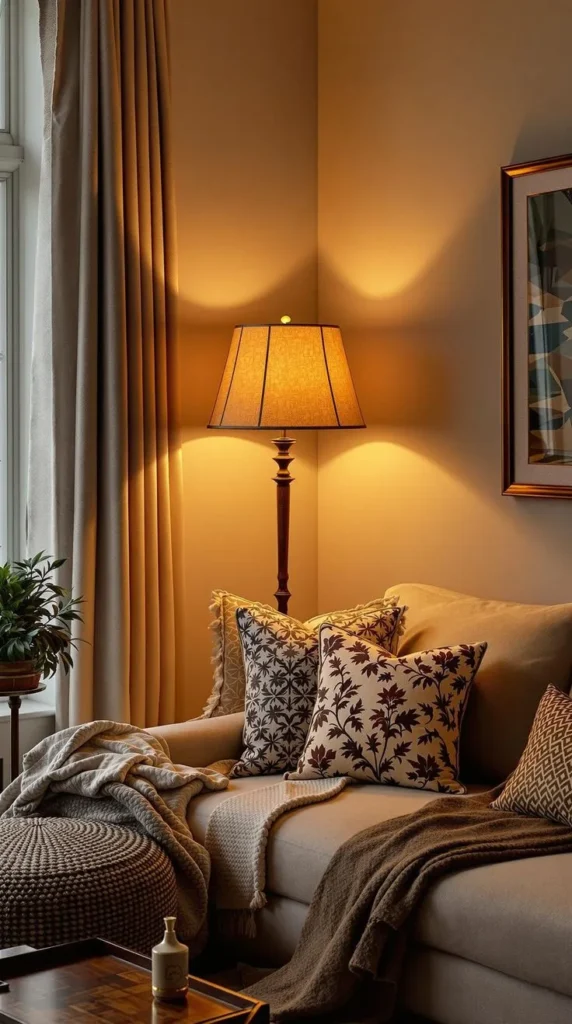
Which Lighting Fixtures Work Best in a Living Room?
Different fixtures solve different problems. The strongest living room design usually combines three or four types rather than relying on a single hero fixture.
Ceiling lights
Best for general brightness. Flush mounts work well in lower-ceiling rooms, while pendants or decorative ceiling fixtures can become a focal point in Larger Rooms.
Floor lamps
Best for reading corners, sofas, and empty corners that need height and warmth. Designer guidance often uses floor lamps to bring light down to a human scale.
Table lamps
Best for soft pools of light. They are useful on side tables, consoles, and shelves.
Wall sconces
Best for mood, symmetry, and subtle architectural detail. They are especially helpful when floor space is tight. Architectural Digest’s current lighting guidance highlights wall sconces and layered lights of different heights as a reliable way to improve ambience.
LED strips
Best for modern media walls, shelf lighting, under-cabinet effects, and indirect glow. They are excellent when you want a clean, contemporary look.
Best Light Color for a Living Room
Light color matters as much as fixture style. For most living rooms, warm white is the safest and most comfortable choice. IKEA’s guidance identifies 2700K as the classic warm-white range associated with the traditional incandescent look, while cooler light works better for tasks and focus. UPSHINE also notes that 3000K–4000K can work for a balanced, comfortable feel, depending on the room and use.
| Kelvin Range | Look and Feel | Best Use |
| 2700K–3000K | Warm, cozy, relaxed | Living rooms, bedrooms, lounge spaces |
| 3000K–4000K | Cleaner, brighter, balanced | Multi-use living rooms, modern interiors |
| Above 4000K | Cooler and sharper | Task-heavy spaces, not ideal for cozy living rooms |
Practical rule
For a typical living room, start with warm white. If the room also functions as a workspace, use dimmable or tunable bulbs so you can shift the mood when needed. Energy and IKEA guidance both support choosing brightness, dimmability, and color temperature based on the room’s intended use.
Brightness, Lumens, and CRI: The Buying Details Most People Skip
This is where many articles stay vague, but buyers need clarity. The U.S. Department of Energy explains that lumens measure brightness, not watts, and it also notes that for interior lighting, a minimum CRI of 80 is generally recommended, with CRI 90+ offering stronger color fidelity when you want more accurate color appearance. UPSHINE’s 2026 guide also emphasizes lumens, color temperature, CRI, and dimmability when choosing living room lighting.
Use this simple buying checklist
- Choose lumens for brightness.
- Choose Kelvin for the mood.
- Choose CRI for color quality.
- Choose dimmability for flexibility.
Living Room Lighting Layout by Room Size
A lighting plan should match the room size. One of the most useful improvements you can make is to stop using the same lighting formula in every room.
Small living room
Use one main ceiling fixture, plus one floor lamp and one table lamp. Keep the light soft and avoid oversized fixtures that crowd the room.
Medium living room
Use a ceiling light, a floor lamp near the reading zone, and a table lamp or wall sconce on the opposite side to balance the room.
Large living room
Create separate lighting zones. The sofa area, reading corner, media wall, and console area may each need its own light source.
Open-plan living room
Use light to define zones. A pendant may mark the dining area, while floor lamps and sconces shape the lounge area. This kind of zoning is increasingly important in modern homes because living spaces often need to perform multiple functions at once.

Best Color Combinations for a Light-Filled Living Room
The right palette can make lighting feel richer.
Best combinations
- Cream + warm white + brass
- Soft beige + wood + amber light
- Greige + black accents + diffused lighting
- White walls + light oak + linen shades
- Taupe + muted gold + layered lamps
These combinations work because light reflects softly off neutral surfaces and natural materials, while metallic accents add polish without making the room feel cold.
Best Materials and Decor Choices
Lighting is more effective when it is supported by the rest of the room.
Materials that work well
- linen lamp shades,
- matte metal,
- light oak,
- rattan,
- frosted glass,
- ceramic bases.
Decor that supports good lighting
- mirrors,
- light curtains,
- textured rugs,
- low-profile furniture,
- wall art with subtle contrast.
A mirror can bounce light deeper into the room, while soft textures prevent the space from feeling too sharp or sterile.
Budget-Friendly Living Room Lighting Ideas
A beautiful living room with light does not need a luxury budget.
Smart budget moves
- Use one strong ceiling fixture and add affordable floor lamps,
- choose plug-in sconces instead of hardwired ones,
- Use LED strip lighting behind shelves or TV units,
- Buy dimmable bulbs first, then upgrade fixtures later,
- Place lamps strategically instead of buying too many.
This approach gives you the biggest visual improvement for the least money. Smart controls and adjustable bulbs also make budget lighting more flexible over time.
Premium and Luxury Living Room Lighting Ideas
Luxury lighting is not only about price. It is about finish, proportion, and control.
Premium elements
- sculptural pendant or chandelier,
- wall sconces with a refined finish,
- hidden cove lighting,
- layered dimming,
- high-CRI bulbs,
- custom feature lighting for artwork or shelving.
Architectural Digest’s current styling examples and 2026 trend pages show how statement fixtures and layered lighting can become part of the room’s identity rather than just a utility.
Smart and Modern Design Trends for 2026
The most relevant 2026 Trends are practical, not gimmicky.
1. Sculptural lighting
Fixtures are being treated more like decorative objects.
2. Layered warmth
Rooms are moving toward soft, cozy, human-scale light.
3. Hidden illumination
LEDs are used in coves, shelves, and media walls for subtle depth.
4. Smart and tunable lighting
Homeowners want brightness and color temperature control from an app or smart device.
5. Minimal but expressive design
Less visual clutter, more deliberate impact.
Common Living Room Lighting Mistakes to Avoid
Many living rooms feel unfinished because of just a few avoidable errors.
Using only one overhead light
This is the fastest way to flatten a room.
Choosing light that is too cool
Cold light can make a living room feel harsh and less inviting.
Ignoring corners
Corners should either be lit or intentionally dark. Random darkness usually looks accidental.
Skipping dimmers
Without dimmers, the room has only one mood.
Choosing fixtures that are too small or too large
Proportion matters. UPSHINE’s guide highlights fixture size as a key factor, because scale affects how balanced the room feels.
Expert Tips Most People Ignore
These small decisions often make the biggest difference.
Light of different heights
Use ceiling, table, and floor lights together. This creates visual rhythm and helps the room feel deeper.
Match the light to the wall finish
Soft light looks better on matte walls, while glossy surfaces can reflect more glare.
Use lighting to guide attention
If you want the room to feel more upscale, highlight art, shelves, or one strong focal wall.
Keep the brightest source out of direct eye level
This helps the room feel calmer.
Test the room at night
A lighting plan that looks great in daylight may feel too weak or too harsh after dark.
How to Maintain Lighting for Long-Term Value
Good lighting lasts longer when it is cared for properly.
- Dust lamp shades and diffusers regularly.
- Replace bulbs in matched sets when possible.
- Check dimmer compatibility before buying new bulbs.
- Re-evaluate your lighting when furniture layout changes.
- Upgrade to efficient LED bulbs when older bulbs fail.
Who Should Choose This Style?
A layered, light-forward living room works especially well for:
- homeowners who want a polished but comfortable room,
- apartment renters who need flexible, non-permanent solutions,
- families who use the living room for many activities,
- design lovers who want a modern, editorial look,
- people who want a room that photographs well and feels good in person.
Who Should Avoid This Style?
This approach may be less suitable for:
- people who prefer a single-fixture, ultra-minimal utility setup,
- rooms where electrical access is extremely limited,
- spaces where dark, dramatic lighting is intentionally preferred,
- homeowners who want zero maintenance or zero layering.
Quick Summary
A great living room with light is built from layers, not luck. Start with a strong ambient source, add task lighting where people actually sit or read, and use accent light to create depth and personality. For most homes, warm white lighting, dimmable bulbs, and a mix of floor lamps, table lamps, and ceiling fixtures will produce the best result. The strongest 2026 lighting pages all point in the same direction: layered, warm, flexible, and visually intentional lighting is the modern standard.
People Also Ask Section
The best living room lighting is layered lighting: one source for general brightness, one for tasks like reading, and one for mood or accent. This gives the room comfort, depth, and flexibility.
Most living rooms work best with at least three light sources, though larger rooms may need more. A ceiling light, a floor lamp, and a table lamp are a strong starting point.
Warm white is usually the best choice for a living room. Around 2700K–3000K feels cozy and relaxed, while slightly higher ranges can work in multi-use spaces.
Use ambient lighting for the room’s base, task lighting for reading or work, and accent lighting for art, shelves, or architectural features. Put the lights at different heights to avoid a flat look.
Yes, especially if the room has multiple uses. Smart lighting lets you adjust brightness and sometimes color temperature, which makes the room easier to adapt for relaxing, entertaining, or movie nights.
Conclusion
If you want a living room that feels modern, cozy, and useful, start with lighting before anything else. The best setup is usually not the most expensive one; it is the most thoughtful one. Use layered light, choose warm and flexible bulbs, place fixtures at different heights, and let the room’s real activities guide the plan. That approach will work for small apartments, family rooms, and stylish modern homes alike. It also matches what the strongest current living-room lighting content is already moving toward: layered, smart, warm, and practical design.
For TheRoomsArt.com, this topic is ideal for readers who want Inspiration they can actually use, not just pretty photos. It is also a strong pillar for future cluster posts about floor lamps, ceiling lights, sconces, and room styling. Bookmark the guide, share it, and keep building out the living-room decor cluster around it.
Legal disclaimer: Prices, materials, trends, and product availability may change over time depending on region, suppliers, and brands. Always verify dimensions, materials, and compatibility before purchase or renovation.
