
Introduction
Extra Large Wall Mirrors for Living Room are a powerful design element that can completely transform your space by enhancing light, creating depth. And adding a sense of luxury. Cruise dining is one of the most satisfying parts of a vacation at sea because it blends routine. Comfort, and a little bit of ceremony. It is also one of the most time-sensitive parts of the ship. Unlike a buffet where you can drift in whenever you are hungry. The main dining room often runs on a structured schedule. And specialty restaurants usually operate with even tighter reservation rules. That is why cruise dining room late arrivals can turn into a real issue when plans slip. Excursions run long, or someone in the group needs “just five more minutes.” Royal Caribbean, Carnival, Norwegian Cruise Line, and Disney Cruise Line all handle dinner timing differently, and those differences matter.
The practical reality is simple: the more fixed the dining plan, the less tolerance there is for lateness. Traditional main dining room seating is built around assigned times and a steady service rhythm. Flexible models like Royal Caribbean’s My Time Dining, Carnival’s Your Time Dining, and Norwegian’s Freestyle Dining give guests more freedom. However, they still depend on availability, check-in rules, and venue capacity. Specialty dining is the strictest category of all because published cancellation windows and no-show fees are common. And some venues enforce them aggressively. Disney adds a particularly useful backup by offering 24-hour room service on all ships. With most meal items included in the cruise fare.
What Cruise Dining Room Late Arrivals Really Mean
When people search for cruise dining room late arrivals, they are usually asking one of three things. They want to know whether they can still be seated after their assigned time. They want to know whether the staff will turn them away, rush them, or hold the table. Or they want to know whether being late triggers a real penalty, especially in specialty dining venues. The answer depends on the cruise line, the dining format, and whether the meal is in a complimentary dining room or a reserved restaurant.
Fixed dining and flexible dining are not the same experience. Fixed dining means the cruise line has already assigned your dinner time, and sometimes your table, before you even walk on board. Flexible dining means the meal is available within a broader window, but you may still need to check in, join a queue, or wait for a table to open. Royal Caribbean’s traditional dining uses assigned early or late seating, while My Time Dining is built around flexibility and reservations. Carnival offers Early Dining, Late Dining, and Your Time Dining. Norwegian’s Freestyle Dining removes fixed dinner times in complimentary venues altogether.
That structure explains why late arrivals are treated differently from one ship to another. In a fixed dining room, the staff is moving through a carefully timed sequence of courses and table service. That is not guesswork; it follows directly from how the cruise lines publish their dining rules.
Cruise Dining Late Arrival Policies by Major Cruise Lines
Royal Caribbean
Royal Caribbean separates traditional dining from My Time Dining. Traditional dining uses fixed early or late seating, and your table assignment appears on your SeaPass card. My Time Dining is the more adaptable option: it is flexible, guests are seated with the people they arrive with, and reservations are strongly recommended so you do not face a delay in seating. Royal Caribbean also says pre-reserving My Time Dining before sailing is strongly Recommended because times can fill up, although onboard reservations may still be possible depending on availability.
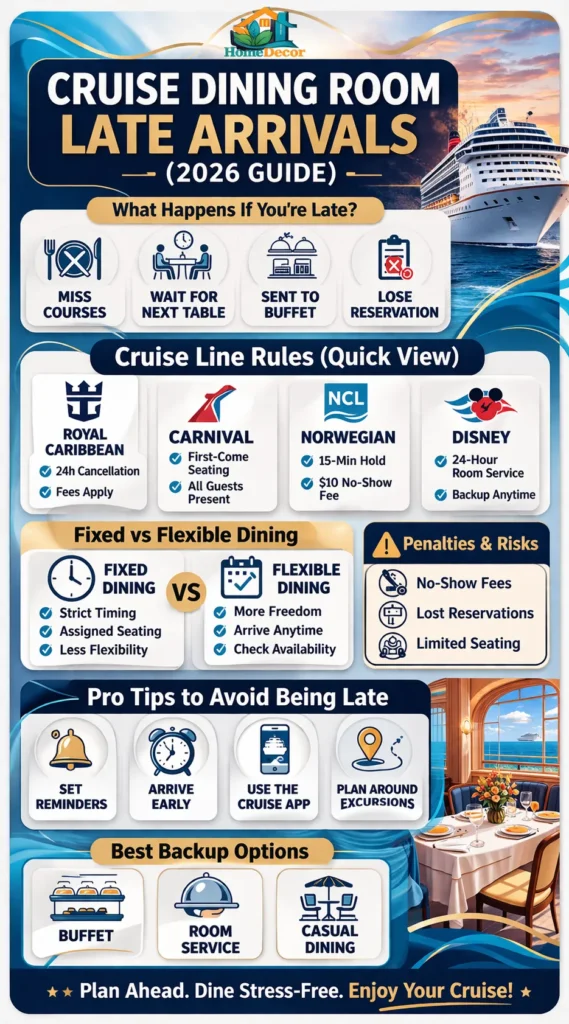
Royal Caribbean is much stricter in specialty dining. The cruise line states that specialty dining reservations can be changed or canceled any time up to 24 hours before the reservation time. If you cancel within 24 hours or do not show up, a $25 per person fee applies. Some venues have higher charges, and the published policy says each venue’s rules are shown at the time of booking. That makes specialty dining the place where lateness has the clearest financial consequence.
Royal Caribbean also emphasizes that its ships offer multiple complimentary dining venues, including the Main Dining Room and Windjammer, so missing a dinner seating does not necessarily mean missing a meal. That said, a backup venue is not the same as a guaranteed seat at your preferred time, which is why planning still matters.
Carnival Cruise Line
Carnival’s main dining room also follows a structured model. Guests can choose Early Dining or Late Dining for reserved seating, or use Your Time Dining for a more open approach. Carnival says Your Time Dining works on a first-come, first-served basis, and guests are generally accommodated within about 20 minutes. The line also states that all guests in the party must be present before the group is seated, and advance table reservations are not accepted for Your Time Dining.
Carnival’s own materials make the distinction even clearer: Early and Late Dining are fixed choices, while Your Time Dining is the flexible option. Carnival also notes that priority dinner reservations and guaranteed dining time preferences are benefits tied to certain loyalty levels or booking conditions, which reinforces the idea that main dining room timing is a real part of the cruise experience, not an afterthought.
For backup dining, Carnival offers 24-hour room service. Its help page says the room service menu has been expanded to include more culinary choices for in-room delivery, though charges may apply. That makes Carnival a solid option if your dinner timing slips and you need a fallback beyond the main dining room.
Norwegian Cruise Line
Norwegian Cruise Line is the most flexible of the three major mainstream examples here because its complimentary dining is built around Freestyle Dining. That is exactly why so many travelers associate NCL with freedom and low-pressure meal planning.
Specialty dining is different. Norwegian says it can hold a dinner reservation for only 15 minutes. After that, the reservation is canceled. The cruise line also says a $10 per person fee applies if a scheduled reservation is not canceled or updated at least two hours before the scheduled time. In other words, Norwegian is generous in its complimentary venues but strict in its specialty ones.
That combination makes NCL highly forgiving for casual dinner plans and highly unforgiving when a reserved specialty table is involved. It is a good match for travelers who value spontaneity. But it is not a free pass to ignore restaurant policies.
Disney Cruise Line
Disney Cruise Line stands out because it makes late-night eating especially easy. Its general cruise inclusions page also highlights 24-hour room service as part of the standard cruise experience. That gives families and late eaters a very dependable backup when plans go off script.
Disney’s dining structure still has its own schedule-based elements, but from a practical standpoint, the 24-hour room service option dramatically reduces the pressure of missing a conventional dinner window. That is especially helpful for families with unpredictable schedules, younger children, or guests who simply prefer a slower evening pace.
What Happens If You Are Late for Cruise Dinner
If you are late for a main dining room meal, the result is usually shaped by the dining style rather than a single universal “late rule.” On a fixed dining plan, you may arrive after service has started, miss the opening course, or need to wait for the host team to fit you in without disturbing the service flow. On a flexible plan, you may still be seated, but only if the dining room has capacity and the staff can accommodate the timing. Cruise lines do not publish one standard grace period that applies everywhere, so the experience can vary by ship, venue, and crowd level. That variability is not a loophole; it is part of the system.
In specialty dining, the consequences are much more concrete. Royal Caribbean allows modifications only up to 24 hours before the reservation, after which a $25 per person fee can apply. Norwegian holds reservations for only 15 minutes and may charge $10 per person if the reservation was not canceled or updated at least two hours ahead. In practical terms, that means a late arrival can turn into a lost table and a charge rather than a delayed meal.
If you completely miss dinner, you are rarely left without food. Royal Caribbean publishes a range of complimentary venues, Carnival provides 24-Hour room service, Disney provides 24-hour room service with most items included, and Norwegian offers complimentary restaurants with flexible timing. The real risk is not starvation; it is losing the meal structure, the preferred venue, or the reservation you wanted most.
Cruise Dining Room Etiquette for Late Arrivals
Cruise dining is a social system as much as a food service. The dining room runs smoothly because the staff knows when guests are supposed to arrive, how many people are at each table, and how quickly courses need to move through the evening. Fixed seating makes that rhythm especially important because the same service team is often managing a predictable wave of guests at the same time every night. That is why arriving late is not just inconvenient; it can affect the structure of the meal for everyone around you.
The best etiquette rule is also the simplest: arrive a little early rather than exactly on time. That cushion gives you room for elevators, bathroom stops, extra time to change clothes, and the occasional shipboard delay that seems small until dinner is starting without you. If you are using My Time Dining or Your Time Dining, it is still smart to check in promptly, because those systems depend on queue management and real-time availability.
If you know you will be late, communicate early. Staff members can work with the information they have; they cannot work with silence. On flexible dining systems, being honest about your timing gives the host team a better chance to adjust. On fixed dining systems, it helps the team understand whether you are a true no-show or just delayed by circumstances. That small courtesy goes a long way on a cruise ship, where the dining room is part hospitality and part choreography.
Fixed Dining vs Anytime Dining
The easiest way to understand cruise dining room late arrivals is to compare fixed dining and flexible dining side by side in plain language.
Fixed dining is the scheduled model. You have a set dinner time, usually the same time every night, and often the same table or the same service team. This is how Royal Caribbean’s traditional dining and Carnival’s Early or Late Dining work. The advantage is predictability. The downside is obvious: if you are late, the system has less room to bend.
Flexible dining is the open model. Royal Caribbean’s My Time Dining, Carnival’s Your Time Dining, and Norwegian’s Freestyle Dining all move toward a looser schedule, although each one still has rules. Royal Caribbean still recommends reservations. Carnival’s Your Time Dining is first-come, first-served and requires everyone to be present. Norwegian’s Freestyle Dining has no fixed complimentary dinner times, but specialty restaurants still impose a reservation hold and cancellation deadline. Flexibility reduces pressure, but it does not erase policy.
For travelers who hate rigid schedules, the flexible model is usually the better fit. For travelers who enjoy routine, fixed seating can actually be more comfortable because it removes daily decision fatigue. The right choice depends less on status and more on personality, family rhythm. And how tightly your shipboard day is planned. That is an inference from the way these dining systems are built and marketed by the cruise lines.
Practical Tips to Avoid Being Late
The smartest way to handle cruise dining room late arrivals is to stop them before they happen. The first habit is to build in buffer time. If dinner is at 6:30, do not plan to leave your cabin at 6:30. Set one reminder for getting ready and a second reminder for heading out. That small behavioral nudge sounds basic, but it is one of the most reliable ways to avoid unnecessary stress.
The second habit is to avoid stacking activities too tightly before dinner. A spa appointment, a long shore excursion, a photoshoot, or a crowded show can all push dinner time later than expected. That is especially risky on port days, when transport delays and embarkation timing can eat into the evening faster than guests expect. The cruise lines’ own dining policies make clear that timing and availability matter, so leaving slack in the schedule is simply practical planning.
A third habit is to use the ship’s digital tools. Royal Caribbean encourages pre-reserving My Time Dining. Carnival’s HUB App lets guests check in for Your Time Dining ahead of time or when they are ready, and the app then notifies them when the table is prepared. Norwegian supports dining planning through onboard tools and reservations, and Disney’s 24-hour room service provides a dependable fallback if timing fails. In modern cruise dining, the app is not a luxury; it is part of the navigation system.
Finally, always keep a backup plan. If dinner slips away from your original schedule, the buffet, casual venues, or room service may save the evening. Royal Caribbean, Carnival, Disney, and Norwegian all provide some form of alternative dining, and that safety net is part of what makes cruising workable even when plans shift.
Dining Room Layout, Service Flow, and Why Timing Matters
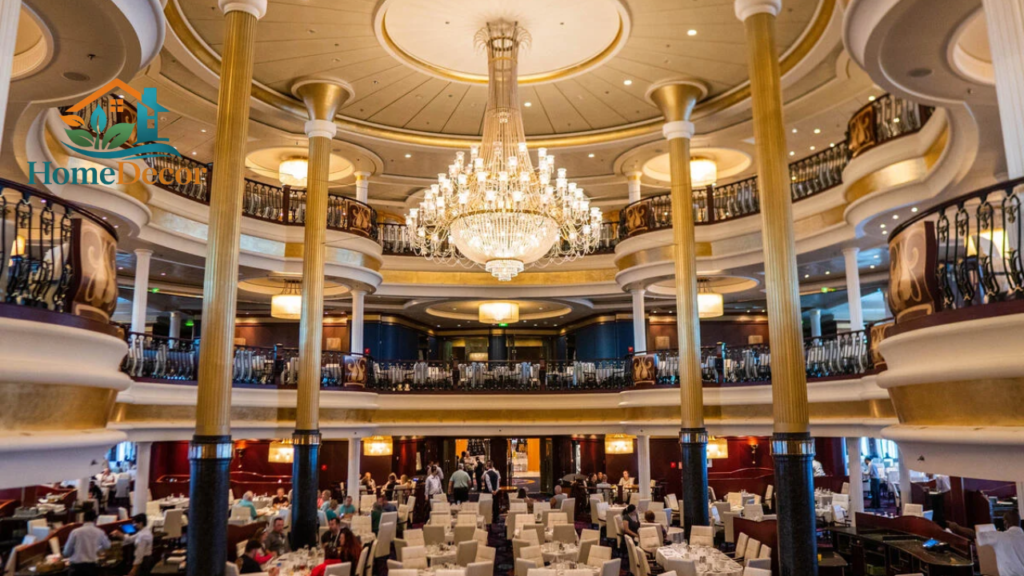
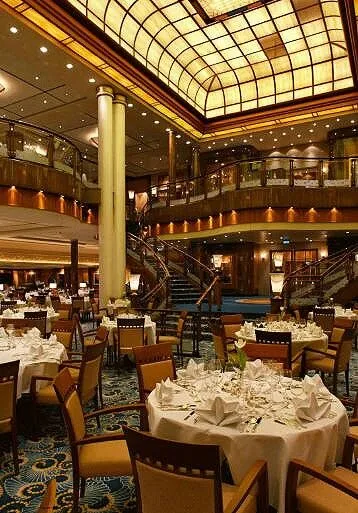
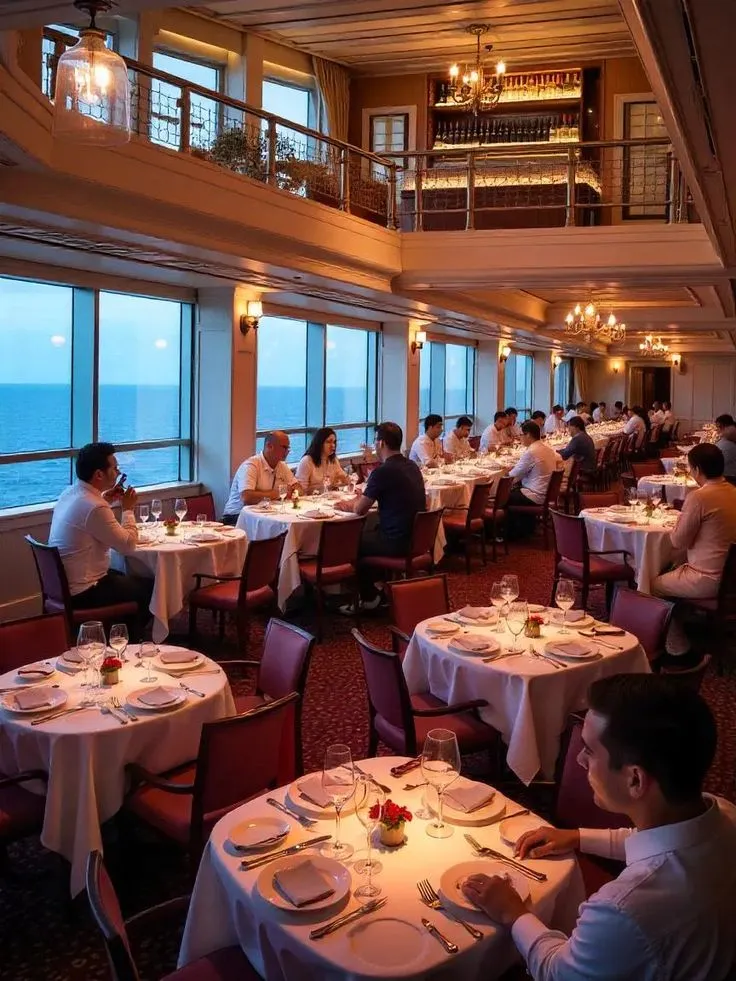
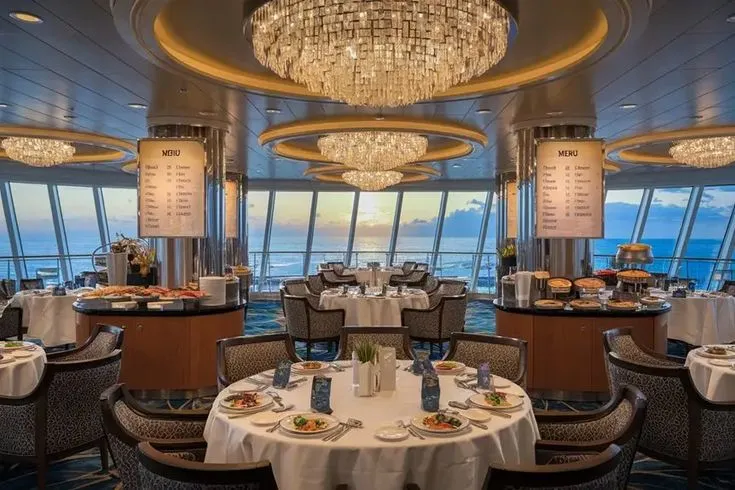
Cruise dining rooms are designed for service efficiency, not just atmosphere. The wide walkways, table spacing, and repeated seating patterns are all meant to keep food moving smoothly from the kitchen to the guests. That is one reason late arrivals create more friction than people expect. When the room is operating at full speed, the staff is timing courses, clearing plates, and preparing for the next wave of diners. A late arrival can interrupt that rhythm, especially in a fixed seating system. This is an operational reality inferred from how cruise dining is structured across the lines.
Layout also affects the guest experience. Shared tables require more coordination, while private or fixed tables need careful pacing so the whole service cycle stays balanced. A flexible dining room has to manage waitlists and arrivals in real time, which is why it benefits from pre-booking, app check-ins, and clear arrival windows. The calmer the room looks, the more structured the backstage operation usually is.
This is why timing matters even when the dining room feels casual. Guests see the meal as leisure; the staff sees it as a timed sequence of coordinated tasks. Respecting that rhythm is the easiest way to keep dinner pleasant for everyone.
Budget Cruise vs Luxury Cruise Dining Experience
Dining flexibility often feels different depending on the style of cruise you book. Mainstream cruise lines tend to rely on clearer scheduling because they serve large numbers of guests efficiently. That means late arrivals are usually less forgiving in fixed dining rooms, but the ships also provide more buffet and casual alternatives. Royal Caribbean’s current guidance notes that ships have multiple complimentary dining venues, Carnival offers 24-hour room service, and Norwegian’s Freestyle Dining is built for open scheduling.
More premium-leaning or more service-intensive experiences often feel smoother because the ratio of staff attention to guest demand is different, but the official dining policies still matter more than the word “luxury” itself. Even on a ship with a relaxed atmosphere, specialty restaurant reservation windows can still be strict. The real distinction is not simply budget versus luxury. It is how much scheduling discipline the dining model expects from the guest. That is an inference drawn from the published policies, not a universal law.
For time-sensitive travelers, the most important question is not whether the ship looks fancy. It is whether the dining plan offers enough flexibility for your routine. If dinner timing changes often, a flexible or freestyle model is usually the better fit. If you like stability, fixed seating can feel wonderfully easy.
Common Mistakes to Avoid
The first common mistake is assuming every cruise line treats dinner the same way. It does not. Royal Caribbean, Carnival, Norwegian, and Disney all publish different rules for reservations, wait times, room service, and fallback options. A guest who understands one line’s policy may still be caught off guard on another.
The second mistake is treating flexible dining as if it means unlimited freedom. My Time Dining, Your Time Dining, and specialty reservations still have practical limits. Royal Caribbean encourages reservations. Carnival requires all guests to be present for Your Time Dining seating. Norwegian may cancel specialty dining after 15 minutes. Flexibility is helpful, but it is not a magic eraser for policy.
The third mistake is overbooking your schedule on port days. That is when delays are most likely, and it is also when the dinner window is easiest to miss. The fourth mistake is ignoring the ship’s app or daily planner. Those tools exist for a reason, and they can dramatically reduce timing confusion. The fifth mistake is forgetting that backup dining exists. A late seating is inconvenient, but it is not the end of the evening.
Maintenance and Dining Experience Tips
A smooth dining experience usually comes down to routine. Keep your evening pattern simple: get ready early, check the schedule, and leave with a buffer. Small habits create large comfort on a cruise because ship time can feel compressed when entertainment, port calls, and meals all compete for the same hour. This is not a special secret; it is the natural result of a tightly coordinated vacation environment.
It also helps to review the daily itinerary each day. A sea day, a port day, or a show night can completely change how much time you have before dinner. If you know the evening will be crowded, use a flexible dining option or an earlier meal when possible. When plans change, tell the staff as soon as you can. Cruise dining teams are much more effective when guests communicate early rather than arriving quietly at the last second.
And do not think of room service or the buffet as second-best choices. On many ships, they are the smartest choices. Royal Caribbean, Carnival, Disney, and Norwegian all provide alternative ways to eat when the dinner clock gets away from you, which is exactly why cruise dining remains manageable even when schedules shift.
Smart Dining Trends for 2026
Cruise dining is becoming more digital, and 2026 continues that shift. Royal Caribbean pushes pre-booking through My Royal Cruise. Carnival’s HUB App helps guests check in for Your Time Dining. Norwegian supports reservations through app-based and onboard channels. Disney continues to lean on the reliability of room service as an easy fallback when guests need flexibility. The pattern across these lines is clear: less paper, more planning, and more real-time handling of dining flow.
The likely direction of travel is more app-based reservation handling, better digital waitlists, faster table notifications, and more hybrid systems that mix structured reservations with walk-in flexibility. That is an inference from the current tools that the cruise lines already publish. What is Unlikely to change is the basic truth that dinner timing still matters. Even with better technology, capacity, venue rules, and service rhythm will continue to shape how dinner works onboard.
Pro Tips for Stress-Free Cruise Dining
Choose the most flexible dining plan available if your schedule changes often. Book specialty restaurants early if you care about a specific time or venue, because Royal Caribbean and Norwegian both make clear that reservation windows matter. Do not treat assigned dinner seating as optional if you have booked a fixed dining time. Use room service, casual dining, or the buffet as your backup instead of waiting until you are already frustrated. And before you sail, read the actual dining policy for your ship so you know the rules that apply to your booking rather than relying on general cruise advice.
These habits are small, but they make a large difference. Cruise dining becomes far more enjoyable when you stop treating timing as a mystery and start treating it like part of the vacation plan.
FAQs
The result depends on your dining style: In fixed dining, you might be seated late, miss part of the meal, or be asked to wait. In flexible dining, you’re usually accommodated if space allows. Each cruise line—Royal Caribbean, Carnival, Norwegian, and Disney—runs its schedule differently, so outcomes vary.
Cruise lines rarely penalize late arrivals in the main dining room, but specialty restaurants do. Royal Caribbean charges $25 per person for no-shows or cancellations within 24 hours (higher at some venues), while Norwegian charges $10 per person if you don’t cancel at least two hours before your reservation.
There is no single universal cutoff for every main dining room. That is why the answer depends on the ship and the dining style. For specialty dining, the rules are much clearer. Royal Caribbean requires changes at least 24 hours before the reservation time, while Norwegian holds reservations for 15 minutes before canceling them.
Yes, usually you can. Royal Caribbean publishes multiple complimentary dining venues, Carnival offers 24-hour room service, Disney offers 24-hour room service with most meal items included, and Norwegian’s Freestyle Dining gives you broad flexibility in complimentary venues. Missing your dinner seating is inconvenient, but it is rarely the end of the evening.
Cruise lines use different dining systems, from fixed schedules to flexible options, with some offering room service as backup.
Conclusion
Arriving late to the cruise dining room may seem like a small issue, but it can affect service flow, seating, meal quality, and even your overall cruise experience. Every cruise line handles late arrivals differently; some offer a short grace period, some quietly redirect you to alternative venues, and others may simply close the doors once service begins.
The best strategy is simple: know your ship’s dining rules, plan, and Communicate early if you expect a delay. With a little preparation, you can enjoy smoother evenings, better food, and a stress-free dining routine throughout your entire voyage.
If you follow the tips in this guide, setting reminders, choosing the right dining style, understanding deadlines, and keeping backup dining options in mind, you’ll never have to worry about missing dinner on your cruise again.
