
Introduction
A Small Living Room can feel stylish, comfortable, and spacious when the furniture is chosen and arranged with purpose. The problem is that many people buy pieces that look good in a showroom but fail at home because they block walkways, crowd corners, and make the room feel heavier than it really is. That is exactly why searchers want practical answers like how to arrange furniture in a small living room, not just product lists. Google’s own guidance emphasizes helpful, reliable, people-first content, and it rewards pages that answer the real task a searcher is trying to solve. It also encourages using the words people actually search for in clear titles and headings.
This guide is built for that intent. It goes beyond generic “buy a small sofa” advice, showing you how to choose the right pieces, arrange them smartly, and make a compact room feel bigger without sacrificing comfort. The current search landscape also shows a clear pattern: top pages often focus on inspiration, compact sofas, modular layouts, raised legs, slim arms, round tables, mirrors, and light palettes, but they usually do not go deep enough into step-by-step layout strategy and buying decisions. That gap is where this article wins.
Table of Contents
- What makes a small living room different
- Why small-space furniture matters in 2026
- Best furniture types and styles
- Best layout ideas that actually solve spacing problems
- Space-saving furniture ideas that work
- Storage furniture solutions
- Color, lighting, and visual tricks
- Step-by-step buying checklist
- Comparison table: what to choose and what to avoid
- Common mistakes to avoid
- Expert tips most people ignore
- Maintenance and long-term value
- FAQs
- Conclusion
What Makes a Small Living Room Different
A small living room is not just a “smaller version” of a large room. It has different rules. Every piece matters more because the room has less floor area, fewer circulation paths, and less visual breathing space.
The three biggest challenges
- Traffic flow gets blocked quickly.
- Visual clutter builds up faster.
- Scale becomes the make-or-break factor.
A bulky sofa, oversized coffee table, or wide TV unit can make the room feel cramped even if the room is technically usable. That is why many well-ranked articles now stress compact dimensions, slim arms, raised legs, modular pieces, and flexible layouts. Swyft’s 2026 sofa guide and Induscraft’s layout advice both point to the same idea: small rooms need furniture that fits the scale of the room, not just the style of the room.
Snippet-ready answer
What makes a small living room different?
A small living room needs furniture that saves space, keeps movement clear, and looks visually light so the room feels open instead of crowded.
Mini summary:
Small rooms reward smart scaling, not more furniture. The right proportions matter more than the number of items.
Why It Matters in 2026
Small-space living is not a temporary trend. Compact homes, apartments, studios, and open-plan layouts keep pushing people toward furniture that does more with less. In 2026, several sources emphasize modular design, slim silhouettes, raised legs, and warm neutral palettes as major directions for small living spaces.
That matters because search intent is no longer just “show me cute ideas.” People want:
- The best furniture for a small living room
- space-saving furniture ideas
- small living room layout ideas
- storage furniture for a small living room
- best sofas for small living rooms
Searchers want confidence before they buy. They want to know what fits, what works together, and what to avoid. Google’s helpful-content guidance supports exactly that kind of content: pages that solve the task, satisfy the user, and deliver a good experience instead of thin keyword stuffing.
Mini summary:
In 2026, small living room content wins when it helps people choose, place, and combine furniture with real-world clarity.
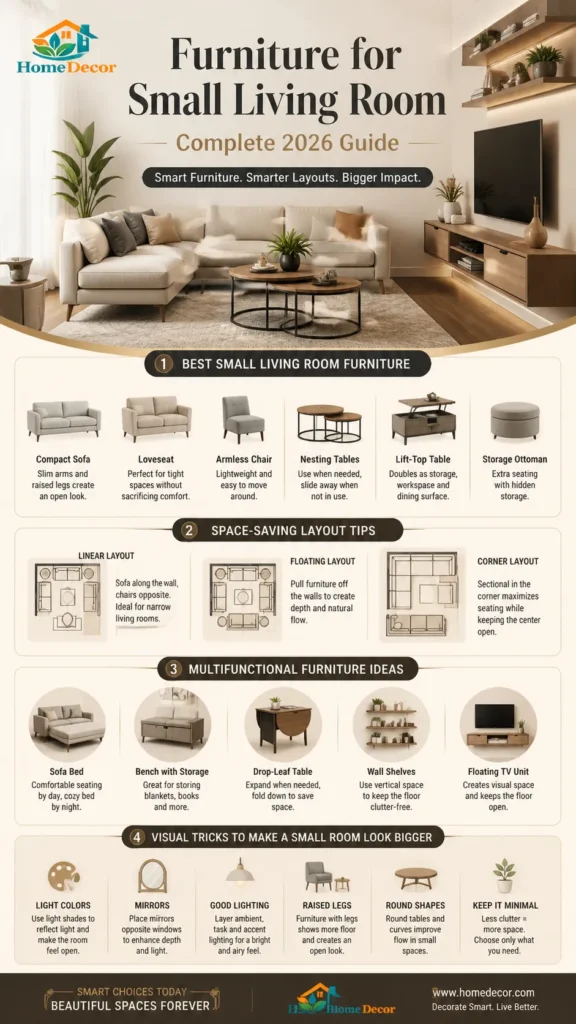
Best Furniture Types for Small Living Rooms
The best furniture for a compact living room is usually simple, narrow, and flexible. The goal is to save space without making the room feel empty.
Best furniture categories to prioritize
1) Compact sofa or apartment sofa
Choose a sofa with a smaller footprint, slimmer arms, and a clean silhouette. Raised legs help the room look lighter because more floor is visible. Swyft specifically highlights compact dimensions, slim arms, shallow seat depth, and raised legs as key features for small living rooms.
2) Loveseat
A loveseat is often the smartest seating choice for a very small room. It gives you comfortable seating without dominating the layout.
3) Modular sofa
A modular sofa is ideal when you want flexibility. You can change the shape later, move sections around, or start small and expand over time. Modular design is one of the clearest 2026 trends in small-space living.
4) Armless chair or slipper chair
These pieces visually take up less space than bulky armchairs. They are perfect as a second seating option in a corner or reading zone. The 2026 resurgence of the slipper chair makes sense for compact rooms because it keeps the room open while still adding style.
5) Nesting coffee tables
These work well because you can pull them apart when needed and tuck them away when not in use.
6) Round or oval coffee table
A round table improves movement and feels less boxy in a tight plan. Induscraft specifically recommends round coffee tables for easier circulation in small rooms.
7) Lift-top coffee table
This adds storage and also works as a laptop table or casual dining surface.
8) Slim side table
A narrow side table often works better than a large coffee table if your room is extremely tight.
9) Storage ottoman
This is one of the best multifunction pieces for small rooms because it can act as seating, a footrest, or hidden storage.
10) Wall-mounted TV unit or floating console
This frees floor space and keeps the visual line cleaner.
Best furniture types at a glance
| Furniture Piece | Best For | Why It Works | Watch Out For |
| Compact sofa | Main seating | Smaller footprint, cleaner scale | Oversized arms and deep seats |
| Loveseat | Very small rooms | Comfortable without crowding | Too many matching pieces |
| Modular sofa | Flexible layouts | Can be rearranged later | Large sectional in a tiny room |
| Slipper chair | Accent seating | Light visual weight | Low comfort for long lounging |
| Nesting tables | Flexible surface area | Easy to store or move | Poor-quality wobble |
| Round coffee table | Easy movement | Softer traffic flow | Too large in a tiny room |
| Storage ottoman | Hidden storage | Multi-use and practical | Too tall or too bulky |
| Floating console | Floor-space saving | Clean, modern look | Weak wall mounting |
Mini summary:
Look for pieces with slim arms, visible legs, and multifunction use. These details make the biggest difference in a small room.
How to Arrange Furniture for Maximum Space
This is the section many competitor pages miss. Furniture choice matters, but furniture arrangement is what usually determines whether the room feels open or cramped.
The best layout principles
Float furniture slightly off the walls
A small room does not always look bigger when everything is pushed against the wall. Floating the sofa a few inches off the wall can create depth and improve circulation.
Build around one focal point
That focal point might be a TV, fireplace, window, or statement rug. Once the focal point is set, place the main seating around it.
Use a conversation cluster
Place the sofa and chairs so they can “talk” to each other. This creates a natural social zone and prevents the room from feeling like a hallway.
Keep the walking space clear
Do not block the shortest route into and through the room. The layout should guide movement, not fight it.
Use corners wisely
Corners are perfect for accent chairs, small lamps, plant stands, or slim storage.
Houzz’s small living room guidance recommends using smaller-scale pieces, wall-mounted TVs, a loveseat, and a long sofa with a thin coffee table in narrow rooms. It also notes that a large rug can help define open-plan spaces, which is a useful trick when your living room connects to dining or kitchen areas.
Layout options that work well
Layout A: Linear lounge
Best for narrow rooms.
- Sofa along one long wall
- One slim chair opposite or at an angle
- Round or narrow coffee table
- TV wall-mounted or on a floating console
Layout B: Floating cluster
Best for rooms that need depth.
- The sofa pulled away from the wall
- Slim console behind the sofa
- One accent chair nearby
- Rug defining the zone
Layout C: Corner sectional
Best for people who need maximum seating.
- L-shaped modular sofa in one corner
- Small side table instead of a large coffee table
- TV across from the open side
Layout comparison table
| Layout Type | Best For | Pros | Cons |
| Linear lounge | Narrow rooms | Easy flow, simple setup | Can feel formal if overdone |
| Floating cluster | Small square rooms | Creates depth and openness | Needs careful measuring |
| Corner sectional | Family use | More seating, efficient corner use | Can overwhelm very small rooms |
| Solo sofa + chairs | Minimalist homes | Flexible and airy | Less seating capacity |
Mini summary:
The best layout is the one that protects walking space first and seating second. That order matters.
Space-Saving Furniture Ideas That Actually Work
This is where the room starts to feel smart instead of just small.
Top space-saving ideas
Storage ottomans
A storage ottoman gives you seating, a Footrest, and hidden storage in one piece.
Benches with shelves or drawers
A bench can replace a bulky chair or sideboard.
Drop-leaf or foldable tables
These are useful if your living room also works as a dining or work area.
Console table behind the sofa
This adds surface space without taking over the room.
Stackable side tables
Use them when needed, tuck them away when not.
Wall shelves
Vertical storage keeps the floor open and draws the eye upward.
Lift-top coffee table
This is one of the easiest ways to combine storage and function.
Sofa bed or futon
If the room doubles as a guest room, this solves two problems at once. Induscraft highlights sofa-beds as a strong dual-function option in small homes.
Pros and cons of multifunction furniture
Pros
- Saves floor space
- Reduces the number of separate items
- Helps the room work harder
- Often, more cost-effectively long-term
Cons
- Can be heavier or more expensive
- Some designs sacrifice comfort
- Cheap versions may feel flimsy
- Too many multifunction items can still look busy
Mini summary:
The best space-saving furniture earns its place by doing two or three jobs without looking bulky.
Storage Furniture Solutions
A small living room always needs storage, but storage should not look heavy.
Best storage strategies
Vertical storage
Use wall shelves, tall bookcases, and floating cabinets to move storage upward instead of outward.
Concealed storage
Storage ottomans, bench drawers, and coffee tables with hidden bins keep clutter out of sight.
Slim media storage
Choose a narrow TV console instead of a deep cabinet.
Basket storage
Baskets are useful for throws, toys, cables, or magazines.
Smart storage rules
- Store daily-use items within reach
- Hide rarely used items
- Keep surfaces visually clean
- Leave some space on shelves so they do not look packed
Induscraft’s small-room guidance strongly emphasizes the use of correctly scaled, multifunctional furniture and vertical thinking, while Houzz also points toward wall-mounted TVs and smaller side tables to reduce visual bulk.
Snippet-ready answer
What storage works best in a small living room?
Vertical shelves, floating consoles, storage ottomans, and slim cabinets work best because they save floor space and reduce clutter.
Mini summary:
Good storage should disappear into the room, not announce itself.
Color, Lighting, and Visual Illusion Tips
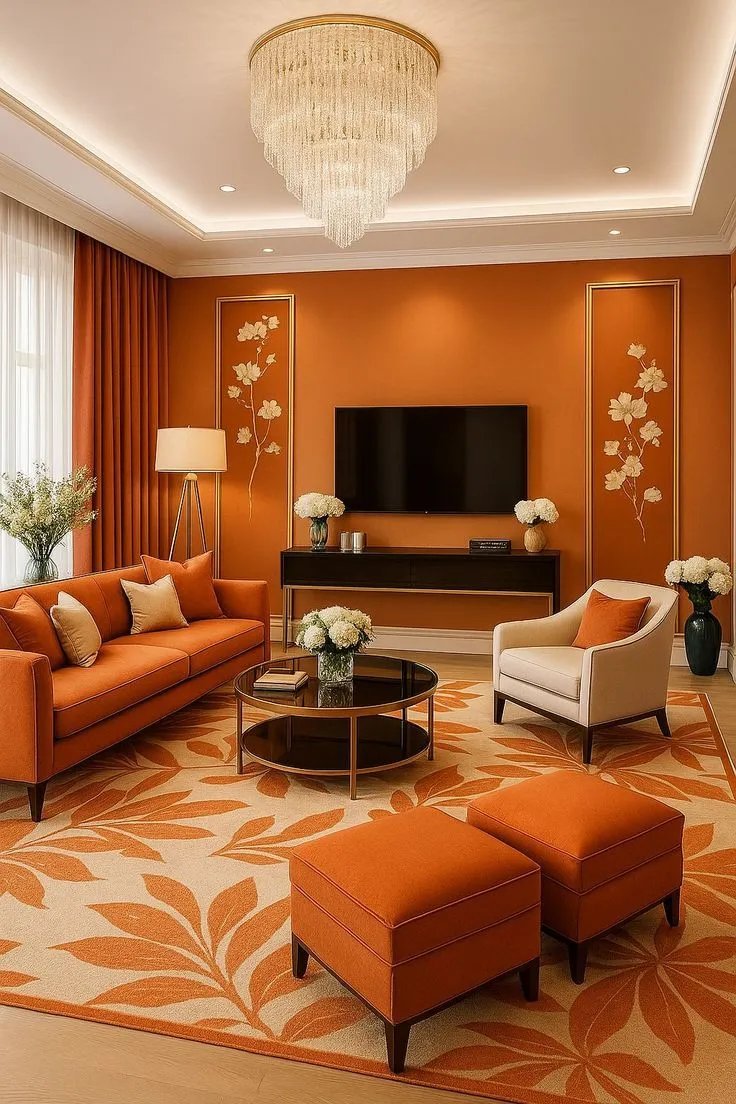
Furniture is only half the story. Color and lighting strongly affect how large the room feels.
Best color choices
- Light neutrals: cream, beige, oatmeal, Soft Gray
- Warm natural tones: stone, sand, taupe
- Small doses of darker color for depth and contrast
Swyft notes that warm neutrals and earthy tones are especially prominent in 2026 sofa styling, and Houzz explains that light walls can help a small room feel more spacious and uncluttered.
Best lighting choices
- Ambient lighting for overall brightness
- Task lighting for reading or work areas
- Accent lighting to highlight features
- Wall sconces to save floor space
Best visual tricks
Mirrors
A mirror opposite a window can increase reflected light and make the room feel deeper.
Visible legs
Furniture with legs allows more floor to show, which creates a lighter visual effect.
Simple rug placement
A rug helps define zones without adding clutter.
Fewer, larger accents
One large art piece often looks better than many small decorations.
Mini summary
Use light, layered, and uncluttered design choices to make the room feel calmer and larger.
Best Furniture Choices by Budget
Not every room needs premium pieces. A smart budget strategy matters.
Budget-friendly options
- Compact loveseat instead of a full sofa
- Nested tables instead of matching heavy tables
- Storage ottoman instead of an extra chair
- Wall shelves instead of a large cabinet
- Round budget coffee table instead of a wide rectangle
Mid-range options
- Modular sofa
- Lift-top coffee table
- Floating TV unit
- Upholstered accent chair
- Quality rug that anchors the space
Premium options
- Custom modular seating
- Built-in storage bench
- High-quality sofa bed
- Designer wall-mounted console
- Premium natural-material accent pieces
The best way to spend money first
- Buy the right sofa or loveseat.
- Add storage.
- Add lighting.
- Finish with decor.
That order usually gives the best return because seating and flow affect daily use the most.
Mini summary:
Spend first on scale, then on storage, then on styling.
Step-by-Step Guide to Choosing Furniture for a Small Living Room
Use this checklist before buying anything.
- Measure the room carefully.
Write down wall lengths, window positions, door swings, and walkway paths. - Choose the main function.
Decide whether the room is mainly for TV, conversation, reading, or multi-use living. - Pick one main seating piece.
Usually a compact sofa, loveseat, or modular sofa. - Choose one anchor table.
Round, oval, nesting, or lift-top work best. - Add only one or two accent pieces.
Avoid crowding the room with extra chairs and side tables. - Plan storage next.
Use hidden storage, wall shelving, or slim media units. - Leave breathing room.
The room should look finished, not packed.
Buyer’s checklist
- Does it fit the room scale?
- Does it have slim arms or legs?
- Can it do more than one job?
- Does it block traffic flow?
- Will it still work if you rearrange later?
Mini summary:
Buy for the floor plan you actually have, not the floor plan you wish you had.
Common Mistakes to Avoid
This section is useful because it speaks to pain points directly.
Avoid these mistakes
- Buying a sofa that is too deep or too wide
- Using too many small decor items
- Ignoring walking paths
- Choosing bulky coffee tables with sharp corners
- Pushing every piece against the wall without thinking about depth
- Using dark, heavy fabrics everywhere
- Ignoring vertical storage opportunities
A lot of top-ranking content mentions styling tips, but the best pages now also tell readers what not to do. That is one reason practical content tends to hold attention better than a pure inspiration gallery. Google’s core guidance is to build pages that feel satisfying and useful to people, not pages that simply repeat common ideas.
Mini summary:
Most small-room problems come from scale mistakes, not style mistakes.
Expert Tips Most People Ignore
These are the details that improve the result fast.
Choose visible legs
Furniture with legs Looks Lighter and shows more floor space.
Use one larger rug
A rug can unify the room better than many small mats.
Match furniture depth to room depth
Deep sofas can swallow a compact room. Shallow or medium-depth seating is often better.
Keep the TV zone slim
Use a wall mount or floating console so the media area does not feel heavy.
Use contrast carefully
Too much contrast can chop the room into fragments. Gentle contrast is safer in small spaces.
Rehearse the layout on paper
Tape or sketch the furniture outline before buying. This reduces costly mistakes.
Think in zones
Even a tiny living room can have a reading corner, TV area, and storage wall if the pieces are planned well.
Expert mini summary
The best small living rooms feel intentional because every piece has a reason to be there.
Maintenance and Long-Term Value
A good small-living-room setup should stay useful for years.
How to protect long-term value
- Buy durable upholstery
- Choose neutral or adaptable colors
- Prefer furniture that can be moved to another room later
- Avoid novelty items that will feel dated quickly
- Clean and declutter regularly
- Recheck the layout every season if your needs change
Why this matters
A modular sofa, storage ottoman, nesting tables, or floating console usually gives more flexibility than a one-purpose item. That flexibility matters even more in apartments and compact homes, where the room may need to serve different jobs over time. Current design coverage in 2026 repeatedly points to modularity, compact proportions, and adaptable living, making these choices safer in the long term.
Mini summary:
Long-term value comes from flexibility, durability, and a layout that can evolve.
FAQs
The best furniture is compact, lightweight, visually appealing, and multifunctional. A small sofa, loveseat, modular sofa, round table, and storage ottoman are strong choices.
Start with the main focal point, protect walking space, and use a layout that keeps the center or main path clear. Floating furniture slightly off the wall often works better than pushing everything tightly against it.
Yes, but only if the sectional is compact or modular and fits the room scale. A corner sectional can work well when it does not overpower the center of the room.
A round, oval, nesting, or slim coffee table usually works best because it improves movement and feels less bulky than a large rectangular table.
Light neutrals and soft warm tones usually make a room feel more open. Light walls, lighter upholstery, and controlled contrast work especially well.
Conclusion
The best furniture for small living room spaces is not just smaller furniture. It is furniture with the right scale, the right shape, and the right function. The strongest small-room designs use compact seating, slim tables, visible legs, smart storage, and layouts that protect traffic flow while keeping the room visually calm. That is what searchers really want when they look up small living room Furniture Ideas or how to arrange furniture in a small living room.
For theroomsart.com, this article’s angle is strong because it gives the reader practical layout help, product logic, and visual design tips in one place. It also matches what Google asks for: helpful, reliable, people-first content that solves the task clearly.
