
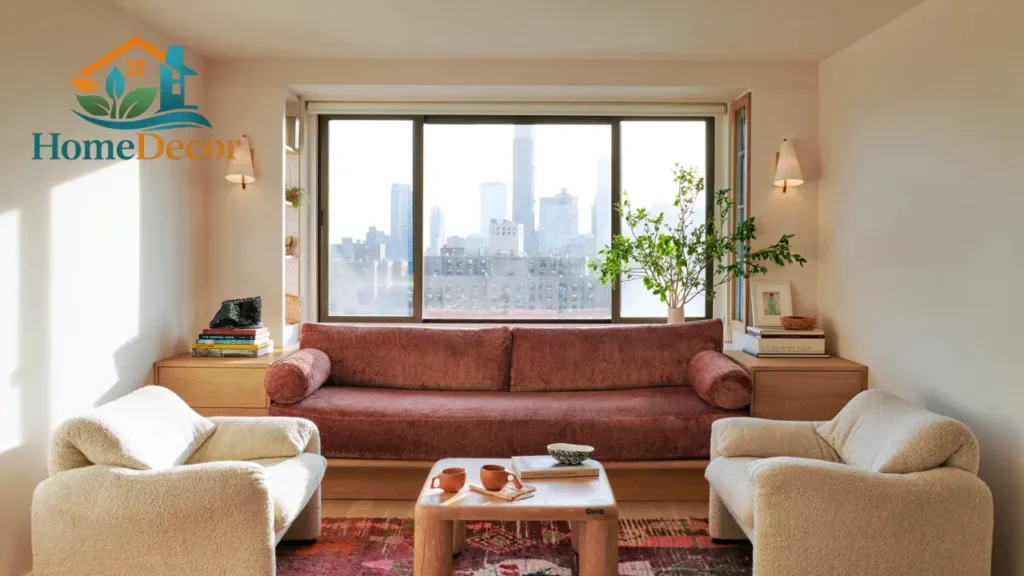
Introduction
A Small Living room Layout is never just about squeezing a sofa into a limited footprint. A space works best when it stays calm, cozy, and ready for regular life. Not cluttered rooms – but clear ones – shine brightest. Purpose shapes everything. With solid structure, the area guides motion, respects habits, keeps paths open, and lets each thing belong. Order hides in how things connect, not how much you fit inside.
Because of this, how things are placed counts way more than looks by themselves. Even with nice paintings, fancy pillows, a soft floor covering, and smooth details everywhere, the area seems off when furniture gets in the way, or pieces overwhelm the floor plan. Inside tighter spaces, size relationships, gaps between items, along with clear arrangement, carry most of the weight. It must let people move easily before it catches the eye, followed by creating quiet comfort. Once these elements line up just right, even something quite tiny opens up, finds balance, and appears put together.
A well-shaped plan can make tight spaces seem airier, even when square footage stays the same. Because corners matter just as much as centerpieces, fitting pieces smartly beats stuffing them in randomly. Some shapes invite flow, others block it – knowing which helps avoid clutter before it starts. Furniture sits better when relationships between items feel natural, like conversation spots forming on their own. Ideas shift depending on ceiling height, window position, or foot traffic patterns nobody plans for. Zones appear once purpose guides placement instead of habit dictating where things go. Mistakes repeat often, yet spotting them early stops frustration later down the line. Practical steps stick close to daily routines because comfort wins over trends every time. Style remains, but only if function comes first in rooms meant to be lived in. By next year, what feels right now will still hold up simply by working naturally.
Why Small Living Room Layout Matters So Much
A tiny lounge might seem tricky because of a few things. Crowded spaces often play a role here. Oversized pieces tend to take up too much space. Without something central, your gaze just wanders around. Bent around a corner, the route across the floor might snag on furniture, giving tightness where none should be. Yet cluttered shapes and busy patterns stir tension in the eyes, leaving calm just out of reach.
Most times, extra decorations aren’t what’s needed. Instead, a better structure makes the real difference. When you plan a compact living area carefully, things fall into place naturally. Movement becomes smoother throughout the day. The purpose behind each piece lets the space breathe easier. Open sightlines let the space breathe, making walls seem farther apart. Furniture fits as it belongs there, which quietly suggests care went into picking each piece.
Right off the bat, a solid plan handles multiple jobs without fuss. One corner becomes a natural stopping point for your eyes. Paths stay open because clutter never gets invited in. Pieces match the area they sit in – never too big, never too small. Empty spots are kept on purpose, like quiet moments between notes. Most people skip that bit, yet it shapes how light and movement flow through tight areas. Open areas aren’t empty. They give a room its calm, clarity, and balance.
Small rooms in 2026 won’t look like crowded displays. Instead, they’ll seem carefully trimmed. Zoning helps divide space while light builds depth piece by piece. Furniture stays tiny yet functional because size matters less than fit. Less happens on purpose – each item earns its spot. This approach shapes how the whole guide unfolds.
How to Plan a Small Living Room Layout the Right Way
Before buying anything, begin with the room itself. Measure the space. Note the windows, doors, radiators, built-ins, and awkward corners. Then think about how the room needs to work on a normal day. This is the point where a lot of layout problems get solved before they even begin.
A practical planning sequence is simple: purpose first, focal point second, circulation third, furniture scale fourth.
Start with the room’s main purpose
Ask what this room has to do most often. Is it mainly for TV viewing? Conversation? Reading? Family time? A lot of compact homes need one room to carry out several jobs at once. That means the layout should reflect real habits, not just a perfect showroom image. If the room must support multiple functions, the plan should quietly divide those functions into clear zones rather than trying to make one corner do everything.
This is where micro-zoning becomes useful. A reading chair near a lamp can form one zone. A sofa facing the TV can form another. A small side table by the window can form a third. The room stays unified, but each part has a distinct role. That sense of order is what makes a small room feel easier to use.
Choose the focal point first
Every living room needs a visual anchor. That focal point might be a fireplace, a TV wall, a large window, a piece of artwork, or a seating arrangement that naturally pulls attention inward. Once the focal point is chosen, the rest of the room becomes easier to arrange. Furniture can be oriented around that anchor, and the room starts to make sense as a whole.
A lot of layout confusion disappears when the focal point is defined early. Without it, furniture tends to drift toward the walls or cluster randomly in the center. With it, the room gets a direction. The eye knows where to go, and the seating can support that line of sight.
Protect the circulation path
A beautiful room is still frustrating if people cannot move through it comfortably. Circulation is one of the most important parts of any small living room layout. The walkway should feel open enough that a person can pass through without turning sideways or squeezing around corners. If a room works beautifully on paper but feels awkward to cross, it is not really working.
A useful way to think about this is to design the walking route before placing the furniture. Mark the entry points and the likely path of movement. Then place the main pieces so the route remains open. When circulation is protected, the room feels calmer, more polished, and less cramped.
Match the furniture scale to the room
Scale is one of the biggest make-or-break factors in compact spaces. A huge sectional can dominate the room. Tiny furniture can make the room look fragmented and underplanned. The right solution is not “small everything.” The right solution is correctly sized for everything.
A narrow-profile sofa, a slim coffee table, a lightweight side chair, and a petite accent table often perform better than oversized pieces. Furniture with exposed legs can also help because it creates visual lightness. The room appears less heavy when the floor remains visible beneath more of the furniture.
Leave negative space on purpose
Small rooms often look best when they are not filled to the edge. Negative space gives the eye a place to rest. It lets the room feel deliberate rather than desperate for more objects. It also helps the most important elements stand out.
In 2026, the strongest small-space interiors often lean into this edited, breathable style. They use fewer but better pieces, stronger silhouettes, and cleaner visual lines. That approach works especially well in a compact living room, where too many competing elements can quickly create stress.
Best Small Living Room Layout Ideas
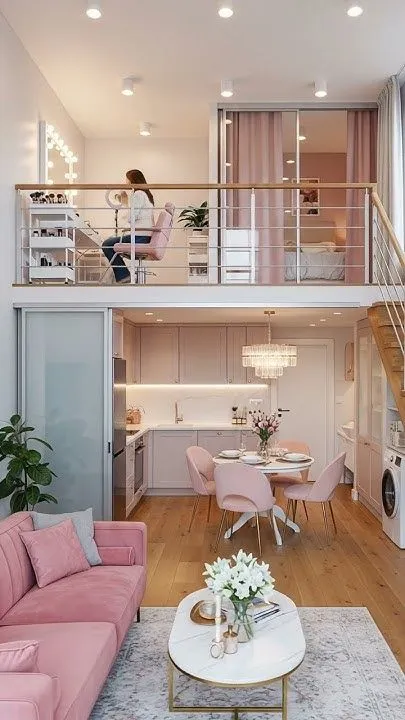
The best small living room layout ideas depend on the room’s shape, traffic pattern, and daily use. A layout that works beautifully in one room may fail in another if the proportions are different. That is why there is no single universal answer. Instead, there are a few highly adaptable arrangement types that solve common space problems well.
Floating Furniture Layout
A floating sofa arrangement is one of the most effective ways to improve a small room. Instead of pressing every large piece against the wall, you pull the main seating slightly inward and allow the room to feel layered. That simple shift adds depth. It also makes the room feel more intentional, because the furniture is creating a zone rather than just occupying space.
This layout works especially well when the Sofa Faces a TV, fireplace, or art wall. It also helps in open-plan rooms, where a small amount of separation can make the seating area feel more defined. Even a modest gap behind the sofa can improve the visual flow and make the room feel less static.
L-Shaped Living Room Layout
An L-shaped arrangement is a smart choice for a compact room because it uses the corner efficiently and keeps the center area from feeling crowded. It creates a natural conversation area while still leaving enough openness for movement. This is one of the most flexible options when the room needs to support both relaxing and socializing.
The L-shape also works well in rooms that are not perfectly square. It gives the furniture a logical structure and reduces the need to force symmetry where it does not belong. If the room has a clear corner, this arrangement can make the layout feel more grounded and less improvised.
U-Shaped Layout for a Cozy Feel
A U-shaped seating plan can be wonderful in a small room when the goal is warmth and conversation. It feels enclosed in a good way, almost like the furniture is gently embracing the center of the room. This can be very inviting if the room is used for family time or guests.
The key is restraint. A U-shape should feel intimate, not crowded. If the arrangement spreads too wide or reaches too far into the walking path, the room starts to feel blocked. When done well, though, it gives the living room a social, welcoming atmosphere.
Sofa-Less Layout
Not every small room needs a sofa. In some cases, a loveseat, two lounge chairs, a chaise, or an ottoman-centered arrangement works better. This can free up valuable floor space and make the room feel lighter. It can also give the room a more custom, editorial look because the seating mix feels more considered.
This approach is especially useful in very small apartments or in rooms that do not have enough width for a conventional couch. A sofa-less layout can still feel complete if the seating is balanced by a proper table, good lighting, and one strong focal point. The result is often a room that feels less bulky and more adaptable.
Zoned Open-Plan Layout
Open-plan rooms need subtle boundaries. Without them, the living area can drift into the dining area, hallway, or kitchen until the whole space feels shapeless. Rugs, lighting, shelving, and the backs of sofas can all help define a living zone without adding walls.
This is one of the most important small living room layout ideas for modern homes because so many compact spaces are open-plan. A living area needs its own identity even when it shares square footage with other functions. Zoning gives each area a job and helps the home feel more organized.
Corner Hub Layout
A corner can become one of the most valuable spots in a small room. A reading chair, a side table, a floor lamp, a small stool, or a plant can turn a dead corner into a functional mini-zone. This is especially useful in narrow rooms where the center has to stay open.
A corner hub is a smart way to use overlooked square footage. Instead of trying to make the center of the room do everything, you let the edges become active. That makes the room more efficient without making it feel crowded.
Small Living Room Layout Rules by Room Shape
The shape of the room is the hidden framework behind every successful arrangement. A square room has different needs from a long, narrow room. An L-shaped room behaves differently from an open-plan room. The best layout respects the architecture rather than fighting it.
Square Rooms
Square rooms are deceptively tricky. They can look balanced very quickly, but they can also become stiff if the furniture is overly Symmetrical or too evenly distributed. The best strategy is usually controlled symmetry. You want the room to feel stable without turning it into a rigid grid.
A centered rug, a clear focal point, and a carefully balanced pair of chairs or tables can help. It is often better to use fewer pieces with a stronger presence than to scatter many tiny items across the floor. That keeps the room from feeling busy.
Long Narrow Rooms
Long, narrow rooms can easily start to feel like corridors. If all the furniture lines the walls, the room becomes even more tunnel-like. The better approach is to break the room into functional segments. Use the rug to define the primary seating zone, and place furniture so the eye does not run straight from one end of the room to the other.
In a narrow room, fewer larger pieces often work better than many small ones. Too much fragmentation creates visual clutter. A single sofa, one chair, one table, and one lamp may create a stronger result than several pieces fighting for attention.
L-Shaped Rooms
L-shaped rooms are naturally suited to zoning. The shape already suggests that the room can support more than one purpose. One arm of the “L” can become the main seating area, while the other can be used as a reading nook, media area, or small work zone.
This shape is actually a gift in a compact home because it allows the room to feel organized without requiring construction or heavy division. With the right plan, the room can feel purposeful and open at the same time.
Open-Plan Rooms
Open-plan rooms need visual definition. A rug may mark the lounge area. A lamp can help define the conversation zone. A sofa back or low shelf can establish a boundary without blocking light or sightlines. In open layouts, clarity matters more than separation.
The goal is not to overload the room with more furniture. The goal is to make the space readable. When each zone has a clear function, the whole space feels calmer and more refined.
Rooms with a Window on the Short Wall
A window on the short wall can work in your favor because it brings light into the room and can make the space feel wider. Light naturally expands perception, so window placement should be part of the layout strategy. In many cases, placing seating so it benefits from the daylight can improve both comfort and visual openness.
Mirrors can support this effect by reflecting brightness deeper into the room. Used correctly, they make a small living room feel larger without adding more objects.
Furniture Placement Tips That Make the Biggest Difference
When people think about design, they often focus on style. In reality, furniture placement is what turns a decent room into a good one. The difference between “fine” and “great” is often just a few inches.
Keep Walkways Open
Movement should feel intuitive. A room feels more expensive when people can pass through it easily, without weaving around furniture or side-stepping table legs. The best layouts preserve clear circulation and avoid blockages around doors, corners, and main traffic routes.
This is why a room should often be arranged by movement first and appearance second. If the path is comfortable, the layout will usually feel better overall.
Pull the Sofa Slightly Away from the Wall
A sofa does not always need to sit flush against the wall. In many small rooms, a small gap behind it can make the arrangement feel more thoughtful and less rigid. That little bit of breathing room creates a visual lift and reduces the boxed-in feeling.
Even a narrow margin can help the room appear more layered. It is a small move with a noticeable effect.
Make Seating Easy to Talk Across
A living room is a social space, so the seating should support conversation. Chairs and sofas should not be so close together that they feel cramped, but they should not be so far apart that talking becomes awkward. Comfortable spacing helps the room feel welcoming and functional.
This is especially important in a compact living room, where the arrangement has to do more than simply look attractive. It has to support actual use.
Size the Coffee Table Correctly
The coffee table should be proportional to the sofa and to the size of the room. If it is too large, it blocks movement and dominates the center of the room. If it is too small, it looks accidental or underpowered. The goal is to create balance in the middle of the seating area.
Round tables often work well in tight rooms because they soften edges and improve circulation. Nesting tables are also excellent because they can be expanded or tucked away depending on need.
Use a Rug That Anchors the Room
A rug is one of the most powerful tools in a small living room layout because it visually ties the furniture together. A rug that is too small breaks the room into disconnected fragments. A well-sized rug creates a unified seating zone and makes the room feel more finished.
The key is to use a rug that supports the arrangement, not one that merely fits the floor. When the front legs of the main seating pieces sit on the rug, the room usually feels more stable and intentional. In many small rooms, a larger rug actually makes the space feel bigger because it reduces the number of visual breaks.
Make Sure Every Seat Has a Surface Nearby
This is a tiny detail that changes daily comfort in a big way. Every place where someone sits should have an easy-to-reach surface nearby for a drink, book, lamp, or remote. That surface can be a side table, a pedestal table, a tray on an ottoman, or a narrow console at the edge of the arrangement.
When people have a place to set things down, the room functions better. It feels more finished, more convenient, and less improvised.
Color, Lighting, and Materials That Help a Small Room Feel Bigger
Layout comes first, but atmosphere matters too. Color, light, texture, and finish can either reinforce the sense of openness or make the room feel heavier than it needs to be.
Use Light to Open the Room
Natural light is one of the most effective ways to make a small living room feel more spacious. If the room gets strong daylight, softer paint colors can help bounce that light and keep the room feeling airy. If the room is dimmer, very stark white may not always be the best answer because it can appear flat or clinical.
The smartest approach is to choose a color based on the room’s actual light. A warm neutral, a soft greige, a muted clay, or a pale earthy tone may perform better than a bright white in some spaces because it feels softer and more inviting.
Place Mirrors with Purpose
A mirror can work like an amplifier for light and space. When positioned thoughtfully, it can extend sightlines and reflect brightness deeper into the room. One large, well-placed mirror is usually more effective than several small ones because it creates a stronger visual statement.
The most useful mirror Placement is often opposite a window or across from something worth reflecting, such as a lamp, artwork, or a brighter part of the room. That creates depth instead of visual clutter.
Use Reflective Surfaces Carefully
Glass, polished metal, and lightly reflective finishes can reduce visual heaviness. They help light move around the room and make the furniture feel less solid. In a compact space, that effect can be very helpful. It is not about making the room shiny. It is about making it feel lighter and less dense.
Curves Can Soften a Tight Room
Rounded coffee tables, curved chairs, and soft-edged accessories can reduce the boxy feeling that small rooms often develop. Curves create a gentler visual rhythm. They also make a room feel less rigid and more comfortable to inhabit.
This is one reason curved silhouettes continue to be popular in small-space design. They make the room feel friendly rather than severe.
Budget-Friendly Small Living Room Layout Ideas
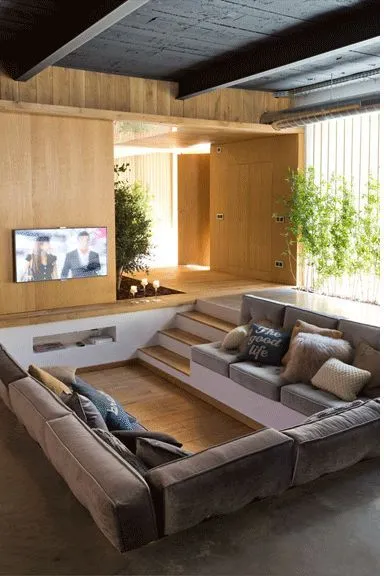
A strong room does not require expensive pieces. It requires pieces that fit the room and perform well. The most effective small-room upgrades are often practical rather than glamorous.
A compact sofa is often better than a giant sectional. Nesting tables are often better than one oversized coffee table. A slim side table is better than a bulky storage unit if the room is tight. Wall-mounted lighting can free up floor space. A wall shelf can handle storage without crowding the room. These are not flashy decisions, but they are smart ones.
A budget-conscious layout can still look polished if the room is edited carefully. The best budget strategy is usually to invest in the pieces that matter most for scale and function, then keep the styling calm and uncluttered. A small room benefits more from discipline than from quantity.
A few low-cost upgrades can go a long way. A larger rug can make the room feel more complete. A mirror can add brightness. An ottoman can double as seating and a table. A single wall light can improve the whole mood. When every item works harder, the room feels more considered.
Premium Small Living Room Ideas
Luxury in a small room is not about adding more. It is about making each choice feel deliberate and precise. High-end compact rooms often succeed because they appear edited, balanced, and quietly confident.
A slim sofa with visible legs can make the room feel lighter. Floor-to-ceiling curtains can extend the vertical feel of the room. Built-in storage can hide clutter and make the room look cleaner. A statement mirror can become both a practical tool and a focal point. A textured side table can add depth without requiring extra furniture.
Built-ins are especially valuable because they allow the room to keep necessary items without making the room look overloaded. They use wall space efficiently and reduce the need for floor-hogging storage units. That makes the room feel more tailored and more architectural.
A premium small living room often feels luxurious because it has room to breathe. The furniture is fewer, the lines are cleaner, and the balance is more disciplined. That kind of restraint reads as sophisticated.
Common Small Living Room Layout Mistakes to Avoid
Many compact rooms feel uncomfortable for the same handful of reasons. Once you know the typical mistakes, they become much easier to avoid.
Pushing everything against the walls
This is one of the most common errors. It seems logical because people want to “open up” the room, but it often has the opposite effect. When all the pieces hug the perimeter, the room can feel stiff and disconnected. The center becomes oddly empty instead of useful.
Using furniture that is too large
A single oversized sofa or extra-chunky chair can overpower a small room. Scale matters much more in compact interiors than in large ones. Even one inappropriate piece can throw off the balance of the entire layout.
Choosing a rug that is too small
A small rug breaks the room into fragments and makes the furniture look unconnected. A rug should unify the seating zone, not isolate it. This is one of the simplest fixes in the whole room, but it has a major visual effect.
Ignoring the room shape
A narrow room should not be treated like a square room. An L-shaped room should not be laid out like a hallway. The architecture must guide the arrangement. When the shape is ignored, the room usually feels awkward, even if each item is attractive.
Forgetting the room has to function
A living room is not just a visual composition. It is a daily-use space. People need to sit in it, cross it, place things on it, and relax in it. If the arrangement looks good but does not work well in real life, the layout is not finished.
Quick Pro Tips for Better Small Living Room Flow
A few small decisions can make the whole room feel better.
Measure before you buy.
Map the walkway before you place the sofa.
Choose one focal point and build around it.
Use one properly sized rug instead of several tiny ones.
Keep major furniture visually light.
Use mirrors and lamps to extend depth.
Add storage near the perimeter when possible.
Keep the seating arrangement simple and clear.
These are small actions, but together they create a much stronger result. They also reflect the core logic of modern small living room layout ideas: less clutter, better scale, clearer function, and calmer visual flow.
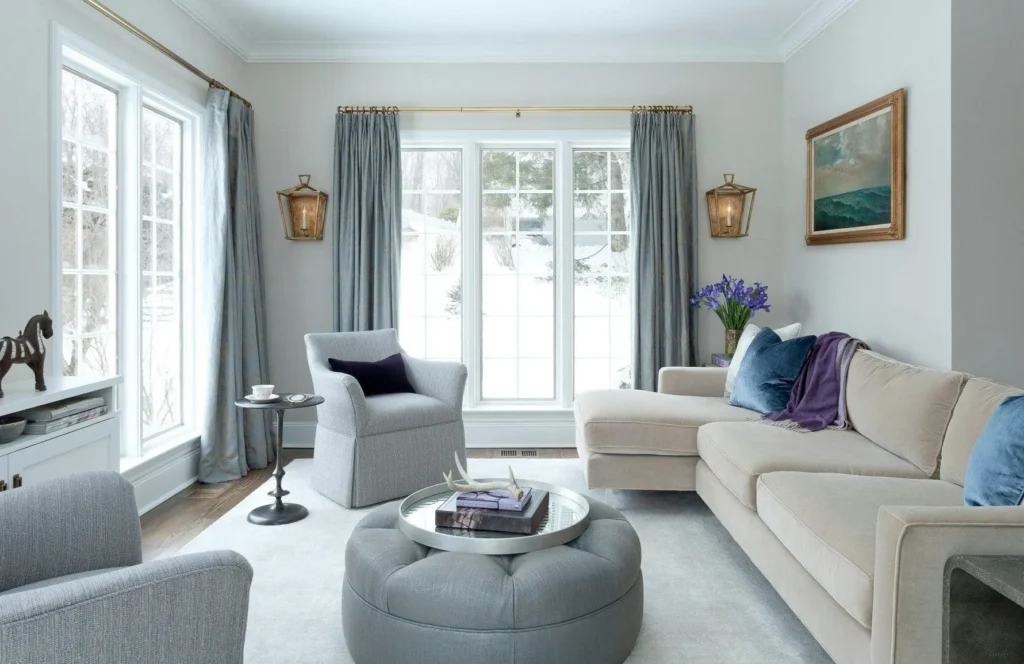
Example Layout Plans You Can Copy
Small Square Living Room
Use one compact sofa facing the focal point, one chair on the side, a medium-to-large rug, and one round coffee table. Keep enough open space for movement around the seating cluster. This arrangement works because it creates balance without crowding the center.
Narrow Living Room
Place the seating arrangement across the width of the room rather than forcing furniture to run down both long walls. Use a rug to define the sitting zone and a slim table to keep the layout useful. This helps the room feel like a room, not a corridor.
Open-Plan Living Room
Use a rug, a lamp, and the back of a sofa to define the lounge area. If needed, add a console table or low shelf to strengthen the boundary. This gives the living zone a clear identity without adding walls.
Tiny Apartment Living Room
Skip the oversized sectional. Use a loveseat or two chairs, one small table, Wall Lighting, and a storage piece that fits the wall. Add a mirror to bring in more light. This keeps the room open, manageable, and practical.
Pros and Cons
A good layout usually offers more benefits than drawbacks, but it helps to understand the trade-offs.
Pros
Makes the room feel larger without changing the footprint.
Improves movement and comfort.
Supports multiple functions.
Helps furniture look intentional and balanced.
Reduces clutter and visual stress.
Cons
Requires more planning at the start.
May mean replacing oversized furniture.
Can limit how much furniture you keep.
Needs accurate measuring before shopping.
May feel too sparse for people who like fuller rooms.
The trade-off is straightforward: fewer pieces, but better performance. In most small rooms, that is the smarter long-term choice.
Suggested Internal Links for Your Website
These internal links can fit naturally inside a content cluster about living room design:
Small Living Room Design Ideas
Living Room Furniture Arrangement Tips
Best Paint Colors for Small Rooms
Small Apartment Decorating Ideas
Modern Living Room Lighting Guide
Storage Ideas for Small Homes
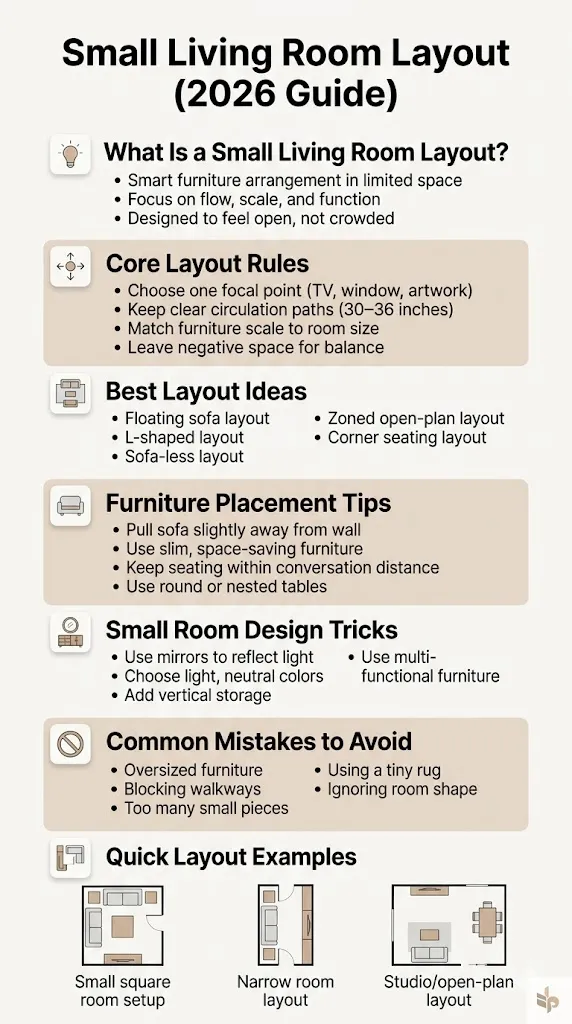
FAQs
The best layout is the one that supports your daily routine while keeping walkways open. For many rooms, an L-shaped or floating layout works well because it balances seating, flow, and openness. Current design guidance keeps emphasizing flow, scale, and focal points as the base of a good room.
A common guideline is 30 to 36 inches for walkways between larger pieces, or 18 to 24 inches in tighter spaces. Between main seating pieces, 3.5 to 10 feet is often the comfortable range.
Not always. Pulling it 3 to 5 inches away from the wall can make the room feel more open and intentional. Even a small gap can improve the look and flow.
A rug should be large enough to anchor the furniture, usually with at least the front legs of the sofa and chairs on it. A rug that is too small makes the room feel disconnected.
Break the room into zones, avoid lining everything against the walls, and use a layout that creates depth instead of a straight corridor. Light, mirrors, and a well-sized rug can also help.
Closing Thought
Space works better when it breathes, not crams. What matters most? How a room flows, who uses it, and what each piece does there. Thought shapes comfort more than size ever could. Movement becomes natural instead of blocked. Everything has its place because nothing fights for one. Cleaning takes less effort, using the area feels smooth, and moments spent inside grow calmer. Tension fades once the arrangement follows the function.
Most tiny spaces work best when they stay open. Quietness shows up where clutter could be. A single flow guides how people move through. Seating fits without crowding. One solid rug ties pieces together instead of hiding the floors. Space between things matters just as much as what fills them. Calm arrives quietly, built by choices, not stuff. The point behind designing small areas in 2026 isn’t about pretending they’re larger. It’s about letting them shine clearly – sharp, uncluttered, confident right now.
