
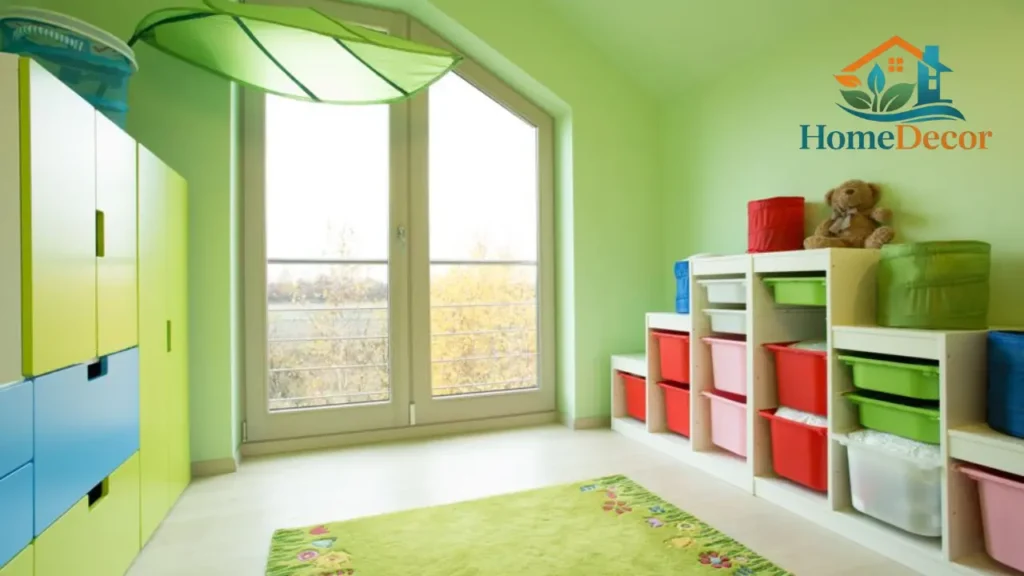
Introduction
Painting just one wall is not a shortcut. It is a deliberate design move that can sharpen a room’s focal point, improve visual balance, and add personality without forcing the entire space into one heavy color story. Benjamin Moore describes accent walls as an easy way to experiment with paint color while adding design impact, and Sherwin-Williams notes that contrasting paint can create focal points, emphasize architectural features, and shape how a room feels, all core reasons behind Why Should Only Paint One Wall in a Room as a design strategy.
By 2026, the concept sticks around – yet feels sharper somehow, nothing like those hasty days of slapping paint on any wall. Today’s look leans into quiet shades: think dusty green-gray mixes, soft sage whispers, surfaces that invite touch. Instead of shouting for attention, walls now frame spaces gently, using edges, depth, and subtle shifts. A single accent wall? It holds its ground – but only if it reads like part of a plan, built in, speaking to nearby elements without force.
What Is an Accent Wall?
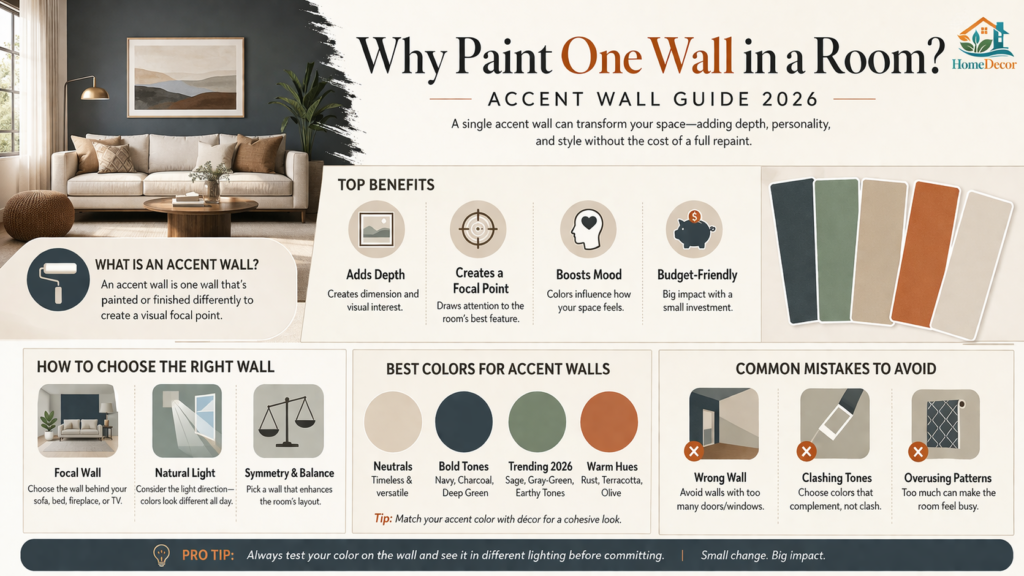
An accent wall is one wall in a room that is intentionally treated differently from the others. That difference may come from paint, wallpaper, paneling, limewash, trim, borders, plaster, wood slats, or another finish. The purpose is not only decoration. The purpose is visual hierarchy. One wall takes the lead, while the surrounding walls stay quiet,r so the room feels ordered instead of busy. Benjamin Moore frames accent walls as a way to add personality and design impact, and Sherwin-Williams recommends using contrasting color or finish to emphasize a feature rather than compete with it.
In practical terms, an accent wall gives the room a job. It may frame a bed, anchor a sofa, highlight a fireplace, support a dining table, or define a work zone. When the wall matches the room’s purpose, the space feels finished and confident. When it is chosen randomly, the room can feel split or awkward. That is why the real design question is not simply whether to paint one wall. The real question is which wall will help the whole room function and look better. Sherwin-Williams specifically recommends using paint to emphasize architectural details and create focal points, which is exactly what a good accent wall does.
Why Painting One Wall Works So Well
It gives the eye a clear landing point
Every room needs a place where attention can settle. A single painted wall creates that anchor immediately. The room feels more composed because the eye is guided to one meaningful surface instead of drifting across multiple competing finishes. Benjamin Moore says accent walls add visual interest with purpose, and Sherwin-Williams notes that a strong wall treatment can establish a focal point when a room needs one.
It creates impact without a full-room commitment. ent
One wall usually requires less paint, less time, and less labor than repainting the entire room. That makes it appealing for renters, first-time decorators, budget-conscious homeowners, and anyone who wants a visible transformation without a complete overhaul. It is one of the fastest ways to change the mood of a room while keeping the project manageable. Benjamin Moore also highlights accent walls as a simple way to bring personality into a space without overwhelming it.
It can influence mood and perception.
Color affects how a room is experienced. A university study on interior color and psychological functioning found that blue interiors were preferred most, green came next, and room lightness changed based on the interior color. The same research also found that blue was associated with studying activity. That does not mean color affects everyone the same way, but it does confirm that wall color shapes perception, preference, and the emotional tone of a space.
It helps balance proportion and scale.
A carefully chosen accent wall can make a room feel more grounded, more intimate, or more open,n depending on the shade and placement. Sherwin-Williams explains that paint can be used to emphasize architectural features and create focal points, which also affects how large or small a room feels. In a room that feels flat, one richer wall can add depth. In a room that feels too busy, one quieter wall can bring back calm.
It supports the room’s best features
Accent walls work best when they do not fight the room’s strongest elements. A fireplace, built-in shelving, arched window, bed headboard, or dining zone already gives the room a natural center of gravity. A painted wall can strengthen that feature and make it feel more intentional. Benjamin Moore and Sherwin-Williams both point toward this idea: the best wall is usually the one that enhances the architecture, not the one that merely happens to be empty.
One Wall vs Full Room Paint vs Color-Drenching
A one-wall treatment is the best choice when you want emphasis, contrast, and a controlled design statement. It is especially effective in rooms that need a little more energy or structure without losing openness. Benjamin Moore positions accent walls as an easy way to experiment, while Sherwin-Williams recommends using contrasting paint or wallpaper to create specific focus.
A full-room paint scheme is better when the goal is softness, continuity, and calm. It creates a unified backdrop and can make a room feel more settled and timeless. This works well when you want the furniture, art, and textiles to take the lead instead of the wall color. That kind of all-over consistency is often easier on the eye in compact rooms, transitional rooms, and spaces with many visual elements.
Color-drenching is the boldest path. It wraps walls, trim, and sometimes even the ceiling in a single hue, creating a more immersive and designer-led effect. Recent interior trend coverage shows more appetite for layered, enveloping, and texture-rich rooms, which makes color-drenching appealing for dramatic interiors. Even so, it is not automatically better than an accent wall. It is simply a different tool for a different mood.
The simplest way to choose is this: one wall for focus, full-room paint for harmony, color-drenching for immersion. Each approach works, but each one asks for a different level of confidence and visual commitment.
How to Choose the Right Wall to Paint
The best accent wall is usually the wall the eye notices first when entering the room. In many spaces, that is the wall behind the sofa, the bed, or the fireplace. In other rooms, it may be the wall opposite the entrance or the wall that frames the most important furniture piece. Benjamin Moore emphasizes that an accent wall should be chosen with purpose, and Sherwin-Williams recommends using contrasting paint to make an architectural feature stand out.
A good accent wall often does at least one of these jobs: it greets you when you walk in, it supports the room’s main furniture, it highlights a special architectural feature, or it helps a room feel more balanced. The strongest choices are usually the walls that already have a natural role in the layout. The more the wall contributes to the room’s function, the more successful the result tends to be.
Avoid choosing a wall only because it looks empty. Empty does not always mean appropriate. A wall with too many doors, too many windows, or too many interruptions can look cluttered once it is painted in a stronger color. Also, to avoid the wall that already competes with the room’s main focal point. A successful accent wall should support the space, not steal the spotlight from the room’s most important feature.
A simple interior-design test helps here: ask, “What should people notice first in this room?” The answer to that question is often the correct wall to paint.
How to Choose the Right Accent Wall Color
Color choice can make an accent wall feel elegant, grounded, and contemporary, or it can make the room feel disconnected. The best shade depends on natural light, artificial light, existing furniture, flooring, and the emotional tone you want to create. Sherwin-Williams notes that color can be used to establish focal points and that architecture and light matter when choosing where and how to apply it. Benjamin Moore likewise recommends thinking about the room as a whole rather than treating the accent wall as an isolated feature.
From a mood perspective, blue and green often read as calm and restorative, while warm tones such as rust, clay, mustard, and terracotta feel livelier and more expressive. Deep neutrals like charcoal, mushroom, espresso, and black feel more grounded, modern, and architectural. Research on interior color preferences also suggests that blue and green are often favored in indoor environments, with room lightness changing depending on the wall color.
Light is just as important as hue. A color that looks balanced in the morning can look heavy at night. A shade that feels cozy under warm bulbs may become dull in daylight. This is why large samples matter so much. Sherwin-Williams advises considering how color changes across different light sources, and this is one of the main reasons accent walls fail when people choose a paint color from a tiny chip or a phone screen alone.
Modern 2026 Accent Wall Ideas That Feel Current
Accent walls are still relevant in 2026, but the style language has changed. The loud, random feature wall is losing ground to more atmospheric choices. Recent trend coverage highlights gray-green and sage as especially current, while other reports point to softer contrast, texture, and handcrafted surfaces. That means modern accent walls often feel quieter, richer, and more integrated than the versions people used a decade ago.
Earthy, subdued color families
Olive, moss, sage, gray-green, clay, rust, mahogany, and muted teal are strong 2026-friendly choices. They feel layered rather than loud, which makes them easy to pair with wood, linen, stone, boucle, plaster, and matte finishes. Gray-green, in particular, is gaining attention because it feels tranquil and adaptable across changing light conditions.
Texture instead of only flat paint
Paint is still effective, but it is no longer the only option. Paneling, grasscloth, limewash, plaster, wood slats, and textured wallpaper can create a more elevated focal wall. Trend reporting for 2026 continues to favor tactile, artisanal, and material-driven interiors, which fits this direction very well. A textured wall often feels more expensive and more architectural than a simple flat color.
Borders, frames, and painted geometry
Decorative borders, painted outlines, and simple geometric shapes are becoming more visible again. These treatments add style without requiring a full-room commitment. They work well in children’s rooms, hallways, reading corners, entryways, and compact spaces where you want character but not a heavy wall of color. Sherwin-Williams also recognizes borders and wallpaper as valid ways to create an accent wall effect.
Tone-on-tone contrast
Not every accent wall needs to shout. A modern approach can use related hues from the same color family to create depth without sharp separation. For example, a warm beige room can support a deeper mushroom wall, while a pale sage room can handle a darker gray-green feature wall. The result feels calm, cohesive, and intentional rather than dramatic for the sake of drama.
Treat the ceiling and trim as part of the composition.
A current design mindset often looks at the room as a full shell, not just a set of walls. Trim, molding, and even the ceiling can change how the accent wall reads. Benjamin Moore notes that trim can become a strong design element, and Sherwin-Williams emphasizes architectural details as opportunities for contrast. In 2026, the strongest rooms usually feel planned from corner to corner instead of edited wall by wall.
How to Paint One Wall the Right Way
Decide what the wall should do
Before you choose the color, define the wall’s purpose. Should it frame the bed? Make the sofa area feel anchored? Give the office a more focused zone? Reinforce a fireplace? The job of the wall should be clear before the first coat goes on. Benjamin Moore and Sherwin-Williams both support the idea that color should serve a room’s function, not sit in isolation.
Study the light
Check the wall in the morning, Afternoon, and evening. This matters because the same color may look soft in one part of the day and much darker later on. Natural light, bulb temperature, nearby furniture, and floor reflection all affect how a wall reads. Sherwin-Williams specifically warns that light can change the appearance of color, which is why wall samples should be viewed in real conditions rather than assumed from a swatch.
Test a large sample on the actual wall.
Tiny chips can mislead you. Paint a large sample area and let it live on the wall long enough to observe it in real life. That helps you judge the undertone, the contrast, and the way the color interacts with nearby finishes. It is a simple step, but it prevents the most expensive mistakes.
Keep the rest of the room supportive.
The accent wall should lead, and the surrounding walls, furniture, curtains, rug, and art should support it. Benjamin Moore recommends tying accent color into accessories and neighboring finishes so the room feels connected rather than split. When the rest of the room is calm, the accent wall feels more luxurious and less accidental.
Prep carefully
Clean the wall, patch imperfections, tape clean lines, protect the floor, and make sure the surface is ready before painting. Good prep matters even more with darker colors or textured finishes, because flaws are easier to notice once the paint is on. Sherwin-Williams and Benjamin Moore both treat preparation as part of a successful finish, not an optional extra.
Apply even coats
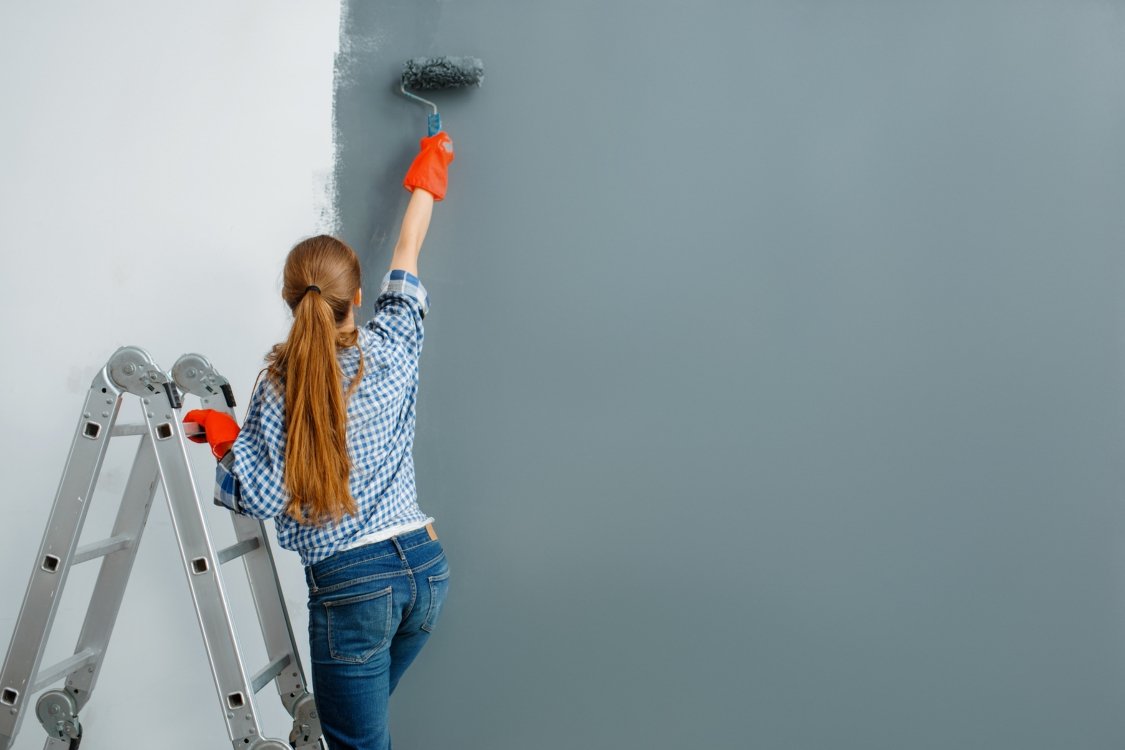
Use a brush for edges and a roller for the main field. Let the first coat dry fully before applying the next. Clean edges, steady coverage, and patience create the polished result people notice in finished interiors. Sherwin-Williams project guidance also highlights careful edging and proper drying time so tape removal does not damage the final surface.
Style the wall after the paint dries
Once the wall is finished, connect it to the rest of the room with art, lighting, shelves, mirrors, or furniture. A painted wall looks strongest when it participates in the room’s larger composition. That final styling stage is what turns color into design.
Budget-Friendly Accent Wall Ideas
A single wall already saves money compared with repainting a full room, but there are still ways to keep the project lean. A matte solid color behind a bed or sofa is one of the simplest and most effective choices. It is inexpensive, clean, and easy to update later. Benjamin Moore notes that accent walls can quickly add personality to small spaces and functional rooms without requiring a full transformation.
Peel-and-stick wallpaper is another renter-friendly option, especially when the goal is pattern rather than long-term permanence. Painted shapes and borders can also look custom without demanding much material. A tone-on-tone wall is especially smart when you want a gentle shift rather than a strong contrast. The most affordable accent wall is usually the one that looks intentional, not crowded.
Another low-cost approach is to reuse the color that already exists in the room. A shade drawn from a rug, curtain, or chair often feels more naturally integrated than a color chosen in isolation. Sherwin-Williams has long advised using existing elements as a guide when creating accent color, which helps the room feel cohesive without additional styling costs.
Premium and Luxury Accent Wall Ideas
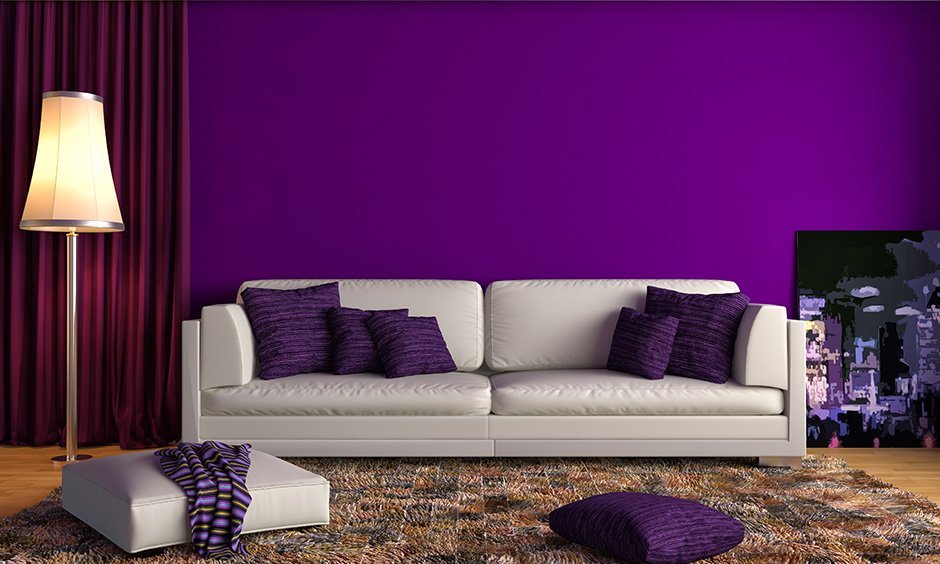
Luxury does not have to mean louder. In many interiors, it means richer, quieter, and more dimensional. Full-height paneling, limewash, plaster, wood slats, textured wallpaper, and stone-inspired finishes all create a sense of depth that plain paint alone may not deliver. Recent design trend coverage points to texture, craftsmanship, and earthy restraint as key 2026 Directions, which align closely with this more refined approach.
A premium accent wall often feels more architectural than decorative. It may wrap a fireplace, sit behind a bed as an upholstered-like backdrop, or use a deeper tone that gives the room weight without darkness. Benjamin Moore and Sherwin-Williams both emphasize that architectural details, focal points, and contrast are central to successful color placement, which is why the best luxury walls usually feel built into the room rather than added later.
You can also elevate a wall by pairing it with calm surrounding finishes. If the accent wall is textured or richly colored, keep nearby materials soft and grounded. Linen, oak, matte black, brushed brass, natural stone, and neutral upholstery help the wall feel expensive instead of overwhelming. That balance is what creates a polished room rather than just a decorated one.
Common Mistakes to Avoid
Choosing a wall that has no clear role
A wall without purpose often looks random once painted. If it does not frame furniture, support the layout, or highlight an architectural feature, it may not deserve special treatment. The best accent walls do something useful for the room, not just something different.
Using too much contrast too casually
High contrast can be beautiful, but if it ignores the rest of the room, the space can feel disconnected. The accent wall should stand out while still belonging to the same visual family as the furniture, flooring, and trim. Sherwin-Williams and Benjamin Moore both stress the importance of harmony around the accent feature.
Ignoring the room’s light
Dark shades can be rich and moody, but in a small or dim room, they may feel heavier than expected. The same is true of green-gray and deep blue tones, which can shift significantly under artificial light. That is why large samples and real-world testing are essential.
Forgetting the room’s story
The wall should connect to the room’s art, curtains, rug, upholstery, or trim. Without that relationship, the wall can feel like a detached feature instead of part of a unified composition. Benjamin Moore recommends using surrounding elements to support the accent wall, which is one reason the best results usually feel edited rather than isolated.
Skipping samples
This is one of the most common mistakes and one of the easiest to avoid. A paint color can look wonderful on a screen and disappointing on a wall. Light, gloss, texture, and surrounding color all affect the finish. Sherwin-Williams repeatedly advises planning for those shifts before committing.
Pros and Cons of Painting One Wall in a Room
A single painted wall costs less, stays sharp, and leaves room to shift direction. This setup draws the eye fast, adapts quicker when tastes change, and opens space to try bolder tones while keeping the rest calm. Experts keep reaching for it – such a move delivers a big presence on a tight budget. According to Benjamin Moore, these feature walls bring character and punch without delay.
A single accent wall might seem off when painted in a clashing shade or stuck where it doesn’t belong. When light falls flat, or the hue shouts instead of blends, the wall can sit like an afterthought, disconnected. Simple to apply, sure – yet pulling it off takes a steady eye. How does Sherwin-Williams frame focus areas and structural details? That hits the mark without tipping into excess.
Best Uses by Room
Behind the couch or fireplace, that’s where eyes land first in a living room. A bedroom feels right when the headboard sits against something bold. What catches attention there often holds the whole look together. For a workspace, pick the surface behind your chair – shelves or not – it pulls purpose into view. Dining areas? Try depth on the stretch of wall close to the table instead. A single wall painted differently in a compact room brings character without making it feel tight. Lighter tones on surrounding surfaces help, say experts at Benjamin Moore. Sherwin-Williams points out that such contrast highlights what matters – like built-ins or windows. Focus lands where intended, not scattered.
Quick Pro Tips
A bold wall can hold just one or two things, like artwork or drapes. Where attention needs to be pulled, go darker. Surrounding spaces stay pale, Textures Stay Gentle, so eyes aren’t pulled everywhere. Paint a patch right on the wall first – see how daylight changes it. A single wall can shape how the whole room feels when seen as more than just something to hang art on. Tiny choices add up, so the outcome looks thought through instead of thrown together.
FAQs
Because one wall can create a focal point, add personality, and shift the mood of a room without the cost or commitment of painting everything. Benjamin Moore describes accent walls as an easy way to experiment with paint color while adding design impact, and Sherwin-Williams explains that contrasting paint can emphasize important architectural features and create focal points.
The best choice is usually the wall you see first when entering the room or the wall behind a major feature such as a bed, sofa, or fireplace. Benjamin Moore advises that the wall should be chosen with purpose and should not compete with the room’s other features.
Yes, but it works best when it feels deliberate. The 2026 design conversation is leaning toward richer texture, calmer earthy tones, gray-green and sage shades, and more integrated room composition.
There is no single best color. Blue and green often read as calm, while earthy reds, rusts, olives, and deep neutrals create warmth, depth, and structure. Research on interior color preferences found that blue interiors were favored most, followed by green, and that color also influenced room lightness.
Yes. A small room can benefit from one wall of color, especially when the surrounding walls stay lighter and simpler. Benjamin Moore specifically notes that accent walls can add personality and design impact in compact and functional spaces.
Conclusion
One wall painted differently draws your gaze, offering rest for the eyes. Not every surface needs attention – some stay quiet on purpose. Because of how light touches paint, certain colors work better where the sun hits slowly or fades early. Mood shifts when surroundings align – the furniture, the floor, a single curtain line. Instead of feeling random, choices look intentional if balanced right. Even with newer styles leaning into layered surfaces and soft greenish grays by 2026, picking just one Wall Holds up. This isn’t lazy decorating – it skips clutter while shaping character. Clarity grows from limits, calm comes from restraint, and style shows through subtle decisions.
