
Introduction
A dining room is one of the easiest spaces to overlook during decorating. Most people spend their energy on the table, chairs, rug, and lighting first, while the walls are left blank, rushed, or filled with artwork that is too small, too high, or visually disconnected from the rest of the room. Even when the furniture is attractive, the space can still feel unfinished if the walls do not carry their share of the design.
The right Wall Art for Dining Room spaces does much more than fill an empty surface. It sets the tone, creates a focal point, and helps the room feel warm, balanced, and thoughtfully arranged. In a compact dining nook, it can make the area feel intentional. Good art gives the room identity.
This guide walks through every important decision: style, size, hanging height, layout, color, material, and mood. It also explains common mistakes, budget-friendly choices, premium styling ideas, and practical hanging rules so you can create a dining wall that feels polished rather than accidental.
Why wall art matters in a dining room
Wall art is not simply decorative filler. In a dining room, it changes how the entire space is perceived.
A strong piece of art can make the room feel calmer, richer, softer, more modern, or more personal. It can also connect different elements in the space, so the table, chairs, and lighting feel like part of a complete composition instead of separate objects placed in a room. That is especially useful in open-plan homes, where the dining area often needs visual definition.
When artwork is well chosen, the room feels complete. When it is too small, too high, or visually unrelated to the furniture below it, the room can feel awkward or underdeveloped.
What wall art does for the room
The right artwork can:
- make a plain wall feel finished
- Add color without repainting
- soften hard furniture lines
- Give a small dining nook more presence
- create a focal point in open-plan layouts
- support the atmosphere you want, whether calm, elegant, vibrant, or modern
What it does in open-plan spaces
In open-plan homes, art is especially useful because it helps signal where the dining area begins and ends. Even without walls separating the zones, the artwork can visually frame the dining space and make the overall layout feel more organized. That is one of the simplest ways to make an open-plan home feel more deliberate and less scattered.
How to choose wall art for dining room spaces
The best wall art for dining room interiors depends on the room’s scale, furniture, light, and overall style. There is no single formula that works everywhere, but there are reliable design principles that almost always help.
Start with the mood
Before choosing the artwork, decide what feeling you want the room to have.
Do you want the space to feel:
- warm and welcoming
- elegant and formal
- calm and minimal
- modern and expressive
- personal and layered
Once the mood is clear, the rest of the decision becomes much easier. A dining room that is meant for entertaining may suit richer colors and a more dramatic scale. A quiet family dining area may work better with softer tones and a relaxed composition.
Start with the furniture
The dining table, sideboard, or buffet should guide the artwork choice. The art should support the furniture, not compete with it. A long table often needs a wider piece or a multi-panel arrangement. A narrow wall may need a vertical composition. A sideboard gives you space for symmetry, pairings, or one large central piece.
Start with the wall space
A large empty wall can handle a bigger piece or a gallery arrangement. A smaller wall usually looks better with one strong print or a clean vertical stack. The objective is always balance. Empty wall space should feel intentional, not neglected.
Best wall art styles for dining rooms
There is no universal “best” style, but some choices work especially well because they suit the dining environment and do not fight with the furniture.
Abstract art
Abstract artwork is one of the strongest and most versatile choices for dining rooms. It adds atmosphere without being too literal, which means it rarely clashes with the table, lighting, or surrounding decor.
Large abstract pieces work especially well above dining tables or sideboards. They can make the room feel modern, calm, expressive, or sophisticated depending on the palette and texture. Warm abstracts bring comfort and coziness. Cooler abstract compositions feel more restrained and refined.
This is one of the most dependable styles for wall art for dining room design because it fits many interior types, from minimal and contemporary to transitional and softly luxurious.
Botanical and nature-inspired art
Botanical prints, floral studies, and nature scenes bring freshness and organic softness into the room. They are ideal when you want the dining space to feel soothing, cheerful, or a little more traditional.
This style works especially well with wood finishes, neutral walls, and daylight. A pair of botanical prints can look elegant above a sideboard, while a single larger plant study can create a gentle focal point above a table.
Landscapes and scenic art
Landscapes are timeless and versatile. They often bring a sense of calm, Openness, and quiet elegance to a dining room. That makes them a strong choice for formal dining rooms, classic interiors, and spaces where you want the wall to feel serene rather than busy.
Landscape art can also make the room feel more connected to nature without introducing literal greenery or excessive ornament. It is a dependable way to add depth and atmosphere.
Black-and-white photography
Black-and-white photography feels crisp, polished, and adaptable. It suits minimalist, modern, and transitional homes well because it brings visual structure without introducing too much color.
This style is easy to coordinate with existing decor because it rarely clashes with the room palette. If your dining room already contains strong tones, black-and-white artwork can act as a balancing element and keep the room from feeling overdone.
Gallery walls and personal photos
Gallery walls are ideal when you want the room to feel personal, collected, and lived-in. Family portraits, travel images, meaningful moments, recipe prints, and mementos can all work, especially when framed consistently.
The key is restraint. A gallery wall looks best when spacing, frame color, and image style feel connected. Without that cohesion, the wall can quickly look crowded or fragmented.
Geometric and line art
For modern interiors, geometric prints and line drawings are a smart match. They are clean, structured, and easy to integrate with other decor. They are especially useful in smaller dining spaces because they bring interest without adding visual noise.
If you prefer a contemporary look that still feels subtle, this is one of the easiest options to style.
How to choose the right size
Size is one of the biggest decisions in dining room wall art. Too small, and the wall looks unfinished. Too large, and it can overpower the room. The right size creates confidence and visual balance.
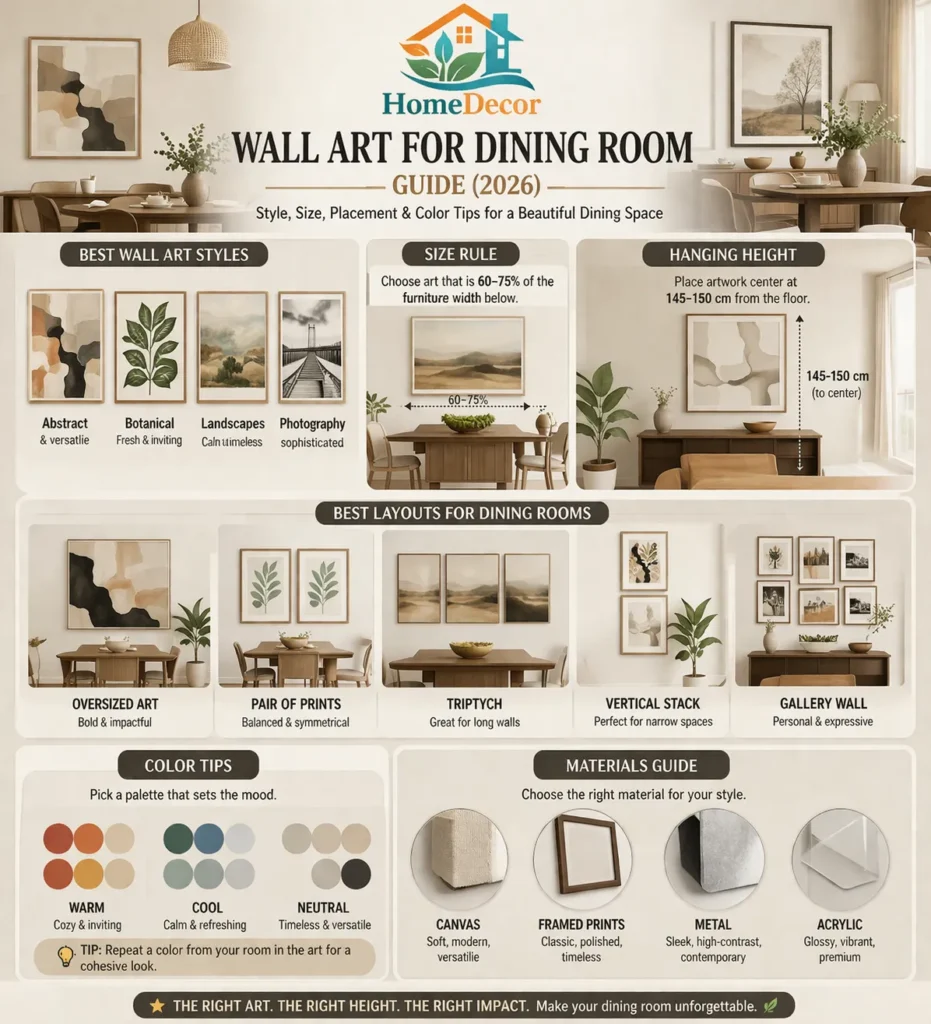
A useful rule is to choose art that is roughly 60% to 75% of the width of the furniture below it. That proportion works well above dining tables, sideboards, and buffets because it creates a balanced relationship between wall and furniture.
Simple size guide for dining room wall art
| Wall or furniture width | Recommended art width | Best format | Notes |
| 120 cm / 48 in | 60–90 cm / 24–36 in | One print or a small pair | Good for compact dining nooks |
| 180 cm / 72 in | 90–135 cm / 36–53 in | One large piece or diptych | Strong for standard sideboards |
| 240 cm / 94 in | 120–180 cm / 47–71 in | Triptych or large canvas | Works well above long tables |
| 300 cm+ / 118 in+ | 150–225 cm / 59–89 in | Oversized art or gallery wall | Best for feature walls |
How to size furniture
Above a dining table, aim for art that feels about two-thirds the width of the table.
Above a sideboard, the art should feel visually connected to the furniture and not float too far above it.
On a blank feature wall, you usually need a larger piece than your first instinct suggests.
On a narrow wall, vertical art or a tall arrangement usually works better than a wide one.
The easiest sizing rule
When choosing between two sizes, the larger one is often the better choice. Dining room artwork usually looks best when it feels deliberate and proportionate. Too-small art is one of the most common reasons a dining wall feels weak.
How high to hang wall art above a dining table
Hanging height matters just as much as the size of the artwork. Even a beautiful piece can look wrong if it is placed too high.
A strong starting point is to place the artwork’s center at 145–150 cm from the floor. That generally sits near eye level and helps the piece feel grounded in the room rather than disconnected from the furniture.
Practical hanging guide
Above a dining table
Keep the artwork visually linked to the table. Do not hang it so high that it feels detached from the dining zone. The art should feel like part of the same composition as the table and chairs.
Above a sideboard
Leave roughly 15–20 cm between the top of the furniture and the bottom of the artwork. That spacing usually looks neat, intentional, and professionally balanced.
On a high wall
Use a larger piece instead of hanging a small piece too high. Bigger art helps the wall feel anchored and reduces the sense of emptiness.
In a small room
Keep the artwork slightly lower and more intimate. Small rooms usually feel better when the artwork stays closer to the furniture line.
The most common hanging mistake
The biggest mistake is hanging art too high. When that happens, the piece loses its relationship with the table, and the room starts to feel fragmented. Dining room art should support the furniture layout, not drift away from it.
Best layouts for different dining rooms
The best layout depends on the wall shape, room size, and visual style you want.
One oversized piece
This is the simplest and most modern approach. One large artwork creates a strong focal point and removes visual clutter. It works beautifully in minimalist, contemporary, and open-plan dining rooms.
A pair of prints
Two matching pieces create symmetry, rhythm, and calm. This layout is ideal for wider walls or spaces with a long sideboard where balance matters.
A triptych or three-piece set
A three-panel arrangement works very well over long dining tables. It adds structure and visual movement while still feeling cohesive.
A gallery wall
A gallery wall is perfect if you want the dining room to feel personal and expressive. It can include photographs, prints, line drawings, and travel images. The key is to keep the spacing even and the framing consistent enough to make the wall feel edited rather than random.
A vertical arrangement
In narrow dining rooms or tighter walls, a vertical stack of two or three pieces can make the room feel taller while using less horizontal space. This is a smart solution when the width is limited.
Layout comparison table
| Layout type | Best for | Strength | Watch out for |
| One oversized piece | Modern rooms, open-plan spaces | Clean focal point | Needs a correct scale |
| Pair of prints | Wide walls, sideboards | Balanced and neat | Can look small if undersized |
| Triptych | Long tables, large walls | Strong rhythm | Needs even spacing |
| Gallery wall | Personal rooms, family homes | Flexible and expressive | Can become messy |
| Vertical stack | Narrow rooms | Adds height | Can feel thin if the artwork is too small |
Wall art for the dining room by style
Different dining room styles call for different visual languages. The artwork should feel like a natural extension of the space.
Modern dining rooms
Modern Rooms usually look best with:
- abstract art
- geometric prints
- black-and-white photography
- oversized canvas pieces
- minimal framing
The goal is to keep the room calm, controlled, and uncluttered.
Traditional or formal dining rooms
Traditional rooms often suit:
- landscapes
- botanical prints
- framed reproductions
- warm color palettes
- decorative frames
These choices help the room feel elegant, composed, and timeless.
Rustic or farmhouse dining rooms
Rustic rooms often work well with:
- nature-inspired prints
- wood-framed art
- muted landscapes
- canvas pieces
- warm earthy colors
These options support a cozy, grounded, and welcoming atmosphere.
Eclectic or boho dining rooms
Eclectic rooms can handle more variety:
- mixed-media art
- layered Gallery Walls
- personal photography
- colorful abstract pieces
- textured prints
The key is still connection. Even a mixed style looks better when it shares one or two common threads, such as color family, frame finish, or subject matter.
Small dining spaces
In compact rooms, the best artwork is art that defines the zone without crowding it. Choose one strong piece, a small pair, or a vertical composition. In a small space, clarity matters more than complexity.
Open-plan dining spaces
In open-plan homes, the wall art should echo colors or tones from nearby rooms so the dining area feels part of the same visual story. Art that repeats a tone from the rug, chairs, curtains, or nearby furniture will feel integrated and purposeful.
Best materials: canvas, framed prints, metal, acrylic
| Material | Look and feel | Best for | Pros | Trade-offs |
| Canvas | Soft, clean, versatile | Modern, casual, everyday rooms | Lightweight, easy to style, flexible | Less formal than framed art |
| Framed print | Polished, structured, classic | Traditional and formal dining rooms | Timeless, elegant, easy to coordinate | Can feel heavy if overused |
| Metal print | Crisp, high-contrast, contemporary | Industrial or modern rooms | Strong impact, sleek finish | Can feel too cool in softer interiors |
| Acrylic print | Glossy, premium, gallery-like | Luxury or statement rooms | Bold, bright, modern presence | More dramatic and attention-grabbing |
Many dining room guides compare these four materials because they each create a different effect.
Color ideas that make dining rooms feel better
Color matters a great deal in dining rooms because it influences the mood of conversations, meals, and gatherings.
Warm color palettes
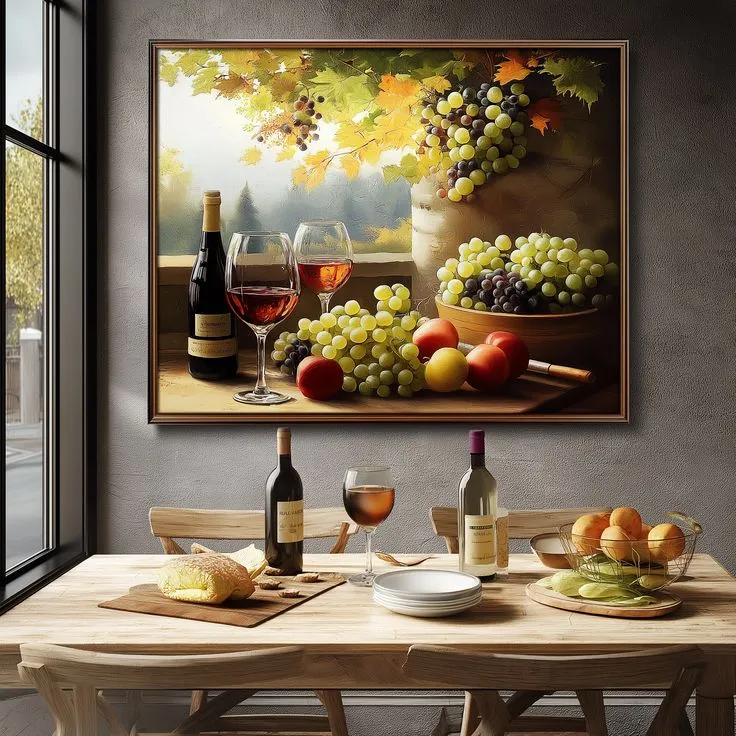
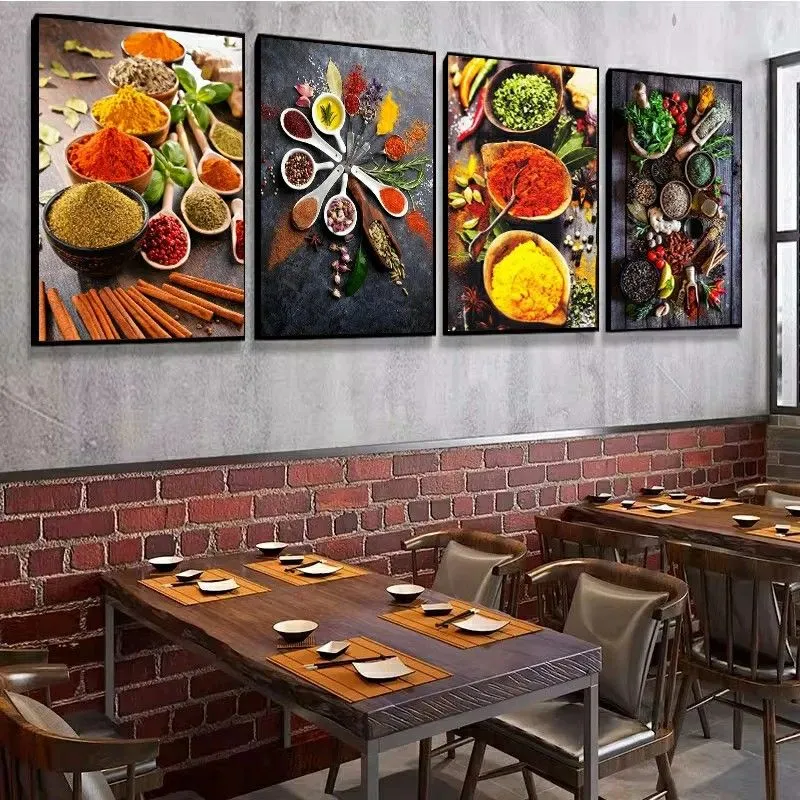
Warm tones such as terracotta, rust, gold, ochre, coral, and earthy red can make a dining room feel lively, social, and inviting. These colors are excellent when the room is used for entertaining.
Cool color palettes
Blues, greens, greys, and charcoal tones feel calm, composed, and elegant. They work well in minimalist or formal interiors and are a good choice when you want a more refined mood.
Neutral palettes
Beige, taupe, sand, ivory, and black-and-white combinations are easy to live with and adapt well to changing furniture or textiles. Neutral art also makes it easier to restyle the room later without replacing everything.
Matching the room around it
The best artwork often connects to at least one existing element:
- the dining chairs
- the rug
- the curtain color
- the table finish
- the wall paint
That connection makes the room feel coordinated instead of accidental.
Budget-friendly dining room wall art ideas
A stylish dining room wall does not need a large budget. Smart choices often look better than expensive but poorly scaled purchases.
Smart low-cost options
- Buy one large print instead of many tiny ones
- Use a canvas print instead of a custom framed package
- Create a gallery wall using personal photos
- Mix affordable prints with one stronger statement piece
- Choose ready-made sets to save time and money
Why large often works better than many small pieces
A single larger artwork often appears more elevated than a collection of tiny pieces. It also gives the room a cleaner visual line, which helps the wall feel more polished, even on a limited budget.
Best budget tactic for renters
Use removable hanging solutions whenever possible, and choose lightweight art that is easy to reposition. That keeps the room flexible and prevents wall damage.
Premium and luxury ideas
If you want the dining room to feel more elevated, the strongest strategy is usually to go bigger, cleaner, and more intentional.
Luxury choices that work well
- oversized statement art
- custom framing
- textured prints
- acrylic finishes
- curated diptychs or triptychs
- art with strong negative space
What makes a dining room feel premium
Luxury is often about restraint rather than excess. A well-scaled artwork with enough breathing room can feel far more expensive than a wall packed with too many pieces.
Best premium styling move
Choose one large piece and give it room to breathe. That simple choice can transform the whole dining space.
Common mistakes to avoid
These are the errors that most often make dining room wall art fall flat.
- choosing art that is too small
- hanging it too high
- centering it on the wall instead of the table or furniture
- using colors that fight the room palette
- filling the wall without a plan
- mixing too many frame styles
- ignoring the room’s light and how it changes color
These mistakes are easy to avoid when you think about the dining room as a complete visual composition rather than an empty wall waiting to be filled.
Maintenance, care, and durability tips
Dining rooms are usually less demanding than Kitchens, but the artwork still benefits from practical care.
Keep the art clean
Dust framed pieces and canvases gently with a soft, dry cloth. Avoid water unless the material allows it.
Avoid direct sunlight
Strong sunlight can fade colors over time. If the wall gets a lot of sun, use UV-protective glass, a matte finish, or a less exposed wall.
Watch humidity
If the dining room sits near an open kitchen or a damp area, choose materials that hold up well in daily use.
Make it family-friendly
If the room gets used heavily, do not place fragile artwork where it can be bumped by chair backs, bags, or moving furniture.
Smart, modern, and future-ready ideas
Dining room wall art can be practical as well as beautiful.
Seasonal rotation
Use artwork that can be swapped throughout the year. This keeps the room fresh without changing the furniture.
Modular arrangements
Photo tiles, small framed sets, and interchangeable prints are useful if you like variety or live in a rental.
Better lighting
Picture lights, wall washers, or adjustable lamps can make art feel more complete, especially in the evening.
Sustainable choices
Long-lasting materials and fewer, better pieces are a smarter approach than constantly replacing inexpensive decor.
Pros and cons of the most common dining room wall art approaches
Large single artwork
Pros: clean, modern, easy to style, strong focal point, works in many room sizes.
Cons: less personal than a gallery wall, and it needs the right scale to avoid looking weak.
Gallery wall
Pros: personal, flexible, great for family memories, useful on large blank walls.
Cons: more difficult to plan, and it can look messy if spacing is inconsistent.
Framed prints
Pros: polished, timeless, easy to coordinate with formal dining rooms, suitable for classic interiors.
Cons: can feel heavy if the room is very modern or minimal.
Canvas art
Pros: versatile, lightweight, easy to position, modern in feel.
Cons: less structured than framed art and may not suit a very formal room.
Practical examples for real dining rooms
Small apartment dining nook
Use one medium abstract canvas above the table. Keep the frame simple. Choose warm neutrals so the nook feels finished without becoming crowded.
Long dining room wall
Use a triptych or two large matching prints above a sideboard. Keep the spacing even and repeat one tone from the rug or chairs for cohesion.
Formal dining room
Use one large framed landscape or a classic botanical print. Add a picture light above it for a refined, polished finish.
Open-plan dining space
Use oversized art that reflects colors from the surrounding living area. That keeps the dining zone visually connected to the rest of the home.
Family dining room
Use a small gallery wall with matching frames and evenly spaced photos. Keep the arrangement calm, consistent, and easy to read.
Quick tips from an interior designer
Start with the furniture width, not the wall width.
Choose art that matches the room’s mood.
Use fewer, larger pieces instead of many tiny ones.
Keep the center of the art close to eye level.
Repeat at least one existing room color in the artwork.
When in doubt, choose the cleaner layout.
These simple rules solve most dining room art problems quickly and reliably.
FAQs
A reliable rule is to choose art that spans about 60% to 75% of the width of the furniture below it. For longer walls, a pair or trio of pieces can also work well.
A good starting point is to place the artwork’s center at 145–150 cm from the floor. If the art hangs above a sideboard, leave about 15–20 cm between the furniture and the artwork. Hanging guides commonly use the same eye-level standard, often near 57 inches to the center of the piece.
Abstract art, botanical prints, landscapes, black-and-white photography, framed prints, and personal photo art all work well. The best choice depends on the mood you want and the room’s style.
Canvas feels softer and more modern. Framed art feels more polished and traditional. The better choice depends on the room style and the furniture below the art.
It should usually be centered on the table or furniture beneath it, not just on the empty wall. That keeps the room visually balanced.
Conclusion
The best wall art for dining room spaces is the kind that fits the room’s scale, supports the furniture, and improves the mood without overwhelming the wall. Start with the right size, hang it at a balanced height, and then choose a style and material that suit how the room is used.
When the artwork feels proportional, connected, and intentional, the whole dining room becomes more complete, more inviting, and more Memorable.
