

Introduction
Large Living Room Wall Art does far more than cover an empty surface. A single piece sets the pace for how eyes move through the space, shifting attention where needed. Mood shifts too, guided by color and form rather than chance. Furniture finds its place more naturally when something holds the wall with purpose. Bare surfaces gain intent, becoming part of the plan instead of afterthoughts. When square footage is tight, a well-chosen image brings order without crowding. Large areas benefit just as much – empty corners lose their emptiness when filled with presence, not volume.
Big wall art works well because it shapes how a space feels. With ease, it brings personality without needing much effort. From sleek modern setups to cozy vintage corners, one strong piece pulls colors and textures together. Even in simple rooms, it adds depth quietly. Wherever order or chaos rules the decor, this kind of detail balances what’s already there.
This step-by-step walkthrough uses everyday words to explain each part. Picking big artwork for your main room becomes easier once you see how proportions matter. Size plays a role, yes – yet location matters just as much. Depending on your space, certain designs fit better than others. Hanging methods can make or break the look, even with perfect pieces. Mistakes happen often, though many are preventable with small adjustments. Some options cost very little, while others reflect higher investment choices. Maintenance tricks help keep things looking sharp over time. Newer arrangements for 2026 lean into subtle shifts rather than bold statements.
Large Living Room Wall Art Importance
That blank wall? It sits there, waiting. Suddenly, a painting appears – space settles into balance. Shapes meet eyes, thoughts slow down.
Big pieces on walls draw attention first. Without one, your gaze might drift aimlessly through space. A bold image stops that drift, guiding sight toward something solid. Over furniture like couches, mantels, narrow tables, or large seating groups, such an anchor makes sense. It settles the energy, quietly organizing what feels scattered.
A room feels off when things don’t match up. Large couches, sprawling seating sets, high ceilings, or flowing spaces often demand something steady to ground them. Placing a small image on a broad wall tends to vanish from view. Something bigger, or several items arranged with care, brings the wall into step with the furnishings beneath.
A single big piece on the wall changes how a room feels. Even when floors shine, lights glow just right, furniture costs plenty, something stays cold. Paintings warm it up, somehow. Quiet countryside scenes slow your breath without warning. A burst of color on canvas wakes up the room. Yet shadows in a photo strip pull things back with quiet grace. Meanwhile, leaves curled into ink stains lend breath where corners feel sharp.
A fresh touch comes through fullness. Most lounges almost hang together yet stay oddly incomplete since blank walls leave gaps. A big painting tidies this up without delay. The purpose shows clearly then. The space speaks of planning, not just filling things in.
Create a focal point
Something feels right when the space sits evenly. A fullness appears without crowding. The eye moves without catching. Each piece lands where it should. Not too much, never lacking. Completion comes quietly.
Staying interesting doesn’t depend on trends. A lasting look skips quick fixes. Time passes, yet some things keep drawing attention. Not everything fades when the moment shifts. What matters settles in slowly. Focus leans toward what lasts, not what shouts loudest now.
A painting might vanish into the walls if it just hangs there quietly. Yet when it clicks – matching light, mood, shape – it starts humming with the space. Walls lean on it. Corners listen. The ceiling feels different above it. Not separate anymore, but stitched in, like a beam or shadow that belongs.
Choosing large wall art for your living room
A single glance might pull you in, yet scale often decides whether it belongs. Even Stunning Pieces feel off when colors clash, or shapes fight the walls. Match the mood of the artwork to the quiet energy a room already holds. Size matters just as much as subject – too small disappears, too large overwhelms. What hangs must speak to both eye level and intention.
Start with the mood of the room
What kind of vibe should your living room give off? Maybe peaceful, bold, elegant, warm, fun, creative, or light-filled. Pictures on the walls can quickly shape that feeling. A painting might settle the space, while a bright print could spark energy.
Soft colors tend to make a crowded family area feel warm. Yet elegance shows up best through careful borders when the room feels dressed up. Even bold choices find their place where imagination leads design decisions.
Look at the furniture before anything else.
Art above your furniture works best when it matches what’s below. Think of size first – big couches ask for bold pieces that fill space. Long, low shelves? Try something stretched out but not too heavy on the eyes. If the seat looks airy and simple, go for artwork that feels just as calm. Chunkier setups carry weight better, so darker tones, sharper edges, or oversized frames fit without tipping the balance.
A painting leans into a chair’s shape, making the whole room seem meant to be. If it does not, the walls sit apart like strangers at a party.
Start by pulling hues straight out of the space itself
Start by pulling out a couple of shades you already see around you. Maybe they’re hiding in the fabric of throw pillows or woven into the rug near your feet. Sometimes the curtain trim holds a hint worth using elsewhere. A lampshade could offer up one tone, an armchair another. Build quiet balance by echoing what’s there – no need to invent anything new.
Exact color matches aren’t necessary. Too much precision often feels stiff. Try letting colors respond to one another instead. A space with soft beige, creamy accents, and wooden finishes? Muted browns and ochres tend to settle right in. Rooms built on gray, white, and black might welcome a sharp image in solid blacks and whites. Harmony comes through rhythm, not repetition.
Decide whether you want harmony or contrast
Some rooms look best when the artwork gently blends in. Other rooms need contrast to feel alive. A neutral room might benefit from a bright, saturated painting. A colorful room may need calmer artwork to create visual breathing room.
Both approaches can work. The best choice depends on whether the wall needs energy or balance.
Match the shape of the wall
A wall’s shape matters as much as its size.
Tall walls often suit vertical artwork or stacked compositions.
Wide walls usually look better with horizontal pieces, panoramic scenes, or multi-panel arrangements.
Large blank walls may call for a single oversized piece or a structured gallery wall.
Narrow wall sections often benefit from a slim vertical format or a pair of aligned pieces.
Choosing the right shape creates architectural harmony
Think about the viewing distance
Artwork should make sense from where people actually sit and walk. In a large living room, viewers may see the art from the sofa, from the doorway, or from across an open-plan space. That means the piece needs enough clarity and scale to hold attention from a distance.
Tiny details can get lost if the art is too small or too delicate. A stronger composition reads better in a spacious room.
Decide between one statement piece or a group
A single oversized artwork creates a clean, powerful look. A set of framed pieces or a Gallery Wall tells a more layered story. Neither is universally better.
Choose a single piece when you want simplicity, confidence, and visual calm.
Choose a grouped arrangement when you want variety, movement, and a more collected feeling.
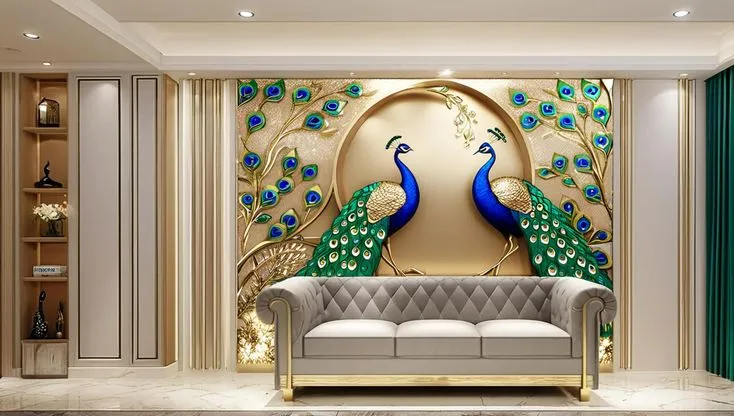
Large Living Room Wall Art Size and Placement Rules
This is where many decorating mistakes happen. People often choose art that is too small, hang it too high, or place it too far from the furniture below it. A few basic rules can solve most of those problems.
The width rule
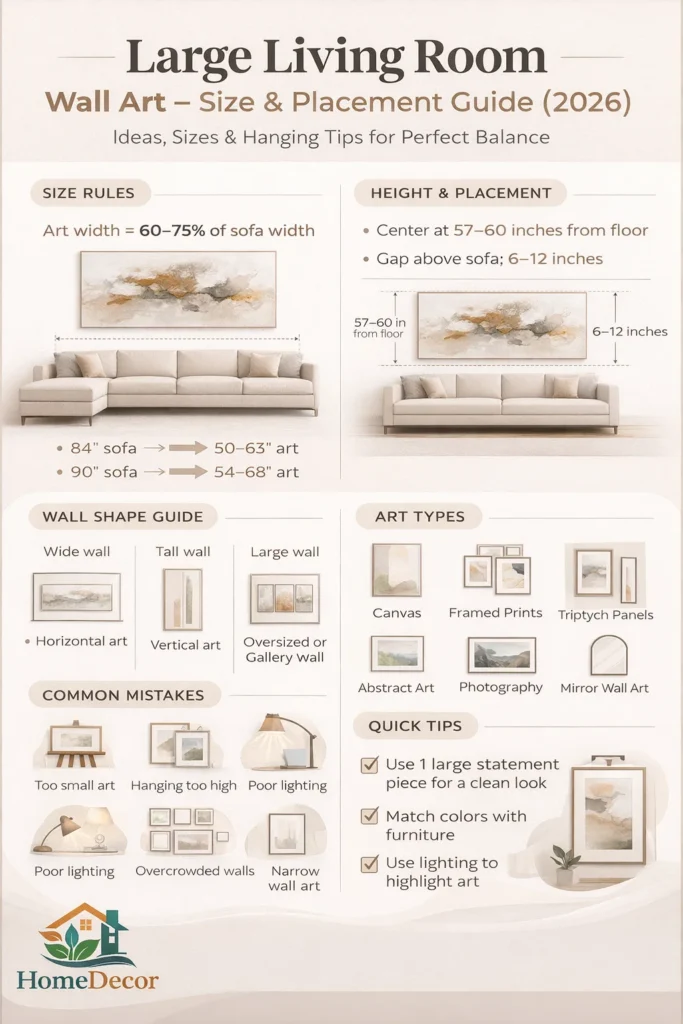
A reliable approach is to select wall art that spans about 60 to 75 percent of the width of the furniture beneath it, especially above a sofa. This creates the right proportional relationship between the wall decor and the seating area.
For example, if the sofa is wide, the art should have enough breadth to feel visually related. If the sofa is narrow, the art should not extend so far beyond it that the composition feels awkward.
The height rule
Artwork usually looks best when its center sits around eye level. In many homes, that means approximately 57 to 60 inches from the floor to the center of the piece. That height helps the art feel naturally placed rather than floating too high on the wall.
When hanging art above furniture, the bottom edge should usually sit close enough to the piece below it to feel connected, but not so close that the wall becomes crowded.
The clearance rule
Leaving roughly 6 to 12 inches above furniture is a useful, practical starting point. This is not a rigid law, but it helps prevent the common mistake of hanging art too far away from the sofa, sideboard, or console table.
The room scale rule
A large room usually needs stronger art. The greater the wall expanse and viewing distance, the more the piece must carry visual weight. Large artwork should not merely fill space; it should command it with confidence.
Simple placement guide
| Placement Area | Recommended Approach | Why It Works |
| Above sofa | Art should be about 60–75% of the sofa’s width | Keeps the composition balanced |
| Above console table | Aim for half to two-thirds of the table width | Feels intentional and refined |
| Large blank wall | Use one oversized piece or a grouped arrangement | Prevents fragmentation |
| Tall wall | Choose vertical art or stacked panels | Helps the room feel taller |
| Wide wall | Use horizontal art or a panoramic format | Matches the wall’s shape |
How many pieces should you use?
The answer depends on the wall and the mood.
A single large piece works well when the goal is elegance and clarity.
A pair of artworks creates symmetry and polish.
A triptych suits long walls and modern interiors.
A gallery wall is ideal when the room benefits from personality, story, and layering.
A practical beginner check
If you are unsure, place the artwork on the floor and step back. If it already feels too small there, it will almost certainly look too small on the wall.
Useful starting examples
An 84-inch sofa often pairs well with art around 50 to 63 inches wide.
A 90-inch sofa can usually handle artwork around 54 to 68 inches wide.
A large blank wall above a sectional often looks better with one large canvas or a three-panel set than with many tiny frames.
A tall wall with high ceilings often benefits from vertical artwork or layered arrangements.
Best Types of Large Living Room Wall Art
Different artwork types create different emotional effects. The best choice depends on the room’s architecture, furniture, and personality.
Oversized canvas art
Canvas is one of the most versatile options. It has a Soft Finish, feels modern, and works well in contemporary, transitional, and minimalist homes. Canvas art is often a strong solution when you want impact without a heavy frame.
Framed prints
Framed artwork looks polished, structured, and timeless. It is a strong fit for traditional rooms, elegant interiors, and gallery-style arrangements. Frame material matters too. Black frames feel crisp and graphic. Wood frames feel warm. Metallic frames introduce a more refined or luxurious tone.
Triptych and multi-panel art
A triptych divides one image into three parts, which works beautifully on long walls. Multi-panel art adds rhythm and movement while keeping the overall look cohesive. This is especially useful above large sofas or sectionals.
Abstract wall art
Abstract pieces are a favorite in modern interiors because they offer color, form, and energy without being literal. They can feel bold or subdued, depending on the palette. Abstract art is especially effective when you want the room to feel creative and contemporary.
Photography art
Photography brings realism, depth, and sophistication. Black-and-white photography creates elegance and contrast. Color photography can add travel-inspired interest, natural beauty, or urban character. Landscape photography often works beautifully in living rooms because it adds openness and calm.
Textured and dimensional art
Metal, wood, woven fiber, and mixed-media art introduce physical depth. These pieces catch light differently throughout the day, which makes them feel dynamic. Textured art is a smart choice when the room needs a tactile, layered quality.
Gallery walls
A gallery wall gives you room to mix photographs, prints, sketches, and meaningful images. It works well when you want a collected, personal, or evolving aesthetic. It can be formal and symmetrical or relaxed and eclectic.
Large mirrors used as wall art
A mirror can function like art because it reflects light, expands the room visually, and creates a strong focal point. This is especially useful in smaller living rooms where you still want a statement piece without adding visual heaviness.
Sculptural wall decor
Metal forms, carved wood elements, and layered wall objects can act like art while adding dimension. This type of decor is often used in designer spaces because it feels more architectural and less like a traditional framed picture.
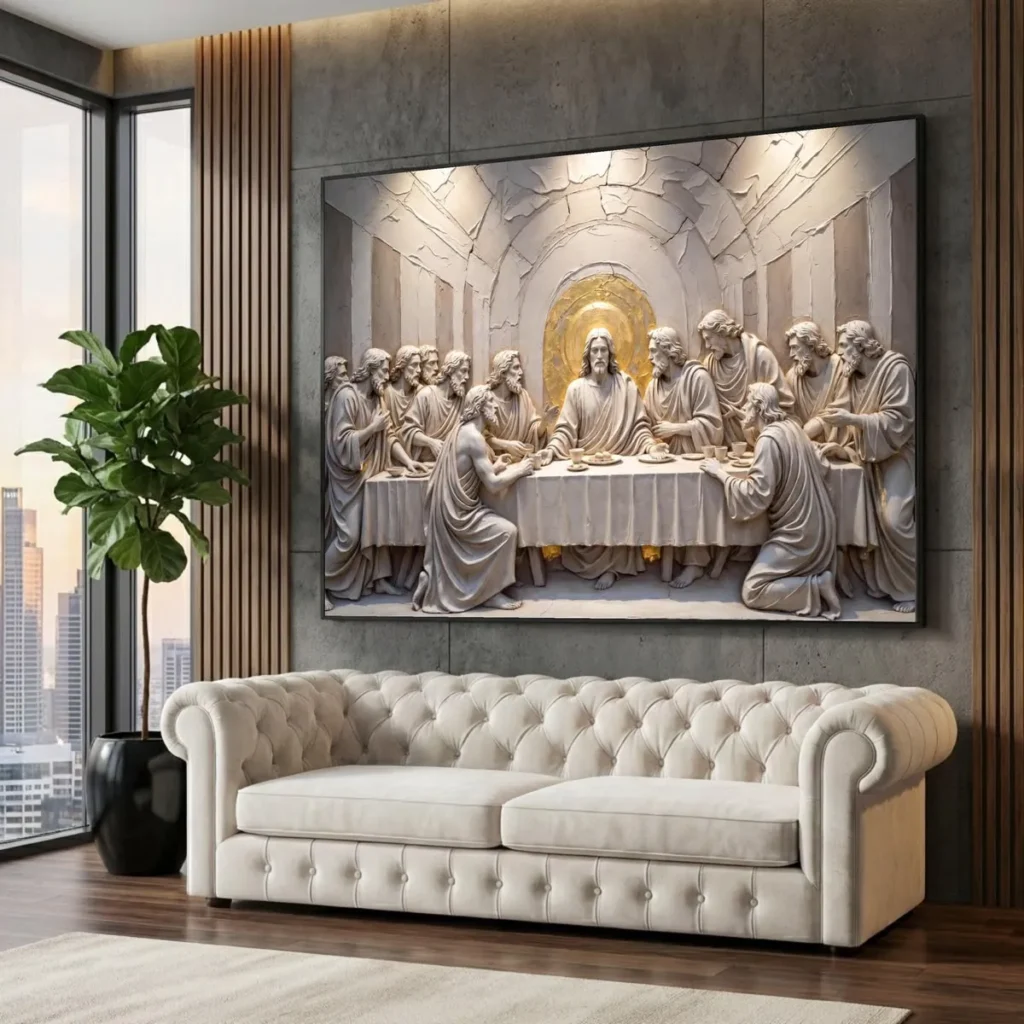
Large Living Room Wall Art Ideas That Work Beautifully
Here are practical, style-friendly ideas that can work in many different living rooms.
One oversized abstract canvas
This is one of the easiest ways to create a strong statement above a sofa or console table. It feels clean, bold, and modern.
A panoramic landscape
A wide landscape scene stretches visually across the wall and can make the room feel calmer and more expansive.
A black-and-white photo series
This is timeless, elegant, and very easy to coordinate with different furniture styles.
A symmetrical pair of prints
Two matching or coordinating artworks can create balance in a formal or refined living room.
A three-panel artwork set
Triptychs are especially useful for big walls because they create movement without clutter.
A floor-to-ceiling gallery wall
This works well in tall spaces, artistic homes, and areas where you want the wall to feel collected and expressive.
Oversized botanical prints
Large leaves, floral forms, or nature-inspired compositions can soften a room and make it feel fresh.
Sculptural metal wall art
Metal pieces add shine, texture, and modern drama, making them a strong fit for industrial or luxury interiors.
Framed textile art
Woven or fabric-based wall art adds warmth and softness, especially in bohemian or eclectic rooms.
A typography statement piece
Text-based wall art can feel personal, expressive, or playful when used with intention and restraint.
A custom family portrait or commissioned piece
Personalized art makes the room feel unique and meaningful. It is especially useful if you want something no one else has.
A muted monochrome composition
This is ideal for minimalist rooms where calm, clarity, and visual breathing room matter most.
A bold color-block painting
Color-block pieces add energy and can become the emotional center of a contemporary living room.
A mixed-media wall piece
Mixed-media artwork brings depth and complexity, making the wall feel more layered and gallery-like.
A rotating seasonal art system
Instead of buying many new pieces every year, rotate prints or panels to keep the room feeling refreshed.
Styling Large Wall Art by Interior Design Aesthetic
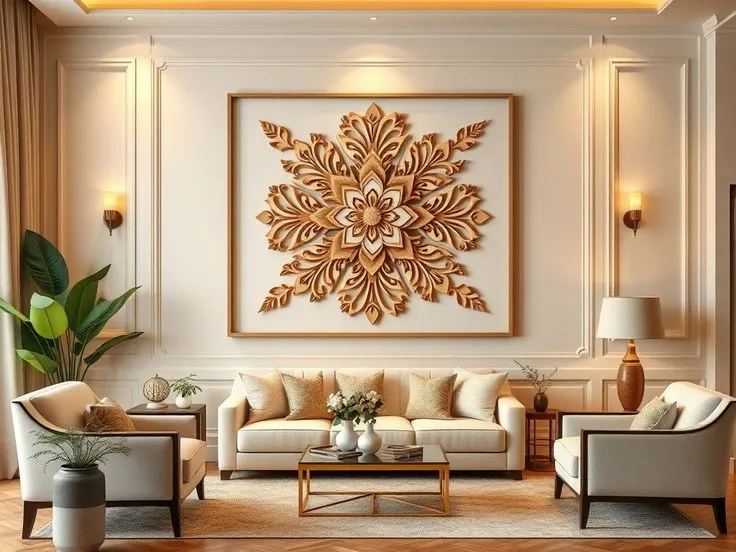
The same artwork does not work equally well in every room. Style matters.
Modern living room
Modern Interiors benefit from abstract art, geometric forms, monochrome palettes, and clean framing. The look should feel deliberate and uncluttered.
Luxury living room
Luxury styling is usually about scale, restraint, and finish. Oversized art, elegant framing, rich tones, and refined textures all work well here. The room should feel confident, not crowded.
Minimalist living room
Minimalist spaces usually do best with one strong artwork rather than many smaller pieces. Soft neutrals, generous white space, and clean lines create visual calm.
Scandinavian living room
This style often pairs well with light wood frames, nature-inspired prints, pale tones, and simple compositions that feel airy and warm.
Bohemian living room
Boho interiors can handle texture, layered materials, global influences, earthy palettes, and a more collected arrangement.
Traditional living room
Traditional rooms often suit landscapes, still life, classical-inspired prints, and framed artwork that feels timeless and dignified.
Transitional living room
Transitional interiors blend classic and modern elements. This makes them ideal for art that feels contemporary but still polished, such as abstracts in elegant frames.
Industrial living room
Industrial spaces benefit from urban photography, dark framing, muted grays, black accents, metal details, and strong texture.
Color, Lighting, and Furniture Tips
Wall art does not exist in isolation. It works with the rest of the room, and the details around it can make a major difference.
Color tips
Choose artwork that relates to the room’s palette. If your space already includes warm wood, beige, cream, and soft brown, then earthy art tones usually feel natural. If the room has black accents and cooler neutrals, artwork with stronger contrast may work better.
You can also use art to introduce a new accent color in a controlled way. This is a smart approach when the room needs a small jolt of energy without a full redesign.
Lighting tips
Good lighting changes everything. Art that is poorly lit can look flat, dull, or underwhelming. Floor lamps, picture lights, sconces, and directional spotlights can all help the artwork stand out.
Proper lighting also helps the piece feel more expensive and intentional.
Furniture tips
The furniture below the art should support the composition visually. A large sectional can make small art look weak. A delicate loveseat can make huge art feel overpowering. The goal is balance, not competition.
Texture tips
If your room already includes patterned rugs, textured upholstery, or heavy drapery, simpler art may work best. If the room feels flat, choose artwork with tactile interest, layered materials, or visible brushwork.
Shape tips
Wide sofa = horizontal art
Tall wall = vertical art
Large open wall = oversized statement piece
Narrow section = slim piece or stacked pairing
Budget-Friendly Large Wall Art Ideas
A beautiful living room does not require a luxury budget. Smart choices matter more than expensive ones.
Budget-friendly styling strategies
Use fewer pieces, but make them larger.
Choose matching frames so affordable prints look more polished.
Stick to one color family so the wall feels intentional.
Place the art where it has the most visual impact, such as above the sofa or fireplace.
Use generous spacing to keep the layout clean.
A simple, low-cost formula
A large print, a clean frame, and one good light source can often look more elevated than a wall full of smaller pieces that have no visual relationship.
Premium and Luxury Wall Art Ideas
Luxury is less about spending the most and more about choosing the right scale, finish, and presence.
Premium options
Commissioned artwork
Original paintings
Museum-style framed prints
Mixed-media pieces
Metal installations
Gallery-wrapped canvases
Limited-edition art prints
What makes wall art feel luxurious?
The scale matters. The material matters. The framing matters. The spacing matters. Even a simple artwork can feel elevated if it is shown with confidence and room to breathe.
Luxury styling tends to avoid clutter. It lets one strong piece do the work of several smaller ones. It also uses refined finishes, balanced proportions, and thoughtful lighting.
Luxury styling cues
Keep the composition simple.
Choose larger sizes
Use refined framing
Allow negative space
Add elegant lighting
Avoid overcrowding the wall.
Common Mistakes to Avoid
Even very attractive artwork can fail if it is used poorly. These are the mistakes most often seen in living rooms.
1. Choosing art that is too small
This is the biggest mistake. Small art on a large wall looks accidental and unfinished.
2. Hanging art too high
When art sits too high, it disconnects from the furniture and feels like it is floating. The eye should be able to connect the artwork with the room naturally.
3. Ignoring wall proportion
A wall’s shape should guide the shape of the artwork. Wide walls need width. Tall walls need height. One format does not suit every space.
4. Matching everything too literally
Your art should coordinate with the room, but it does not need to copy every color, pattern, and finish exactly. Too much matching can make the room feel stiff.
5. Overcrowding the wall
Too many pieces can make the room feel noisy instead of elegant.
6. Forgetting lighting
Even the best art can look underwhelming without proper illumination.
7. Using weak hardware
Large and heavy pieces need secure mounting. This is especially important for framed glass art, oversized canvases, and sculptural decor.
8. Skipping measurements
Measure the wall, the sofa, and the clearance before buying anything. This simple step prevents a huge number of decorating errors.
Pros and Cons of Large Living Room Wall Art
| Pros | Cons |
| Creates a focal point | Wrong sizing can disrupt balance |
| Makes a room feel finished | Large pieces may need proper installation |
| Adds personality and style | Poor lighting can reduce impact |
| Works in many room sizes | Bold art may not suit every taste |
| Can be budget-friendly or premium | Gallery walls can feel cluttered if not planned well |
| Easier to update than major renovations | Heavy artwork needs strong hardware |
Maintenance, Care, and Durability Tips
Large wall art should look beautiful long after installation day. A little care goes a long way.
For canvas art
Dust gently with a soft, dry cloth. Avoid damp cleaning unless the manufacturer says it is safe.
For framed prints
Keep them out of harsh direct sunlight when possible, since long exposure can fade colors over time.
For metal and sculptural art
Use a soft cloth and avoid harsh cleaners that may damage the finish.
For textile and fabric art
Protect it from excessive moisture and heavy dust buildup. If cleaning is needed, follow the material instructions carefully.
For mixed-media pieces
Treat them cautiously, since different materials may react differently to heat, humidity, or pressure.
General durability advice
Use the correct wall anchors for heavy artwork
Check alignment from time to time.
Keep art away from heating vents and damp surfaces.s
Choose materials that suit your household’s lifestyle.
For fragile or valuable work, consider professional installation
Smart, Modern, and Future-Ready Ideas for 2026
Living room wall art is becoming more flexible, more personal, and more adaptable.
Digital frame displays
Digital frames allow you to rotate artwork without replacing the frame itself. This is especially useful if you enjoy changing the mood of the room.
Modular wall systems
Modular systems let you rearrange the layout more easily, which is helpful for people who like to refresh the room without a full redesign.
Sustainable materials
More homeowners are choosing recycled paper prints, reclaimed wood frames, natural fibers, and eco-conscious materials.
Art that changes with the room
A neutral base with one strong art piece makes it easy to update the room later with smaller decor changes.
Multi-functional decor
Mirrors, clocks, and sculptural objects can act as wall art while also serving a practical purpose.
Flexible gallery walls
A gallery wall can evolve. You can add, remove, or swap pieces as your taste changes.
Frequently Asked Questions
A strong rule of thumb is to choose artwork that covers roughly 60 to 75 percent of the sofa’s width. That helps the composition feel balanced.
Most artwork looks best with its center around eye level, often around 57 to 60 inches from the floor. Above furniture, keep it close enough to feel connected.
Both can work well. One large piece feels simpler and more dramatic. A gallery wall feels more personal and layered.
Mirrors, light-toned landscapes, vertical pieces, and panoramic artwork can all help a room feel more spacious.
Framed prints and canvas pieces are usually the easiest because they are straightforward to position and secure.
Final Thoughts
A big painting on the living room wall can change everything – no need to move walls, Swap Sofas, or refinish floors. Fills empty areas like breath filling silence. Proportion feels right when eyes have something tall to follow. Character shows up through color choices and brush marks that people notice only later. The room begins to feel complete, almost by accident.
One thing stands out when you notice how big something is, what form it takes, its hue, and also where it sits. Art should echo how the space feels, almost like a quiet reply. Furniture works better if the piece across from it matches in weight and proportion. A clean setup helps the eye move without snagging. Light changes everything – use it like a pointer, not an afterthought. Walls aren’t gaps begging to be stuffed; they’re pages in the room’s slow conversation.
A shift happens when you make that choice – big artwork on the wall is no longer a mere ornament. Instead, it’s what pulls the whole living space together, giving it presence, balance, and a quiet sense of rightness.
